![[RDCTD]](https://rdctd.pro/wp-content/uploads/RDCTD-Covert-Operative-Tradecraft-Guide-LOGO-tk.png)
![[RDCTD]](https://rdctd.pro/wp-content/uploads/RDCTD-Covert-Operative-Tradecraft-Guide-LOGO-mobile.png)


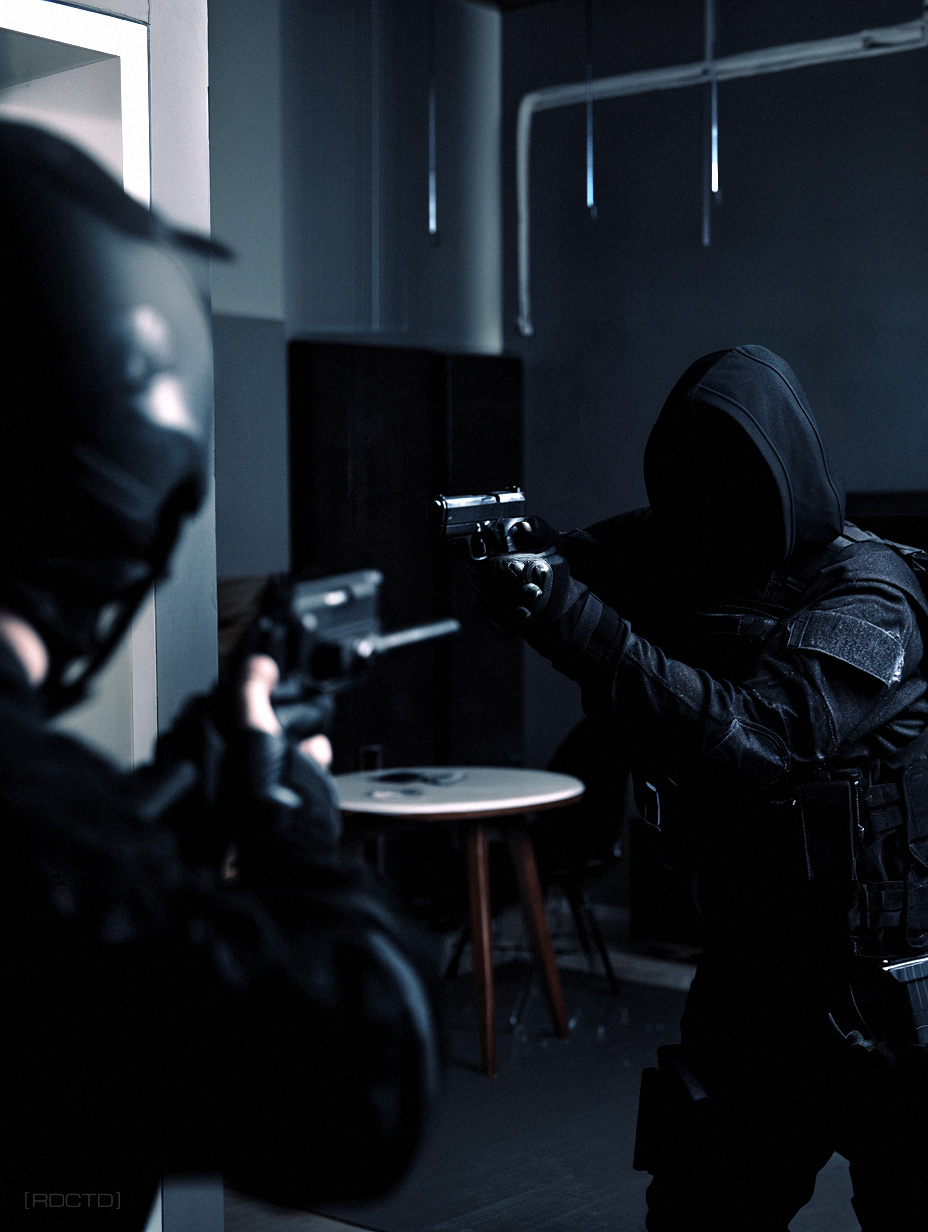 The counter-tactical process of using tradecraft to break a mutual gunpoint freeze – and compel the opposing threat into a safe, step-by-step stand-down without escalating to weapons fire / lethal force.
Leave theatrics to amateurs. Operatives survive by engineering the pace of death with cold precision and deliberate intent.
Armed Standoff Deconfliction defuses a mutual-aim gunpoint crisis without shots fired. The purpose of this skillset is to prevent exchanging fire, not shooting unless absolutely necessary, and preserving options – custody, disengagement, or continued cover. You’ll manage time, hands, and geometry while using short commands that a stressed brain can follow.
Regard this as foundational combatives that anchors your ability to manage lethal standoffs under compromised conditions – for covert operations where noise, surveillance, and third parties complicate outcomes. It also demands strict control of tempo, as governing the pace governs the decision tree – letting you turn a chaotic, lethal freeze into a situation you can dominate.
Anchor your support-side elbow lightly against your ribcage. This stabilizes micro-aim while preventing over-rotation if the threat shifts sharply off-axis.
[ I ] PRE-FIRE GEOMETRY
On presentation, blade (strategic / defensive angling) your body and offset 20–45° from their muzzle line. Keep your own bore on the pelvic/low-thoracic box, it disables without creating the startle-to-kill risk of a head hold.
Don’t accept partners, glass, or bystanders in your bore path. Maintain a mental snapshot of all lateral movement to prevent blind-side exposure.
If you have cover, work the edge so you see hands while hiding your vitals. Move in micro-shifts, not lunges. Never back-pedal blind – earn distance with compliance, not steps. This geometry forces the threat into a narrower decision lane while giving you maximum data on their hands.

• Keep your weight slightly on the balls of your feet, this stabilizes your sights and prevents involuntary rearward movement under high adrenaline. Scan for reflective surfaces, even a storefront window gives you peripheral intelligence without exposing your head.
Use a low, partial blink cycle during high-adrenaline standoffs. It keeps your eyes hydrated without losing visual data or giving the threat a perceived moment of vulnerability.
[ II ] CONTROL OF TEMPO
Your voice sets the operational tempo, acting as the pacing mechanism that slows the threat’s decision cycle and stabilizes your own. Drop your pitch half an octave to project steady authority without triggering panic.
Avoid shouting, raised volume accelerates adrenaline and fractures compliance. Use a disciplined five-part loop: Attention (“Listen to me.”), Assurance (“Nobody wants to fire.”), Single Command (“Lower the muzzle.”), Time Window (“Do it now.”), and Feedback (“Good—hold.”).
Deliver only one action per loop so the threat’s overloaded brain can more easily follow under stress. Repeat the loop verbatim – consistency defeats chaos, and stressed neurology locks onto repeated phrasing more effectively than improvised yet shaky or stable yet overly clever talk.
• Practice your command loop with a 60–70 bpm metronome to hardwire pacing into muscle memory. Record yourself under mild stress (sprints, isometrics). Your voice should remain identical – calm, steady, and unbroken.
Verbalize micro-acknowledgments (“Good. Holding.”) exactly on the exhale. It locks your breathing pattern and prevents respiratory spikes that degrade muzzle stability.
[ III ] COMMAND SCRIPT
Run this baseline sequence unless terrain dictates otherwise: “Freeze.” → “Lower the muzzle to the floor.” → “Index your trigger finger – show me the gap.” → “Engage safety if equipped.” → “Place the gun on the ground by your foot.” → “Step back two steps. Hands high. Interlace fingers.” → “Kneel. Cross ankles.”
Every verb is observable and every action is binary, you can confirm it happened or it didn’t. You reward each success with “Good-hold.” If anything degrades, you snap back to “Stop. Hold.” and restart the loop.
• Keep your muzzle anchored on the low-thoracic box throughout the entire sequence, drifting high telegraphs panic and drifting low invites a sudden rush. Use your peripheral vision to track foot movement – feet often reveal intent before hands do.
When lights are present, use shadow direction to predict arm movement. Shadow elongation gives you a 50–100 ms preview before the limb’s full motion appears.
[ IV ] THREAT READS
You’re watching hands, elbows, breath, and eyes because those four zones reveal intent before a weapon ever fully moves.
Red flags include elbow flare, wrist flex toward a waistband, a sharp inhalation, gaze cutting toward an exit, a sudden muzzle rise, or the distinct click of a safety disengaging paired with lift.
These micro-cues are break triggers – any one of them can break the talk loop and push you into immediate action under ROE.
Green flags include shoulders dropping, an exhale, compliant gaze, finger indexed off the trigger, and a gradual muzzle dip. Name each compliance cue and keep the loop steady, labeling behavior stabilizes the threat’s neurology.
• Hands lie last – watch elbows and feet for the first tells of intent. If you lose sight of either, reset positioning immediately. Blind spots kill tempo and invite ambush movement.
Monitor the threat’s breathing rhythm for cognitive shifts. When their inhale lengthens, they’re often preparing a decisive action – verbal or physical.
[ V ] PARTNER DECONFLICTION
If you’re not solo, designate a talker and a cover element, and lock those roles until the threat is controlled. Add a quick confirmation check between partners to ensure both understand their assignments.
The talker owns the verbal loop, maintains geometry, and holsters last. The cover element builds a clean “T” geometry to eliminate crossfire and overwatch blind spots. Never mirror your partner’s angle because mirrored lines create instant blue-on-blue risk.
Use compact, unambiguous codes: “Freeze White” = full hold; “Blue Wrap” = partner moves to control/cuff; “Break Red” = imminent shot. All movements are offset, called out, and deliberate – no sudden steps, no silent shifts.
• Run partner drills where the talker loses comms for a moment, the cover must maintain geometry without improvising commands. Conduct T-geometry dry reps at varying distances – most operatives only train it close, but spacing changes the angles dramatically.
Keep your forearm angle consistent while speaking. Neuro-mechanical consistency sends a non-verbal signal of control and suppresses their urge to test boundaries.
[ VI ] ENVIRONMENTAL LEVERS
Name a drop zone the threat can understand: “Place it by the front tire.” Barriers help you steer their attention and shape their muzzle direction without broadcasting your intent. Add subtle hand indexing toward the barrier to guide their focus without creating a visible command gesture.
If you’re using white-light, feather the beam so you identify hands without panic – blinding and triggering a reflexive squeeze. Task bystanders with simple, high-contrast orders: “You in the jacket, don’t move. Hands visible.”
Don’t let ambient noise drag you into fast talk, keep your voice at a steady metronome regardless of chaos. Cameras and surveillance are always a factor – use phrasing you can justify in an AAR and, if needed, in a courtroom.
• Use vertical features – car pillars, doorframes, signage – to create predictable muzzle drop zones. If you shift laterally, do it in micro-steps. Large movements create noise signatures that spike adrenaline and can cause an unstable trigger reaction.
Check for wrist rotation during compliance steps. A slight inward roll of the wrist often precedes a concealed grab or a hidden attempt to re-orient their muzzle.
[ VII ] RESOLUTION PATHS
Disarm only when the gun’s grounded (in almost every case), muzzle oriented away, and you can approach from outside their reach line. Your safety envelope must be intact before you close even a single step.
Use your foot to hook or sweep the weapon away. Don’t bend at the waist, as dropping your head narrows your field of view and exposes your airway.
If your authorities or the environment are brittle, disengage on voice control: “We’re separating now. Don’t move. Count to twenty.” For custody, keep muzzle accountability while a partner moves methodically – hands first, then weapon, then body – to prevent sudden mechanical leverage from the threat.
This structured resolution keeps you from improvising and ensures the threat is neutralized through process. Adding precision to each step also creates a post-incident record that defends your decisions under scrutiny.

• When sweeping a grounded weapon, angle the muzzle away from both you and your partner before sliding it – never allow a deflected trigger press to cross a friendly. Create a verbal freeze bubble during custody. Silence invites movement, but controlled repetition locks the subject’s nervous system.
Understand the threat’s foot orientation. Toes that angle outward or inward can signal planned movement direction before the threat commits weight.
[ FINAL ]
 Armed Standoff Deconfliction is a discipline that rewards operatives who can impose structure on chaos. When you control geometry, tempo, language, and the threat’s available decision lanes, you turn a lethal freeze into a predictable sequence you can dominate without firing a shot.
The skill’s strength lies in its consistency – repeatable behaviors that preserve your life, keep the mission intact, and keep collateral risk minimal.
// A weapon has no ego, no fear, no mercy. That’s why humans project all three onto it.
+ Covert Operative Kit [ ] gear shop »»
[INFO : Weapon CQC Preemption]
[OPTICS : Undisclosed, Eastern Europe]