![[RDCTD]](https://rdctd.pro/wp-content/uploads/RDCTD-Covert-Operative-Tradecraft-Guide-LOGO-tk.png)
![[RDCTD]](https://rdctd.pro/wp-content/uploads/RDCTD-Covert-Operative-Tradecraft-Guide-LOGO-mobile.png)


 An identity-authentication tradecraft method of verifying callers and contacts through pre-arranged private phrases that impersonators, fraudsters, and AI-generated voice or video can’t reliably replicate.
An ordinary phrase can carry extraordinary authority and security powers when its meaning is strategically controlled.
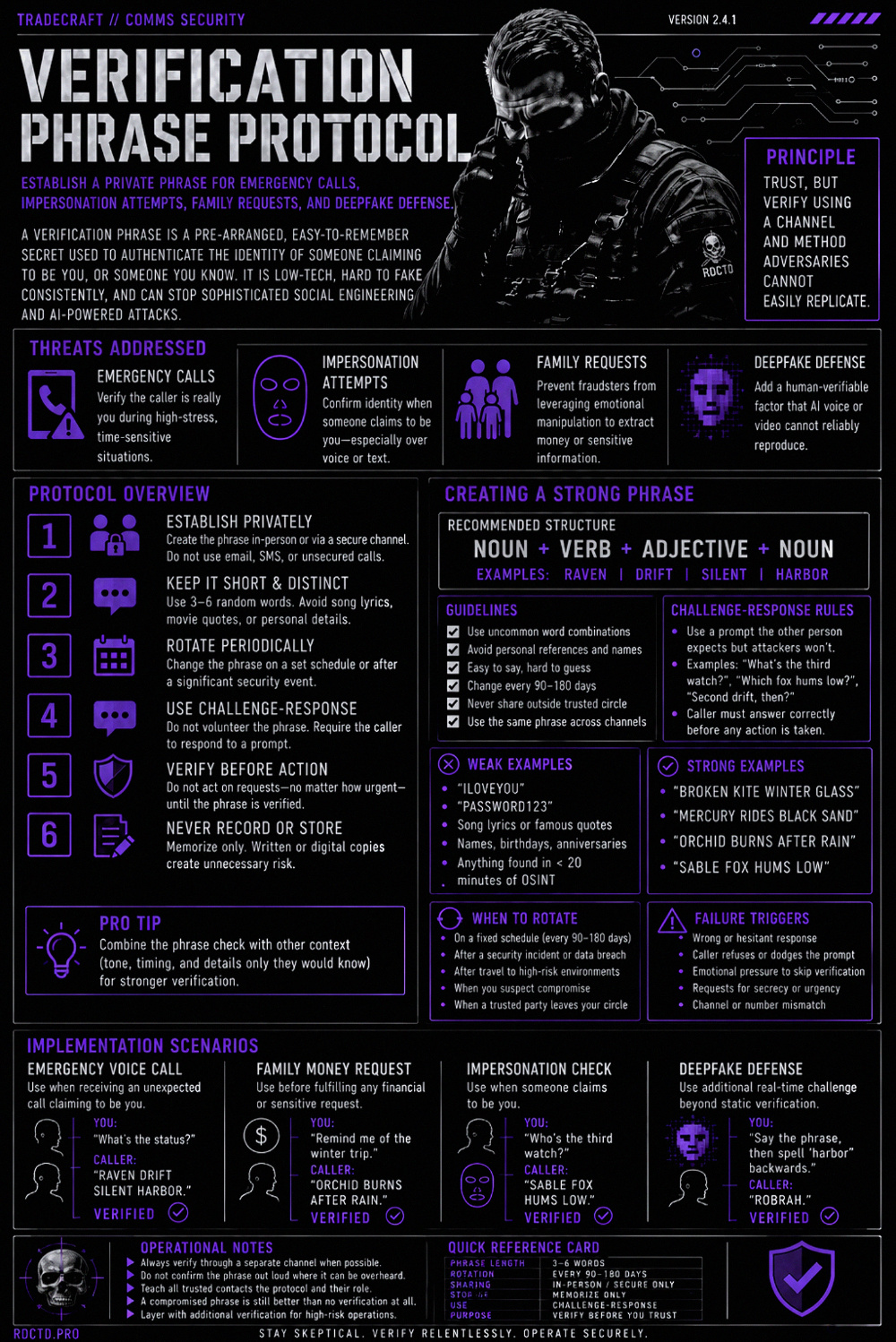
A verification phrase is a pre-arranged, easy-to-remember secret used to authenticate the identity of someone claiming to be you, or someone you know. It’s low-tech, it’s hard to fake consistently, and it counters the attack class scaling fastest right now – AI-driven voice cloning and social engineering run against your family, contacts, and your own name.
Cloning a voice takes seconds of sampled audio and commodity software. Caller ID spoofs for pennies, video synthesis runs near real time, and every one of these attacks come wrapped in manufactured urgency, to suppresses verification. The people closest to you are the softest targets – they’d never question your voice, which is why an adversary borrows it.
The phrase works because it’s stored where adversaries can’t scrape. It’s never written, stored, or sent in the clear, surfacing as a response to a challenge. That puts authentication on a human-verifiable factor machines reproduce poorly of which OSINT can’t recover.
Run it with your family, your assets, and anyone cleared to move money or information on your word. Setup costs one conversation per contact. From then on, every high-stakes request gets settled in seconds, which recovers the hours a fraud investigation or a doubt spiral would otherwise consume. It’s a straight productivity gain riding on top of the security function.
Run the challenge cold – a prompt woven into normal conversation gets a normal answer or it gets a tell.
[ THREAT MODEL ]
Four attack surfaces justify the protocol, of which all exploit the same mechanics – borrowed trust and compressed time. An operative who can name the surface mid-call responds faster and concedes less. The surface changes, but the verification burden does not. When urgency rises, slow the exchange, change channels, and force the claimant to produce proof that borrowed trust cannot supply.
Attack Surfaces
- Emergency Calls — verify the caller is actually you or yours during high-stress, time-compressed situations, when scrutiny drops and compliance spikes.
- Impersonation Attempts — confirm identity when someone claims to be you over voice or text, before they leverage your name and standing against a contact.
- Family Requests — cut off fraudsters using manufactured emotion to extract money or sensitive information from relatives who’d comply on voice alone.
- Deepfake Defense — add a human-verifiable factor that AI voice or video can’t reliably reproduce in real time under an unpredictable challenge.
Why Voice Fails As Proof
Voice functioned as a credential only while copying it stayed expensive and difficult. A snippet of audio pulled from a voicemail greeting, a conference talk, or a posted clip trains a clone that calls your mother in your cadence and asks for money. Your public footprint feeds the model, of which most operatives underestimate how much footprint they’ve already shed.
Under stress, people authenticate on feel – familiarity of tone, plausibility of story, emotional register. Attackers script for exactly that. The phrase removes feel from the decision entirely and replaces it with a binary check that runs the same at 0300 as it does at noon.
Every surface above runs on the assumption that you’ll authenticate by instinct when it matters most. The protocol replaces that instinct with a two-second procedure that survives any level of stress. Audit your own exposed audio and video footprint (voicemail greetings, interviews, social clips) to estimate the clone quality an adversary can already field against your circle, then brief them to that standard.
Weight the challenge to the request; a transfer of funds earns a harder prompt than a status check.
[ PHRASE CONSTRUCTION ]
A strong phrase reads as noise to everyone outside the circle and recalls instantly to everyone inside it. Construction quality decides whether the protocol holds under pressure or breaks down into guesswork. Keep it short enough to retain, distinct enough to prevent accidental use, and ordinary enough to survive being overheard. Rehearse it across every approved channel until recognition and response become automatic.
Phrase Architecture
Build from three to six random words. The recommended structure runs noun + verb + adjective + noun – RAVEN | DRIFT | SILENT | HARBOR – which produces phrases that speak cleanly and anchor in memory without meaning anything. Strong working examples: “Broken Kite Winter Glass,” “Mercury Rides Black Sand,” “Orchid Burns After Rain,” “Sable Fox Hums Low.” Each clears a phone line, a whisper, and a degraded connection.
Selection Criteria
- Uncommon Combinations — pair words that never co-occur in normal speech, so partial overhears and lucky guesses both fail.
- No Personal References — names, birthdays, anniversaries, pets, and unit numbers all sit in records an adversary pulls in minutes.
- Easy to Say, Hard to Guess — the phrase must survive adrenaline, a bad connection, and a lowered voice without degrading into ambiguity.
- Scheduled Replacement — a 90 to 180 day service life keeps the phrase ahead of accumulated exposure.
- Closed Circulation — the phrase never leaves the trusted circle, and the circle stays as small as the mission allows.
- Channel Consistency — run the same phrase across voice, text, and video so verification never stalls on recall of which phrase belongs where.
Weak Constructions
- Sentimental Defaults — “ILOVEYOU” and its relatives top every attacker’s first-guess list for a reason.
- Password Logic — “PASSWORD123” style constructions import every weakness of credential reuse into a system built to escape it.
- Cultural Material — song lyrics, movie quotes, and famous lines are searchable, guessable, and shared by millions.
- Biographical Data — anything tied to your history surfaces through the same profiling work that targeted you in the first place.
- OSINT-Recoverable Content — anything findable in under 20 minutes of open-source work on you or your circle disqualifies itself.
Phrase strength gets tested once – during an attack – so build the margin in now. Generate candidates from random word lists rather than your own head; self-generated “random” words skew toward personal associations a profiler can walk backward. Filter the survivors for speakability under adrenaline and adopt the one your slowest contact recalls without prompting.
Test every candidate phrase against twenty minutes of your own OSINT before it enters rotation.
[ ESTABLISHMENT AND HANDLING ]
The protocol’s ceiling gets set the day you establish it. Sloppy establishment hands an adversary the phrase before it ever protects anything – no amount of downstream procedure repairs that. Establish it through a trusted channel, confirm both parties independently, and retire any phrase exposed during setup. The first exchange is already an authentication event, so every shortcut taken there becomes a permanent weakness.
Secure Establishment
Create the phrase in person or over a channel you’d trust with operational traffic. Email, SMS, and unsecured calls are collection surfaces; a phrase that transits any of them starts life compromised. Brief every trusted contact on the full protocol – the phrase, the prompts they’ll hear, the responses they’ll give, and the actions that wait on verification. A contact who knows only the phrase will volunteer it to the first confident stranger who asks.
Assign each contact a role and compartment the circle where the structure allows it. A phrase shared with six people carries six failure points, and you want to know which one failed when it does.
Storage Rules
Memorize only. No notebooks, no password managers, no drafts folder, no encrypted note that “only you” can open. Every written or digital copy creates a recoverable artifact with a lifespan you don’t control – device seizures, cloud subpoenas, malware, and shoulder surfing all defeat storage without ever touching you. Anchor the phrase with a memory structure and rehearse it on the same schedule you’d rehearse any perishable skill.
Establishment done right takes one secure conversation per contact and produces a credential no technical collection recovers. Run a quarterly rehearsal with your circle disguised as ordinary contact – a call that opens with a prompt and closes normally. Response latency in rehearsal predicts response quality during a real event, and contacts who stumble get retrained before the stumble costs anything.
Store the phrase where malware, subpoenas, and shoulder surfers can’t reach – working memory, nothing else.
[ CHALLENGE-RESPONSE EXECUTION ]
Execution turns a memorized phrase into an authentication system. The rules below govern who prompts, who answers, and what waits on the result. A correct response authorizes only the action attached to that exchange; it does not create blanket trust. Any delay, variation, or unsolicited use freezes the interaction until identity is re-established through a separate channel.
Running the Challenge
Never volunteer the phrase. The party being verified answers; the party verifying prompts. Prompts should read as ordinary conversation to an outsider while signaling unmistakably inside the circle – “What’s the third watch?”, “Which fox hums low?”, “Second drift, then?” A correct answer arrives complete and immediate. Anything else scores as a fail.
- Receive and Stall — acknowledge the contact, commit to nothing, and let the caller talk while you set the challenge.
- Issue The Prompt — deliver the challenge as plain conversation, with no announcement that a verification is underway.
- Score The Response — exact phrase, delivered without hesitation; latency, fragments, and near-misses all count against.
- Cross-Check Context — layer in tone, timing, and details only the real party would hold before you weigh the result final.
- Act or Terminate — proceed on a clean pass; on a fail, end contact and re-verify through a separate known channel.
Verification Before Action
No request executes before the phrase clears – no matter how urgent, emotional, or plausible the framing. Urgency deserves extra scrutiny because it’s the attacker’s cheapest tool; a legitimate emergency survives a ten-second challenge, and a fraudulent one dies under it. Insert a deliberate pause between verification and action when stakes run high, and confirm again through a separate channel before moving money or information.
A challenge that runs at conversational speed protects the relationship as well as the operation – legitimate contacts clear it without friction, and hostile contacts self-identify by resisting it. Pre-script your fail response before you ever need it: a neutral exit line that ends the call without confirming a protocol exists.
Score hesitation on a known phrase as a failed response, then re-verify through a second channel.
[ ROTATION AND COMPROMISE ]
Phrases age like any credential. Rotation keeps the service life ahead of accumulated exposure – failure triggers tell you when the schedule stopped being the deciding factor. Rotate immediately after suspected disclosure, personnel change, channel compromise, or any unexplained authentication failure. Retired phrases become invalid evidence, never backups; accepting one teaches an adversary that expiration is negotiable.
Rotation Schedule
- Fixed Interval — every 90 to 180 days, regardless of whether anything’s flagged; routine exposure accumulates silently.
- Post-Incident — after any security incident or data breach touching you or your circle, treat the phrase as burned.
- Post-Travel — after operating in high-risk environments where comms were likely monitored, rotate on return.
- Suspected Compromise — rotate on suspicion; waiting for confirmation gives an adversary a working window.
- Circle Changes — when a trusted party leaves the circle, the phrase leaves with them the same day.
Failure Triggers
- Wrong or Hesitant Response — the phrase either arrives clean or it fails; there’s no partial credit on authentication.
- Prompt Evasion — dodging, deflecting, or “you know it’s me” answers the challenge in the negative.
- Emotional Pressure — any push to skip verification for the sake of speed or feeling marks the contact hostile until proven otherwise.
- Secrecy or Urgency Demands — “don’t tell anyone” and “right now” are attacker fingerprints, and both trigger a full stop.
- Channel or Number Mismatch — unknown numbers, new accounts, and degraded video quality each raise the verification bar on their own.
A compromised phrase still filters low-effort attacks, which keeps it worth running while a replacement circulates – rotate without a coverage gap by pushing the new phrase through the same secure channel that established the first. Log rotation dates somewhere sterile with no phrase content attached, so the schedule itself never becomes the leak.
Rotate on the calendar, then again after every incident the calendar didn’t predict.
[ FIELD IMPLEMENTATION ]
The scenarios below cover the four contact types the protocol was built for. Drill each until the sequence runs without conscious effort – under a real call, you’ll perform at rehearsal level and no higher. Vary the caller, channel, timing, and urgency so the team learns the decision pattern rather than memorizing a script. Every drill should end in verification, denial, or escalation, leaving no ambiguous middle state.
Scenario Drills
- Emergency Voice Call — an unexpected call claims to be you or yours; you prompt “What’s the status?” and the caller returns “Raven drift silent harbor” before any detail gets discussed or any action gets promised.
- Family Money Request — before fulfilling any financial or sensitive request, the contact prompts “Remind me of the winter trip” and holds all action until “Orchid burns after rain” comes back clean.
- Impersonation Check — someone claims to be you to a third party; the party prompts “Who’s the third watch?” and treats anything short of “Sable fox hums low” as a hostile contact report.
- Deepfake Defense — layer a real-time task beyond the static phrase; “Say the phrase, then spell harbor backwards” forces “ROBRAH”, and live cognitive work breaks playback while straining real-time synthesis.
Operational Tactics


Implementation succeeds when every member of the circle treats a challenge as normal traffic for security. For deepfake conditions, keep a rotating pool of live cognitive tasks – spell a phrase word backward, count down from a stated number, perform a specific gesture on video – since any static challenge eventually gets recorded and replayed.
Drill the protocol until a challenge under stress runs at conversational speed.
[ FINAL ]
The Verification Phrase Protocol costs one conversation to establish, nothing to maintain, and seconds to run. Against impersonation, fraud, and synthetic media it outperforms technical controls costing thousands, because it authenticates on the one factor an adversary can’t sample from a distance – shared private memory under live challenge.
// A voice is data, a phrase is proof. Challenge before you comply.
+ Covert Operative Kit [ ] gear shop »»
[TAG : Comms Security]