![[RDCTD]](https://rdctd.pro/wp-content/uploads/RDCTD-Covert-Operative-Tradecraft-Guide-LOGO-tk.png)
![[RDCTD]](https://rdctd.pro/wp-content/uploads/RDCTD-Covert-Operative-Tradecraft-Guide-LOGO-mobile.png)


 The tradecraft skill of seeing through people to read intent behind the facade – separating performance from motive by evaluating coherence between what someone projects and what their behavior implies.
Determine what they’re calibrating for – approval, control, safety, speed, or image. People rarely calibrate for more than one primary thing at a time, that preference shows up consistently.
“Seeing through people” is the ability to perceive who someone really is and read what’s really driving them, beyond what they say or perform. It’s pattern recognition applied to humans. Incentives, constraints, status needs, fears, loyalties, and habits become the primary variables. Consistency gets tracked across words, tone, timing, and behavior. As per tradecraft, it’s a structured way to infer intent and reliability under uncertainty.
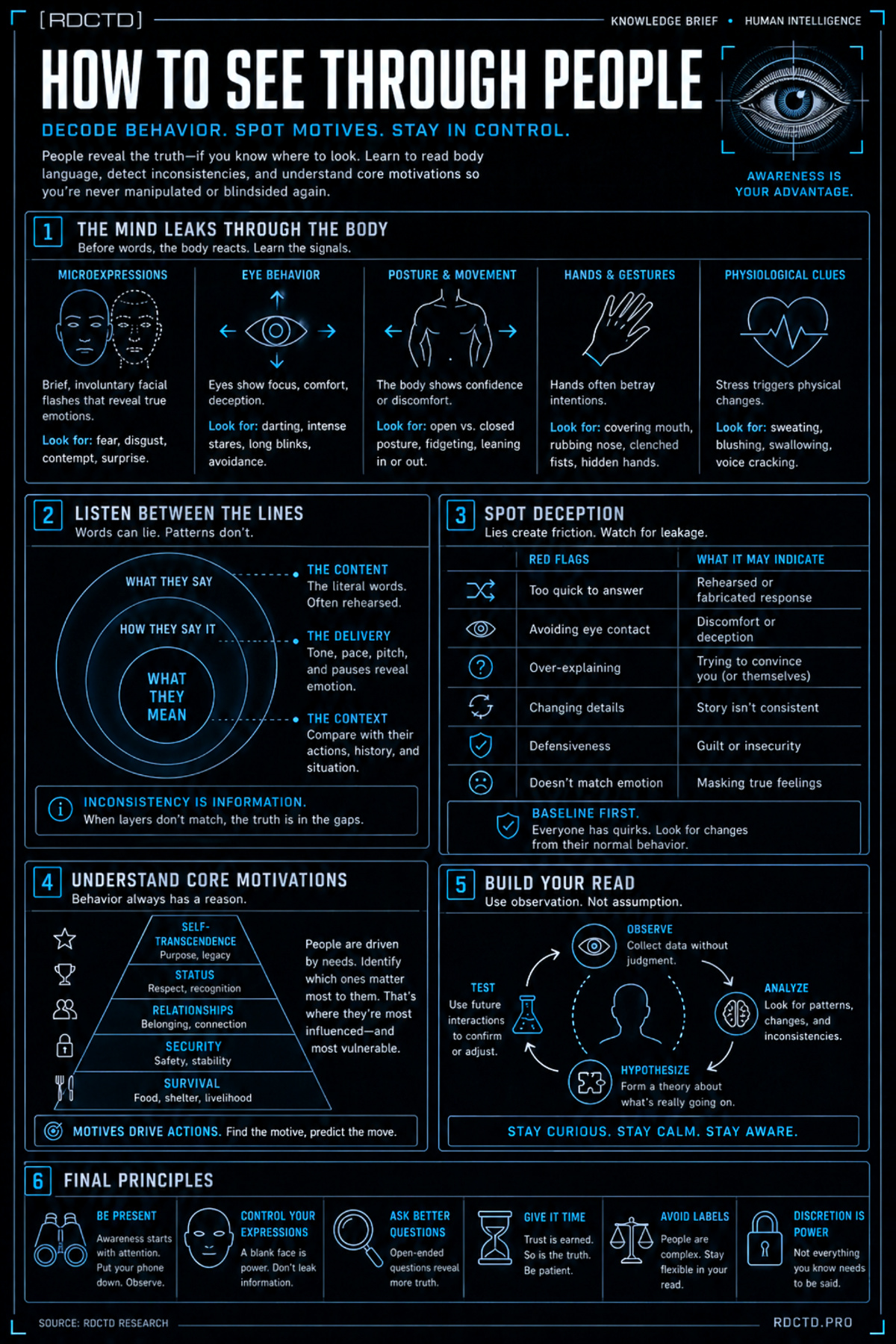 It’s a probabilistic read and you’re always updating it as new data comes in. It reduces surprise by flagging incongruence early and separating sincere alignment from tactical compliance. The standard is quiet accuracy – you don’t confront the mask, you account for it and keep the operation stable.
Note where they assign ownership – “I decided” versus “it was decided.” Responsibility language is a fast proxy for autonomy, confidence, and risk tolerance.
[ CONTROL EDGE ]

The purpose is interpersonal decision advantage. Most operational problems have a human layer, even when it looks technical. Sources hedge, targets posture, gatekeepers protect their turf, partners signal risk without admitting it, and so on.
“Seeing through” helps you choose the right approach, the right ask, and the right pace. It also helps you forecast reactions before you trigger them.
It gives you leverage without theatrics, because you’re acting on what’s real, not what’s performed. It tightens risk management by exposing hidden dependencies, unspoken incentives, and soft vetoes before they harden into operational failure. It also improves messaging, since you can frame proposals in the language a person’s system actually responds to.
Over time, it becomes a form of calibration, you learn which signals predict follow-through and which predict drift. In the field, it determines whether people catch you off guard or you stay ahead of them.
Watch for abrupt style shifts – sudden formality, sudden warmth, sudden certainty. In tradecraft, sharp shifts often mark a switch from candid mode to managed mode.
[ FIELD UTILITY ]

For a covert operative, the advantage shows up in four types of practical scenarios. When you can separate performance from motive, you stop reacting to the surface of what someone appears to be and start managing the real drivers underneath.
Security & Deception
• Integrity Checks: Evaluate whether claims, access, and behavior align – especially when the story is smooth but the details don’t reconcile.
• Insider Risk Awareness: Recognize patterns that often precede compromise – unexplained urgency, boundary testing, sudden secrecy, or inconsistent explanations.
• Compartment Protection: Detect when someone is probing for information outside their lane, even if it’s wrapped in friendly conversation.
• Deception Tolerance: Understand that deception isn’t always hostile, the key is spotting when it intersects with risk and exposure.
• Early Warning Posture: Use incongruence as a prompt to verify and re-check, not to accuse – staying calm keeps your coverage intact.
Surveillance & Countersurveillance
• Intent Discrimination: Separate normal movement and coincidence from purposeful attention by focusing on pattern coherence rather than isolated “tells.”
• Role Identification: Notice who behaves like a task-driven actor versus a bystander, and who seems anchored to an objective rather than to the environment.
• Anomaly Sensitivity: Catch micro-shifts in attention, spacing, and timing that suggest planning, coordination, or heightened vigilance.
• Risk Forecasting: Anticipate escalation points – moments when a person’s behavior indicates they’re about to commit, disengage, or signal a third party.
• Noise Control: Reduce false positives by weighting repeated, context-consistent signals more than dramatic one-offs.
Meetings & Resolutions
• Tempo Control: Read who’s trying to rush decisions, stall outcomes, or redirect agendas, and adjust pacing to keep initiative.
• Hidden Veto Detection: Identify soft “no’s” (non-answers, deflections, repeated reframes) before you waste time or expose intent.
• Status Dynamics: Track who needs to win, who needs to be seen, and who needs to avoid blame – then communicate in a way that doesn’t trigger ego-defense.
• Commitment Clarity: Distinguish polite agreement from operational agreement by watching how they handle specifics, constraints, and accountability.
• Conflict Prevention: Surface friction early by noticing incongruence and addressing it indirectly through structure, not confrontation.
Recruitment & Handling
• Motivation Mapping: Identify what they genuinely value (status, belonging, autonomy, security, money, purpose) and what they won’t trade away.
• Reliability Read: Distinguish a “talker” from a “doer” by watching consistency between commitments and follow-through.
• Rapport Precision: Shape trust around stable interests and shared incentives, not flattery or intensity that collapses under stress.
• Leverage Discipline: Recognize the difference between influence and coercion, and avoid brittle pressure that creates resentment, instability, or blowback.
• Vulnerability Awareness: Spot the personal constraints they’ll hide (reputation risk, family pressure, career dependency) so you don’t trip alarms by accident.
The net effect is you make cleaner calls, faster, with fewer emotional swings and less surprises. In the field, that quiet accuracy compounds because you’re aligning actions to actual intent, instead of to someone’s facade.
Pay attention to decision latency. Fast isn’t always confident, and slow isn’t always thoughtful – what matters is whether the pace stays consistent across similar choices.
[ PATTERN FRAMING ]

Baselines and context come first. You’re building a fast “normal” for the target person (energy, cadence, formality, attention style) then weighting it against the environment (stakes, audience, hierarchy, time pressure). People shift in repeatable ways and the signal patterns.
Establish a Baseline Quickly
Before you start interpreting behavior, take a moment to capture what “normal” looks like for this person. A quick baseline helps you separate genuine shifts from noise later on.
• Note their default tempo, humor, eye focus, and level of detail.
• Observe how they handle silence or pauses; comfort levels reveal internal pacing.
• Separate personality quirks from situational stress.
• Record first impressions immediately – memory distorts quickly under later context.
Map The Context
Every behavior happens inside a frame of incentives, pressures, and audience. Understanding that frame keeps you from overvaluing surface cues.
• Ask yourself: What do they gain, what do they risk, who’s watching, what’s the clock?
• Assume behavior is shaped by incentives and constraints, not vibes.
• Identify external pressures – deadlines, hierarchy, or audience – that may distort behavior.
• Note environmental factors like setting, medium, and stakes; context shifts can flip signals.
Look For Clusters, Not Tells
Single gestures mislead, patterns clarify. Grouping cues by emotion and repetition turns scattered data into usable insight.
• One odd gesture is noise.
• Three aligned shifts across words, timing, and behavior is a lead.
• Group related cues by emotional tone – stress, pride, defensiveness – to see patterns.
• Revisit clusters across different situations to confirm they’re consistent, not situational.
Compare Channels For Coherence
People communicate through words, tone, and body at once. When those channels align, you get truth; when they diverge, you get information.
• Do their claims, confidence, and details line up?
• Watch for recurring gaps – missing steps, fuzzy timelines, selective certainty.
• Check tone against content – does emotional energy match the message?
• Look for micro-adjustments when challenged, quick recalibration often signals awareness of inconsistency.
Track Change Over Time
A single snapshot can deceive, but trends rarely lie. Repeated observation reveals whether behavior is stable, adaptive, or performative.
• Re-check the same topics later and see what stays stable.
• Stability under re-contact is more valuable than a dramatic moment.
• Note whether their story becomes simpler or more complex; both shifts carry meaning.
• Compare their behavior under stress versus.
Write a Hypothesis, Assign Confidence
Treat your read like a working theory, not a final judgment. Labeling confidence levels keeps your analysis honest and flexible.
• Label your read as likely / possible / unknown.
• In the field, disciplined uncertainty beats a confident guess.
• Update your confidence level as new data arrives, agility beats stubbornness.
• Keep a short log of your reads to spot your own bias patterns over time.
Verify with Independent Anchors
Verification protects you from your own narrative. External checks and time gaps turn intuition into evidence.
• Use facts, third-party reference points, and time-separated observations.
• Treat verification as routine, not accusatory.
• Cross-check with neutral observers who have no stake in the outcome.
• Re-verify after a cooling-off period, truth often settles once emotion fades.
Without baselines established, you’ll mistake difference for deception and confidence for competence. When you fixate on single “tells,” you’ll start seeing patterns you want to see, and that’s how you get played by your own bias. The cost is bad decisions made with false certainty.
Don’t overweight intensity, overweight repeatability. A calm pattern that persists is more predictive than a dramatic moment that doesn’t recur.
[ ELICITATION ]

Reading people takes structuring observation so that behavior, language, and timing reveal what’s real beneath the surface. Strategic conversations can turn ordinary dialogue into a diagnostic tool for understanding motive, consistency, and credibility.
Guided Conversation

Sequencing Prompts
Verifiable Anchors
Silence as an Instrument
Response Timing and Reframes
Confidence-to-Clarity Ratio
Motive Language
Status Language
Synthesis

These techniques prioritize clarity and accurate understanding, so you can respond with precision instead of assumption. When you can read the structure of someone’s communication, you can respond with precision, empathy, and strategy instead of assumption.
Watch how they handle minor contradictions. Honest operators correct, clarify, or narrow; performers tend to reframe, dismiss, or broaden to blur the edge.
[ FINAL ]
Mentally write down your hypotheses and your confidence level, your own biases will try to steer the read. Triangulate with independent facts, third-party observations, and time-separated interactions. Consider “seeing through” a person as a continuous assessment that that evolves.
// When someone’s words and choices disagree, believe the choices. A person’s decisions are their autobiography in real time.