![[RDCTD]](https://rdctd.pro/wp-content/uploads/RDCTD-Covert-Operative-Tradecraft-Guide-LOGO-tk.png)
![[RDCTD]](https://rdctd.pro/wp-content/uploads/RDCTD-Covert-Operative-Tradecraft-Guide-LOGO-mobile.png)

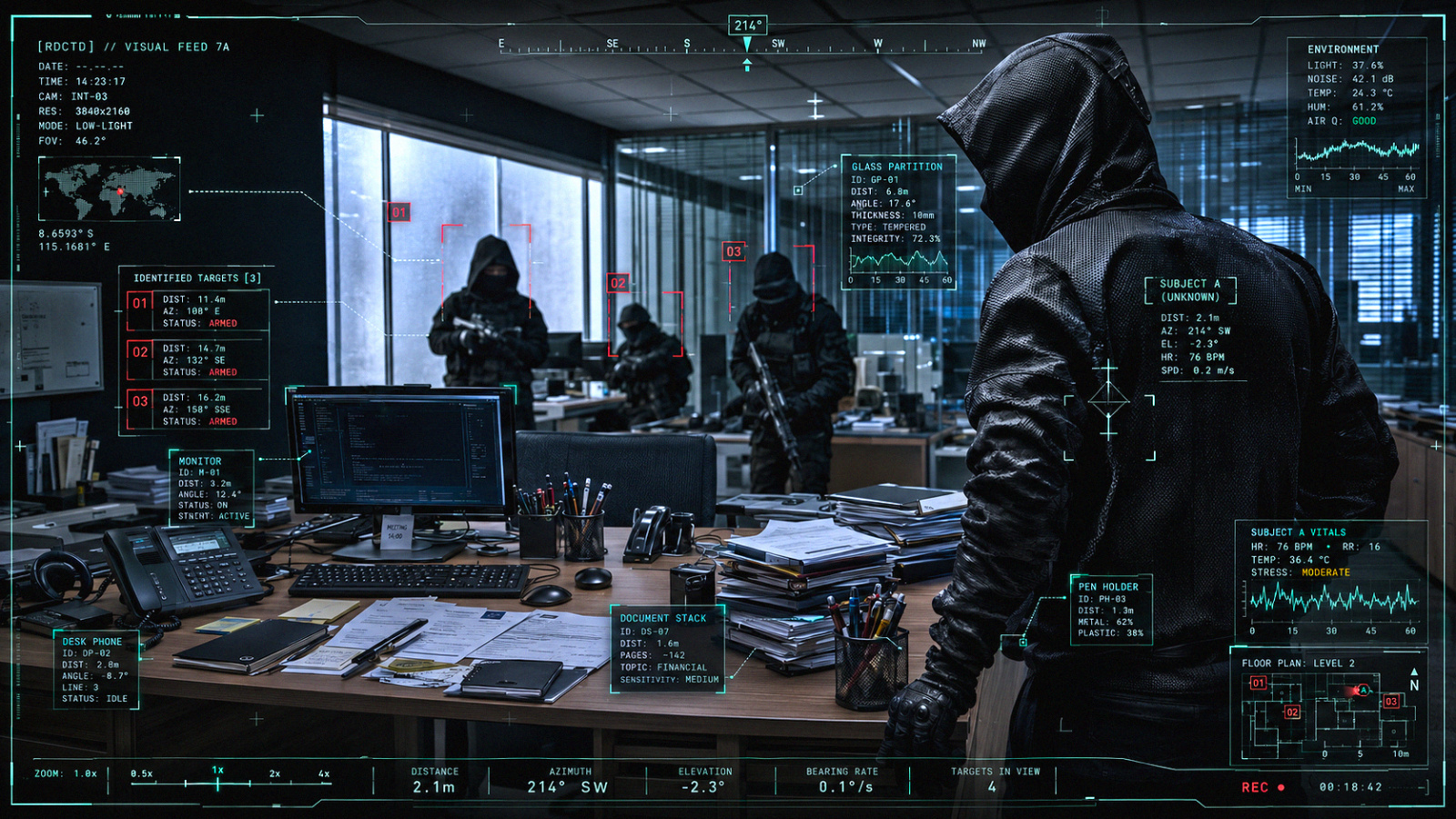
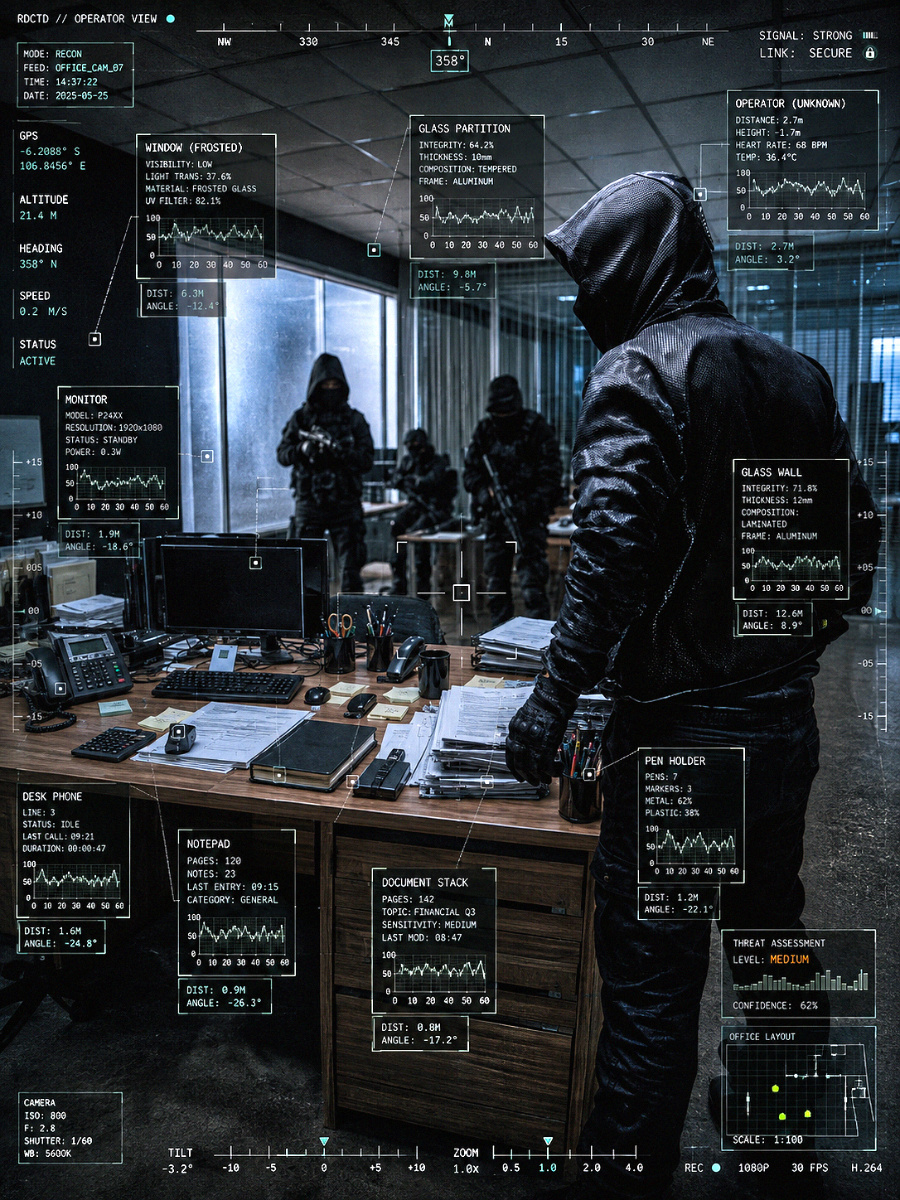 A kinetic engagement framework of weaponizing your surrounding through adaptive improvisation, to generate force multipliers from any available material or structural element regardless of equipment status.
The chair, the pen, the floor itself – everything within your reach exists on a spectrum of lethality or defense determined solely by your capacity to recognize its potential.
In the operational environment, restriction is an illusion. The Environment is Your Weapon is the understanding that physical surroundings constitute an armory of infinite variety – limited only by perception and adaptability. The operative who masters environmental improvisation is never unarmed, regardless of how well equipped or tactical circumstances.
The tradecraft of environmental weaponization exists because carried equipment is a liability – it can be lost, confiscated, or exhausted. The environment is persistent, abundant, and unrestricted by customs or detection. The skilled operative understands that a weapon is not an object but a relationship between mass, velocity, and target.
The framework operates on universal physical principles – kinetic energy transfers through any medium capable of bearing force. A ceramic cup, a charging cable, a door frame – each possesses inherent mechanical properties that convert to combat utility through applied improvisation. Recognition speed determines whether engagement ends in dominance or submission.
The same principles apply in denied-area extractions, ambush survival, active threat scenarios, and covert carry restrictions – the physics don’t change, only the available materials. Situational awareness is the foundation; environmental weaponization is the force multiplier that activates when traditional and obvious options are exhausted or prohibited.
A rolled magazine delivered edge-on to the temple generates approximately 15 PSI concentrated force – equivalent to a tactical baton strike – while maintaining full deniability as an everyday object.
[ THE IMPROVISATION MINDSET ]
Environmental weaponization requires a cognitive shift from fixed-object perception to functional analysis. The operative doesn’t see things as what they’re named as but as what they can do beyond their intended purpose. This perceptual restructuring enables instantaneous weapon identification under stress where conventional thinking sees only obstacles.
Functional Over Form
Abandon nominal classification. A chair is not furniture – it’s mass with structural integrity suitable for impact, barrier, or restraint.
- Analysis — Evaluate objects by density, hardness, reach, and wieldability rather than intended purpose.
- Application — A glass ashtray becomes a palm-load impact enhancer, a belt becomes a flexible striking tool or garrote.
- Operational Note — Train to identify three potential weapons in every room upon entry, before threat manifestation.
With repetition, this functional analysis becomes instantaneous, bypassing conscious categorization to reveal combat utility in milliseconds. Perceiving mass and physics rather than social meaning gives you a decisive advantage in certain environments, armed or not.
Proximity Advantage
The closest weapon is the best weapon especially if it’s the only weapon. Reach dictates speed, and speed determines initiative.
- Analysis — Objects within arm’s extension require zero retrieval time and minimal telegraphing.
- Application — Positioning near potential weapons before engagement is pre-loading your arsenal.
- Operational Note — In seated positions, table edges, utensils, and chair components provide immediate access to force projection.
Every meter of distance adds milliseconds to your response, which determine whether you seize the action-reaction gap or fall into it. Pre-positioning is temporal insurance gained before the threat manifests.
Environmental Manipulation
The environment itself is a weapon – stairs, walls, doors, and terrain multiply force through impact mechanics or leverage towards that.
- Analysis — Structural elements don’t move, meaning they absorb and return force without displacement.
- Application — Corner geometry concentrates impact; stair edges amplify takedown trauma; thresholds create trip hazards.
- Operational Note — Door frames restrict movement to linear paths, use them to limit evasion options.
Fixed elements multiply your force while absorbing theirs, engaging with the environment fights with immutable physics on your side. Terrain is the potential asset that strikes with the mass of the world itself.
Dual-Use Recognition
Everyday carry items and literally any seemingly innocuous objects possess latent combat functionality.
- Analysis — Keys become knuckle-dusters, pens become icepicks, phones become distraction devices or thrown projectiles.
- Application — Hot liquids create immediate threat displacement, bags and clothing become entanglement tools.
- Operational Note — Lanyards and cables provide garrote capability or limb entanglement at 3+ feet range.
Dual-use objects pass through most checkpoint undetected because they’re not weapons until you decide they are. This temporal camouflage (harmless in preparation, lethal in deployment) offers deniability no carried gun or blade can match.
The environment contains no weapons until you perceive them. This perceptual move from passive observer to active weaponizer is the foundational skill of environmental combat.
A 12-ounce ceramic mug swung by the handle generates approximately 35 foot-pounds of force at the rim – sufficient to fracture the zygomatic arch or temporal bone on contact.
[ ENVIRONMENTAL WEAPON CATEGORIES ]
Understanding the mechanical properties of environmental objects enables rapid categorization and deployment. These classifications provide a mental framework for improvisation under duress when analytical thinking degrades.
Blunt Force Multipliers
Objects with mass and rigidity suitable for impact trauma generation. Blunt weapons forgive imperfect angles and require no penetration to disable; kinetic energy transfers through any surface contact.
- Examples — Fire extinguishers, table lamps, books (when hardened), bottles, tools, decorative objects.
- Grip Adaptation — Two-handed for heavy objects, reverse grip for precision strikes with narrow profiles.
- Targeting — Hard to soft, strike bone with rigid objects, soft tissue with flexible ones.
The follow-through determines trauma generation-drive the mass through the target rather than merely to it, ensuring maximum force absorption and structural disruption.
Edged & Piercing Implements
Objects capable of laceration or penetration through concentrated force application. The concentration of force into minimal surface area bypasses protective tissue to access vital systems directly with mechanical efficiency that mass alone cannot achieve.
- Examples — Broken glass, scissors, screwdrivers, keys, metal edges from torn cans, pens, utensils.
- Grip Adaptation — Icepick grip for penetration, hammer grip for slashing with broken edges.
- Targeting — Neck, eyes, torso sides, femoral triangle – areas where penetration creates immediate incapacitation.
Unlike blunt weapons, edged implements risk structural failure or user injury during impact; the operative accounts for this fragility in targeting selection. The trade-off is worthwhile – penetration reaches vital systems that blunt trauma merely bruises, ending engagement with mathematical finality.
Flexible & Entanglement Tools
Linear or fabric objects capable of constraint, strangulation, or whip strikes. These tools multiply reach without adding mass, creating standoff capability from materials that weigh ounces.
- Examples — Belts, charging cables, lanyards, scarves, computer cords, phone chargers, chains.
- Grip Adaptation — Loop and wrap techniques, maintaining tension through body rotation rather than arm strength.
- Targeting — Neck for strangulation, wrists for disarmament, ankles for mobility denial.
Constriction is more difficult to escape than impact – the body cannot flinch away from a closing loop, only struggle against its tightening positioning.
Chemical & Disruptive Agents
Substances and materials capable of sensory denial or physiological reaction. Unlike kinetic weapons, these agents bypass muscular defense and anatomical protection to trigger involuntary responses that override training and willpower.
- Examples — Hot liquids, cleaning chemicals, aerosol sprays, sand/dirt for throwing, fire sources.
- Grip Adaptation — Splash or spray patterns, throwing dispersal for area denial.
- Targeting — Eyes and respiratory system, create immediate involuntary reaction that opens attack windows.
The effect is temporary but the window is decisive – chemical disruption creates the initiative gap that kinetic weapons exploit. Follow-up is mandatory, deploying disruption without preparing closure wastes a critical advantage.
Structural Weapons
Fixed environmental elements that amplify force through immovable mass. Unlike wielded weapons, these elements require no grip strength and don’t degrade with repeated use, converting opponent momentum into concentrated trauma at the point of impact.
- Examples — Walls, door frames, stair edges, curbs, furniture corners, window glass.
- Grip Adaptation — Body positioning to drive opponent into fixed objects, using structure to immobilize limbs.
- Targeting — Head into walls, limbs into door jams, full body throws into corners or edges.
Impact against immovable mass generates trauma that no body armor can mitigate, the operative uses terrain to bypass protection entirely. Control of structural weapons is control of the engagement itself, turning every surface into a silent ally that strikes with geological certainty.
Categorization enables rapid decision-making. When threat manifests, the operative identifies the nearest object in each category, then selects based on range and immediate accessibility.
A standard USB charging cable wrapped around the knuckles creates a weighted flail capable of delivering 20+ foot-pounds of focused impact force while maintaining full deniability as standard electronics.
[ IMPROVISATION PRINCIPLES ]
Environmental weaponization follows systematic principles that maximize effectiveness while minimizing exposure time. These protocols ensure that improvised weapons function as extensions of tactical intent rather than desperate last resorts.
Accessibility First
The best weapon is the one already in your hand or within immediate reach. Retrieval time is vulnerability time – every moment spent accessing a weapon is a moment you can’t defend or attack, converting potential advantage into exposed hesitation.
- Scan radius — Prioritize objects within 3 feet before considering distant options.
- Pre-positioning — In uncertain environments, casually position potential weapons within arm’s reach.
- Speed of acquisition — If retrieval takes longer than 2 (variable) seconds, the object is tactically unavailable.
The two-second threshold represents the window where initiative is won or lost – beyond it, you become a reactor rather than an actor. Pre-positioning is the mark of the prepared operative, the casual placement of a cup or bag today becomes the decisive weapon tomorrow.
Convertibility Speed
The transition from object to weapon must be instantaneous and invisible. Telegraphing converts surprise into warning, allowing the opponent to process and defend before the weapon fully manifests – the moment of conversion must pass in milliseconds, leaving no gap between innocent object and combat tool.
- Grip transitions — Practice shifting from casual hold to combat grip without telegraphing.
- Concealment — Maintain object in non-threatening orientation until deployment moment.
- Deployment — Strike or application occurs simultaneously with weapon presentation.
True mastery eliminates the transition entirely – the weapon exists in potential from the moment the object enters your hand. Muscle memory must replace conscious thought – the grip shift happens below perception, invisible even to the user until deployment completes.
Positioning & Angles
Environmental weapons multiply through positioning rather than just material properties. The same object delivers exponentially different outcomes depending on whether you strike from below, above, or through a constrained channel – positioning determines effectiveness as much as mass.
- Cornering — Use walls and barriers to restrict opponent movement while maximizing your leverage.
- Elevation — Higher ground converts gravity into additional force; stairs provide natural elevation.
- Entanglement — Furniture and fixtures create obstacles that limit opponent mobility while preserving yours.
Controlling the angles can give you control over the engagement, positioning is not merely where you stand but how you force them to stand. Every step before contact is preparation – every step during contact is execution, and the position itself becomes a weapon that strikes without moving.
Multiplicity & Layering
Single weapons fail, layered environments provide continuous options. Redundancy is insurance against the moment when your primary option breaks, drops, or proves insufficient. Whoever plans for failure succeeds while the one who relies on single solutions becomes a victim of circumstance.
- Primary to tertiary — Identify three potential weapons in sequence before engagement.
- Transition paths — Plan movement routes that pass through subsequent weapon zones.
- Combinations — Flashlight in one hand, pen in the other, high-low simultaneous attack patterns.
Layering transforms the environment into a continuous arsenal – as one weapon exhausts or fails, the next awaits without pause. The layered operative is never disarmed because the environment itself is the weapon – inexhaustible, ever-present, and waiting for activation.
Disposability & Deniability
Environmental weapons provide tactical anonymity and legal protection unavailable with carried arms. The weapon that exists only in the moment of need leaves no history to investigate and no pattern to predict – carried weapons announce intent while environmental weapons demonstrate only reaction to circumstance.
- Abandonment — Drop weapons immediately (in strategically sound location / position) post-engagement, they belong to the environment, not you.
- Plausible deniability — Everyday objects carry no intent, they are reactive tools of circumstance.
- Forensic ambiguity — No registration, no purchase records, no ballistic signatures.
Abandonment is not loss but liberation – the weapon returns to the environment from which it came, leaving you unburdened and untraceable. The operative who leaves no signature moves through the world invisible to forensic scrutiny, carrying capability without carrying evidence – this is tradecraft: action without attribution.
Improvisation is not desperation when processed with strategy, it’s calculated optimization of available resources. Every space reveals new options once fixed assumptions are discarded, never facing true disarmament.
A standard office chair on casters delivers 40+ pounds of moving mass; a shove into an opponent’s legs creates immediate balance disruption while maintaining 4+ feet of standoff distance.
[ CQC APPLICATIONS ]
Environmental weaponization manifests across engagement types and contexts. These applications demonstrate how immediate surroundings translate to tactical advantage in specific kinetic scenarios.
Environmental Entry
Using objects to create openings or force reactions before physical contact. The environment becomes your vanguard, absorbing risk and generating opportunity before you commit flesh to the exchange – entry is not merely closing distance but shaping the engagement before your body enters the threat zone.
- Distraction Deployment — Thrown objects create flinch responses, follow the distraction with angle entry.
- Barrier Breach — Doors, chairs, or shields used to crash into or occupy opponent’s space.
- Range Bridging — Long objects (brooms, poles) reduces distance safely before closing to contact range.
Objects extend your reach and multiply your presence, the opponent who flinches at a thrown chair has already lost the initiative before you close. Environmental entry transforms the first moment of contact from mutual risk into calculated advantage, ensuring you arrive already dominant.
Terrain Exploitation
Using fixed environmental features to amplify control or damage. The terrain doesn’t merely contain the fight, it becomes an active participant that strikes with every movement you force upon the opponent – providing consistent force multiplication that requires no grip strength and never misses.
- Wall Pinning — Drive opponent into vertical surfaces to eliminate retreat and multiply impact force.
- Stair & Elevation Work — Height advantage for strikes, edges for takedowns, gravity-assisted throws.
- Triangulation — Position between opponent and fixed object to limit their movement options.
Terrain exploitation converts the entire space into a weapon system – every surface becomes a striking surface, every edge a blade. The opponent who fights you also fights the room, of which never tires, never retreats, and strikes with geological certainty.
Object Deployment Patterns
Specific combinations and sequences that maximize environmental weapon effectiveness. Individual objects create moments – combined in sequence, they create overwhelming cascades that prevent recovery and ensure dominance through compounding advantage.
- High-Low Simultaneous — Hot liquid to face (high) combined with chair leg sweep (low).
- Entangle-Strike — Cable or clothing to bind limb, followed by blunt force to exposed target.
- Throw-Close — Projectile distraction creates closing window, environmental weapon acquired at contact range.
The operative who chains environmental weapons moves faster than reaction time permits, each phase opens the next while closing escape. Master these patterns until they become instinctive – the environment provides the tools, but your sequencing provides the inevitability of victory.
The environment provides not just weapons but tactical positioning. The operative uses surroundings to restrict opponent options while expanding their own.
A standard glass bottle broken at the neck creates a 6-inch jagged edge capable of arterial laceration; the same bottle filled with liquid becomes a weighted bludgeon with concentrated impact mass.
[ TRAINING ENVIRONMENTAL WEAPONOLOGY ]
Environmental weaponization is a trainable skill developed through specific protocols that enhance perceptual speed and improvisation capability under stress.
Weapon Scanning Drills
Develop automatic identification of potential weapons in any environment.

Grip Adaptation Training
Practice converting casual holds to combat grips across object types.
Scenario Improvisation
Stress-tested improvisation under realistic conditions.
Sensory Conditioning
Develop material intuition for weight, balance, and structural integrity.

Environmental weaponization is a perishable skill requiring constant reinforcement. The operative must maintain the improvisational mindset through regular exposure to varied environments.
Train to identify the weapon potential of your own clothing – a removed belt provides 3+ feet of flexible striking range, a jacket becomes entanglement and blinding material, shoes become throwing distractions or impact tools.
[ THE OPERATIVE MINDSET ]
Beyond mechanics and materials, environmental weaponization is a philosophical stance. The operative who sees “tools of weaponology” everywhere has transcended dependence on equipment, achieving true operational autonomy.
Unarmed is a State of Mind
- You’re never unarmed while consciousness and environment persist.
- Disarmament is temporary, rearmament is instantaneous to the trained eye.
- The absence of carried weapons is not vulnerability but freedom from detection and restriction.
Everything is Permitted
- There are no rules of engagement regarding environmental objects – only physics and creativity.
- The environment has no allegiance, it serves whoever activates it first.
- Brutality is a choice, not a requirement, select force levels appropriate to mission parameters.
Adaptation is Survival
- Fixed plans fail; adaptive capability endures.
- The operative who masters nothing but can use anything defeats the specialist who can only use their specialty.
- Environmental fluency is the ultimate insurance against circumstance.
The environment is a manipulatable background, an arsenal of dynamic usability. The operative who internalizes this truth carries infinite weapons while appearing to carry none.
A handful of loose change thrown at the face creates an involuntary eye-closure reflex lasting 200-400ms – sufficient time to close 3+ meters and establish control before vision returns.
[ FINAL ]
The weapon-environment is not a technique but a truth – the world is already armed, awaiting only your recognition and activation. With it, you don’t need to bring weapons into denied spaces, you generate them from the space itself. A capability no search can detect and no restriction can prevent.
// The world is a weapon, you’re merely the trigger.
+ Covert Operative Kit [ ] gear shop »»
[OPTICS : Lone Operative VS Enemy Operators]