




 Covert operative tradecraft guide to recognizing sexual and romantic targeting, denying access to protected information, and responding decisively when a ‘honey trap’ attempts to turn intimacy into leverage.

Honey trapping is an espionage tactic that uses real or feigned romantic or sexual interest to gain access, extract information, influence decisions, or create leverage over a target.
A contact can learn your routine without asking for a schedule. A companion can identify your associates without touching a contact list. An intimate conversation can produce details you’d never release in an official exchange. If that relationship is being directed by an adversary, every exception you make can become a point of access.
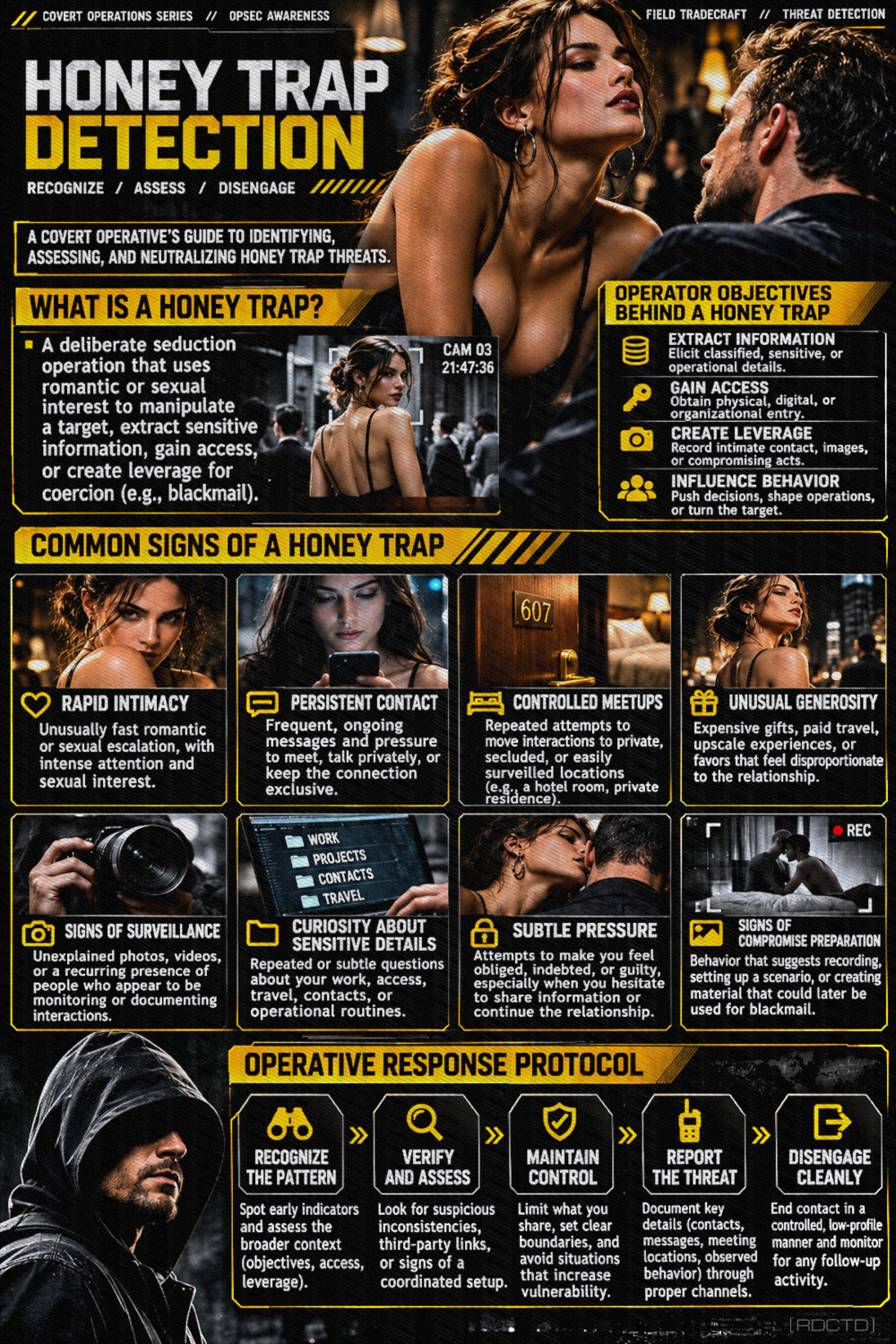
A honey trap is the strategic use of apparent or actual romantic, sexual, or intimate interest to gain access, obtain information, influence a decision, or create leverage over a person. The contact may act independently or on behalf of another party.
Physical intimacy can be involved, although a manufactured relationship, or a recorded conversation can provide the access the attacker wants.
The term sexual or romantic compromise describes the resulting exposure: someone acquires information, material, access, or apparent influence that can be used against your interests or obligations. A honey trap is one way to create that exposure. Fraud, opportunistic extortion, and abuse within an existing relationship can produce similar consequences without an intelligence service directing the contact.
The operative’s task is to protect decisions, people, and information while intent remains uncertain. Attraction doesn’t grant access, and a relationship doesn’t suspend established controls. Apply those controls without assuming that a person’s appearance or interest in you establishes hostile intent.
This guide examines the method from both sides of the encounter. It covers the indicators, defensive boundaries, reporting actions, and the role this tradecraft can play in an authorized assessment.
Compare the permissions granted to a personal contact with the access that would remain if the relationship ended today. Record the accounts, locations, devices, and people requiring attention.
[ UNDERSTAND THE ATTACK ]
A hostile relationship can develop through an unsolicited message, a social introduction, a work event, or repeated contact over a long period. The other party may present a complete false identity, use their real identity while concealing an affiliation, or exploit a relationship that began without a hostile purpose. Their behavior can remain courteous and plausible throughout.
The objective determines the compromise. Someone seeking money may demand an immediate payment. Someone collecting intelligence may prefer continued access and avoid making any explicit threat. Another party may use an intimate image, a fabricated allegation, or knowledge of a private relationship to compel action. One encounter can serve several objectives.
Identify What the Contact Can Gain
Assess exposure by the access or action the contact is seeking – assume it won’t be obvious but subtle. This makes the problem concrete before you’ve established who they are or whom they may represent.
- Information — Details about duties, access, colleagues, travel, internal disagreements, protective measures, or ongoing work can be assembled across routine conversations.
- Physical and Digital Access — Entry to accommodation, proximity to devices, shared accounts, borrowed credentials, or an introduction to a colleague can expand the contact’s reach.
- Influence — Personal attachment can be used to obtain an exception, redirect a decision, delay a report, arrange a meeting, or make an unauthorized introduction.
- Leverage — Real or fabricated material can support threats involving reputation, relationships, employment, legal exposure, or public disclosure.
- Money or Property — An apparent emergency, investment opportunity, or threatened release can produce transfers, access to accounts, or theft.
A contact doesn’t need a complete picture to cause harm. A name confirmed today can give context to an earlier photograph. A rough travel date can narrow an existing estimate. Use the same information boundary for fragments, corrections, and confirmations as you would for a direct request. Elicitation often succeeds because each answer seems too small to matter.
Understand the Progression
An approach may move from contact to familiarity, then to a request that tests your boundaries. The person may cultivate emotional dependence, introduce secrecy, or create an obligation before asking for access. A more direct criminal approach can move from an online exchange to a threat within minutes. There’s no fixed sequence and no reliable timetable.
Watch for the point where the relationship begins to carry a specific demand. A request for a meeting may become a request to change venues, leave your own transport, reveal your hotel room, or discuss a colleague. A personal confidence may become pressure to provide an equivalent disclosure. The significance is in the requested access and how the person responds to your boundary.
Established relationships also require attention to changes in behavior. A familiar partner may be pressured, impersonated, deceived, or used as an intermediary. A genuine relationship can become abusive without ever being an intelligence operation. Counterintelligence starts with the conduct and exposure you can establish.
*NOTE: Request Lineage – Record when each consequential request first appeared and whether it originated with the contact or a third party introduced later.
When a contact volunteers sensitive details about themselves, assess whether their disclosure changes your obligations. Their decision to speak gives them no authority to receive protected information.
[ RECOGNIZE THE INDICATORS ]
No single indicator proves that a person is conducting a honey trap. An awkward question, a fast-moving relationship, or an inconsistent biography can have an innocent explanation. Assess the pattern, the requested access, and the response to reasonable limits. You can decline a request immediately while the broader assessment remains unresolved.
Track the Direction of Interest
Pay attention when ordinary interest repeatedly returns to a protected subject. The contact may ask how your work is arranged, who accompanies you, where you stay, or why you can’t discuss a particular issue. A series of casual questions can resolve a specific information requirement.
- Repeated Specificity — General conversation repeatedly narrows toward your responsibilities, travel dates, associates, access, or security arrangements.
- Assumed Knowledge — The contact presents a guess as fact and waits for you to confirm, deny, or correct the details.
- Unexplained Familiarity — They know details you haven’t supplied, then avoid explaining how they obtained them or offer an account you can’t independently verify.
- Network Interest — Attention moves quickly from you to a colleague, a private event, an introduction, or someone with different access.
Keep the observation precise. “Asked twice for the date after I declined” is useful. “Acts like an intelligence officer” substitutes a conclusion for evidence. Public profiles, mutual acquaintances, and ordinary conversation can explain surprising familiarity. They can also give a deceptive contact material to use. Preserve both possibilities until further information supports a narrower judgment.
Watch for Accelerated Obligation
Rapid affection can be genuine. The concern increases when closeness is tied to immediate concessions: move the conversation to a different platform, share intimate material, provide money, keep the relationship secret from a specific person, or waive a personal safety boundary. An attacker may invoke trust, exclusivity, urgency, or an alleged emergency to keep the request moving.
Basic romance scam guidance identifies isolation, requests for sensitive photos or financial information, and pressure to move communication away from a platform as behaviors warranting caution. Those signals can occur in noncriminal relationships. Their relevance depends on the circumstances and the resulting demand.
A useful test is a clear, ordinary boundary. “I don’t send private images” or “I can’t discuss my work” requires no elaborate explanation. Note whether the person accepts the limit, returns to it, introduces guilt, or recruits someone else to argue for an exception. One respectful response doesn’t verify identity – persistent pressure gives you a direct reason to limit contact.
Identify Control of the Setting
Reassess when a contact controls the transport, venue, room, timing, communications, or other people present and resists reasonable alternatives. A proposed move from a public venue to a private location may be ordinary. A last-minute change combined with pressure to surrender your phone, consume more alcohol, or rely on an unfamiliar driver warrants immediate action.
Consider the full exposure. Someone arranging a meeting can create a record of your presence, bring an undisclosed third party, or place your devices and belongings within reach. A concealed recording is a possibility in some settings – you generally can’t establish privacy by relying on a visual inspection or an inexpensive detector. Assume that anything voluntarily shared can be recorded, copied, or misrepresented.
*NOTE: Independent Exit – Before entering a private setting, confirm that you can leave with your own phone, identification, and transport without requiring the contact’s cooperation.
Before verifying a claimed mutual contact, decide what your inquiry itself would reveal. Use a channel and question that won’t unnecessarily expose the relationship or assignment.
[ ESTABLISH YOUR DEFENSIVE POSITION ]
Resistance begins before an approach. Decide what requires protection while you can assess it without attraction, fatigue, embarrassment, or urgency influencing the decision. Your standard should be usable during a normal social interaction and firm enough to survive pressure.
Audit Your Exposure
Review what a stranger can learn through public profiles, photographs, professional pages, social tags, and people connected to you. Look for recurring venues, relationship details, family members, travel patterns, visible credentials, workplace affiliations, and personal interests that can make an approach appear familiar. Apply pattern-of-life analysis to your own public footprint.
Identify circumstances that can affect your judgment. Loneliness, overwork, relationship conflict, resentment, financial pressure, and a need for recognition can make a particular approach more effective. These conditions don’t make an individual defective – they make pre-established boundaries and independent review more valuable.
Remove or restrict unnecessary public detail where practical. Review who can see contact lists, old posts, tagged photos, and location information. Ask trusted people to limit unnecessary disclosure about you without requiring them to manage your security for you. Assume some previously exposed information remains available elsewhere.
Set Nontransferable Boundaries
Establish limits around information, devices, locations, financial support, and introductions. A relationship may develop, but any access still needs its own legitimate basis. A person can be sincere and still lack permission to receive protected information or enter a restricted area.
- Protected Work — Keep assignments, identities, internal procedures, travel, and other restricted information within authorized channels and actual need-to-know.
- Devices and Accounts — Keep passcodes, authentication prompts, sensitive devices, and account recovery methods under your control; use approved device-separation rules where applicable.
- Personal Material — Decide in advance what you’re willing to create, send, or discuss if it could be copied or circulated; another person’s promise doesn’t control every recipient.
- Third Parties — Obtain permission before sharing another person’s details or making an introduction; your relationship doesn’t authorize exposure of theirs.
Use strong unique passwords, multifactor authentication, current software, and the security settings appropriate to your devices. If an unexpected authentication prompt appears, deny it and investigate through a trusted channel.
Verify Without Escalating Exposure
Verify consequential claims through sources and channels you select. A supplied profile, a photo with a familiar person, a live video call, or a reference chosen by the contact can support a claim – none independently establishes the person’s intent or authority. Images and audio can be stolen, altered, or generated, and genuine accounts can be compromised.
If a claim can’t be established, label it unverified and keep the related access closed. Don’t invent a test that requires disclosing a protected fact. Refer concerning contact to your designated security channel rather than attempting to investigate a suspected intelligence operation on your own.
If a contact offers to solve a problem they introduced, establish whether the proposed solution would give them new access, place you in debt, or prevent independent verification.
[ EXECUTE THE CONTACT PROTOCOL ]
Use the protocol when a personal approach begins seeking protected information, unplanned access, secrecy, or a consequential favor. Immediate physical danger takes priority over assessment. Move to safety and contact emergency services when necessary.
Stop the Request at the Boundary
Use a tactical pause when the situation permits. Identify the specific request before responding. A claim of urgency or affection doesn’t alter the protection required for an account, person, document, or location.

You don’t need to establish the person’s motive before refusing. Avoid announcing that you’ve identified an operation, testing them with sensitive information, or improvising a counterapproach. Each can expose your assessment and create further risk. Authorized professionals can decide whether continued contact serves a legitimate investigative purpose.
Manage the Setting
Arrange an initial meeting where you can leave independently. Retain control of your identification, phone, payment method, and belongings. Follow applicable requirements for restricted devices and facilities. Decide your limits for alcohol or other impairing substances in advance, and leave if you’re pressured to exceed them.
An unexpected change in location or attendees deserves a fresh decision. You can refuse the change without accusing anyone. If you feel impaired beyond what you’d expect, seek help from a trusted person or venue staff and obtain urgent medical care where appropriate. If you suspect assault or involuntary drugging, get to safety and seek medical attention promptly – time can matter for treatment and evidence collection.
Consent must be present throughout intimate contact and can be withdrawn. An intoxicated or incapacitated person may be unable to consent. Pressure, threats, and recording or distributing intimate material without the required consent create serious harm and may constitute crimes. Treat a suspected assault as a safety and medical incident.
Respond to Persistent Probing
A refusal often becomes a new line of inquiry. “Why can’t you tell me?” can elicit a security rule, a name, or an indirect confirmation. “You don’t trust me” can turn your relationship into the subject while the original demand remains active. Keep the answer tied to your boundary.
“I don’t discuss other people’s work.” “I’m not providing that.” “The answer remains no.” If the person continues, end the conversation or leave when safe. Refer a legitimate professional inquiry to an approved channel without identifying a protected source or explaining internal processes. The same defense against social engineering applies when the pressure comes from someone you like.
*NOTE: Aggregate Disclosure – After an interaction, combine your answers, corrections, pauses, and referrals into one account to assess what they revealed together.
When a report contains both an observed threat and a fear about what may happen next, separate them. Response teams need the actual demand, the available evidence, and your assessment of the possible consequences.
[ RESPOND TO A COMPROMISE ]
An explicit threat, unauthorized disclosure, suspected device access, or loss of control over sensitive material requires immediate containment. If the threat is physical or someone is in immediate danger, move to safety and contact emergency services. Once safe, report the incident through the appropriate security, counterintelligence, or law-enforcement channel.
Terminate the Leverage
If someone threatens to expose material unless you pay, disclose information, or perform an action, stop providing further access. Preserve the threat and seek help immediately. Don’t send money, additional images, credentials, or protected information in an attempt to secure silence. Compliance can produce further demands and gives no assurance that copies will be deleted.
The material may be authentic, altered, or entirely fabricated. State what you know and what you can’t verify. You don’t need to inspect, purchase, or forward intimate material to prove a threat exists. Avoid confronting the person in person or trying to recover the material yourself. Follow the direction of security or law enforcement if an authorized investigation is already underway.
Preserve the Record
Record the sequence while it’s still clear. Preserve messages, account identifiers, payment details, dates, locations, and the actual wording of requests or threats using approved procedures. Distinguish direct observation from another person’s account and from your own interpretation.
- Contact — Record how the relationship began, the identities or affiliations claimed, communication channels, and relevant meetings.
- Request — Record what was sought, each refusal or concession, any deadline, and the exact threat where available.
- Exposure — Identify information disclosed, devices or accounts accessible, material shared, other people involved, and what remains uncertain.
- Current Risk — State whether contact continues, a meeting is pending, credentials may be exposed, or anyone faces an immediate threat.
Preserve original records where feasible. Don’t alter messages, circulate intimate files, or transfer sensitive material to an unapproved personal account. If a work device may be compromised, notify the responsible security or IT team promptly and follow its containment instructions. Use a trusted device or channel to contact support.
Report the Whole Exposure
Tell the designated authority what occurred, including the part you find embarrassing and any information you actually disclosed. An incomplete report can leave accounts, colleagues, or operations exposed while responders assess the wrong problem. If you don’t know whether a device was accessed or a claim is true, say so.
*NOTE: Decision Record – Include any planned meeting, pending transfer, or active access in the first report so the recipient can act on the immediate exposure before completing attribution.
Before treating a genuine identity as proof of harmless intent, identify the separate question you still need answered: who requested the access, who benefits, and what the person is authorized to receive.
[ APPLY THE METHOD AS AN OPERATIVE ]
Understanding how an adversary uses romantic access improves your ability to recognize collection, evaluate a source, and design defensive assessments. In intelligence work, an apparent relationship may facilitate access, elicit information, influence a decision, or create leverage. Each purpose creates different evidence and different risks for everyone involved.
An operative tasked to assess such activity needs an authorized objective, clear boundaries, supervisory control, and an exit plan. A personal attraction or the possibility of obtaining information doesn’t create authority to conduct an operation. Consent, organizational rules, and oversight govern the methods available in a particular jurisdiction.
Analyze the Honey Trap’s Method
Reconstruct the encounter around the outcome sought. Identify the initial access, how the relationship developed, the information or action requested, and any apparent beneficiary. Compare the contact’s conduct with alternative explanations, including financial fraud, an abusive relationship, or genuine interest followed by unrelated conflict.
- Collection Requirement — Identify the information or decision the contact repeatedly approaches; compare the questions across messages and meetings.
- Access Route — Establish how contact occurred, which accounts or people enabled it, and whether subsequent introductions expanded the contact’s reach.
- Pressure Mechanism — Record demands involving secrecy, obligation, affection, money, threats, or an alleged emergency, together with the requested concession.
- Evidence and Alternatives — Distinguish confirmed facts from claims, assess independent corroboration, and identify what would weaken your leading explanation.
A contact’s genuine identity doesn’t establish independent intent. A false profile doesn’t establish affiliation with a foreign service. Use the known unknowns to keep gaps visible, and assign confidence to the specific assessment rather than applying a single label to the person.
Operational Employment of a Honey Trap
In a honey trap, the operative or an asset uses apparent or actual romantic interest to establish a relationship with a person whose knowledge, access, or decisions are relevant to the objective. The relationship creates opportunities for contact and conversation. The collection or influence purpose may be concealed from the contact. Sexual activity isn’t required for the approach to function.
Operational use starts with a defined intelligence requirement and an assessment of whether the person has relevant access. The operative establishes contact through the approved channel, manages the relationship within assigned limits, and directs the authorized inquiry toward the requirement. Record what the contact actually says, the circumstances of the exchange, and what remains inference. Information offered in a personal setting still requires independent evaluation.
The method carries substantial exposure for the operative and the contact. The other person may recognize the approach, have their own undisclosed interests, or provide information intended to influence the assessment. Personal involvement can also distort the operative’s judgment.
Establish supervision, a review schedule, consent boundaries, and termination conditions before contact. Threats, coercion, nonconsensual recording, and exploiting an incapacitated person are outside those boundaries. Apply the Countermove Test to what the contact or another party could do with the access created.
Build an Authorized Defensive Exercise
A training or red-team exercise can reproduce the decision pressure of a honey trap without creating actual intimate exposure. Obtain written authorization from the organization and use participants and boundaries approved for the exercise. Define what the assessment may test, who supervises it, what information can be used, and when the scenario must stop.
An exercise can test whether a policy is usable under personal pressure. Its result doesn’t prove how the same person would respond in every relationship or under a real threat. Assess the system as well as the individual: a refusal has limited operational value if the reporting route is inaccessible or the organization punishes prompt disclosure.
Control Operational Use

*NOTE: Independent Review – Assign a reviewer outside the relationship to examine the original collection requirement, contradictory reporting, and whether continued contact still serves an authorized purpose.
During debrief, ask who else may have been exposed through the contact’s introductions. Their access, awareness, and reporting obligations may require separate action.
[ FIELD APPLICATION ]
An operative meets a new contact at a social event. Conversation continues online. Over several days, the contact expresses strong interest and asks about upcoming travel. After the operative declines to discuss work, the contact asks whether a named colleague will be away during the same period. The contact then proposes a private meeting and asks that nobody be told about it.
The operative doesn’t know whether this is an intelligence approach. The facts support a narrower conclusion: the contact repeatedly sought protected scheduling information, attempted to obtain a third party’s details, and requested secrecy around a meeting. Those facts are sufficient to maintain the boundary and reassess the meeting.
- Immediate Action — Decline to discuss schedules or colleagues; don’t confirm or correct the contact’s assumptions.
- Access Decision — Decline the private meeting while the concern is assessed; maintain control of devices, accounts, and personal information.
- Record and Report — Preserve the relevant messages and report the sequence through the applicable channel, including what was actually disclosed.
- Assessment — Leave intent and affiliation unresolved until corroborated; don’t warn the named colleague through an unapproved channel if doing so would expose protected information.
The response protects the operative’s work and the colleague’s information while preserving the option for an authorized assessment. If the contact was genuine and behaved poorly, the boundary was still valid. If the contact was acting for another party, the account gives security personnel a sequence to examine.
After an attempted compromise, review the access the other party retains even if contact has ended. A revoked invitation doesn’t close a shared account, recover a key, or notify an exposed colleague.
[ FINAL ]
Sexual and romantic compromise targets the point where personal access begins to influence professional decisions. The adversary may seek a secret, a favor, a device, a relationship with someone else, or material that can support a threat. The operative’s protection is an established set of boundaries applied before the demand becomes urgent.
// Attraction can change the value you assign to a risk while leaving the risk itself untouched.

+ Covert Operative Kit [ ] gear shop »»
[OPTICS : Operative VS Operative]