![[RDCTD]](https://rdctd.pro/wp-content/uploads/RDCTD-Covert-Operative-Tradecraft-Guide-LOGO-tk.png)
![[RDCTD]](https://rdctd.pro/wp-content/uploads/RDCTD-Covert-Operative-Tradecraft-Guide-LOGO-mobile.png)


 The tradecraft of utilizing asymmetry to engage as the subjectively inferior adversary by converting the enemy’s objectively superior capacity into vulnerability – from covert operations to daily “normal” life.
Dominance looks for answers, but asymmetry reframes the problem, because power that can’t adapt is just inert mass.
Asymmetric Enemy Engagement is a calculus of power conversion. The operative faces an opponent with superior mass, reach, or authorities. The response shifts the contest from mass against mass into angle against structure. The unit of action is the exchange, not the battle.
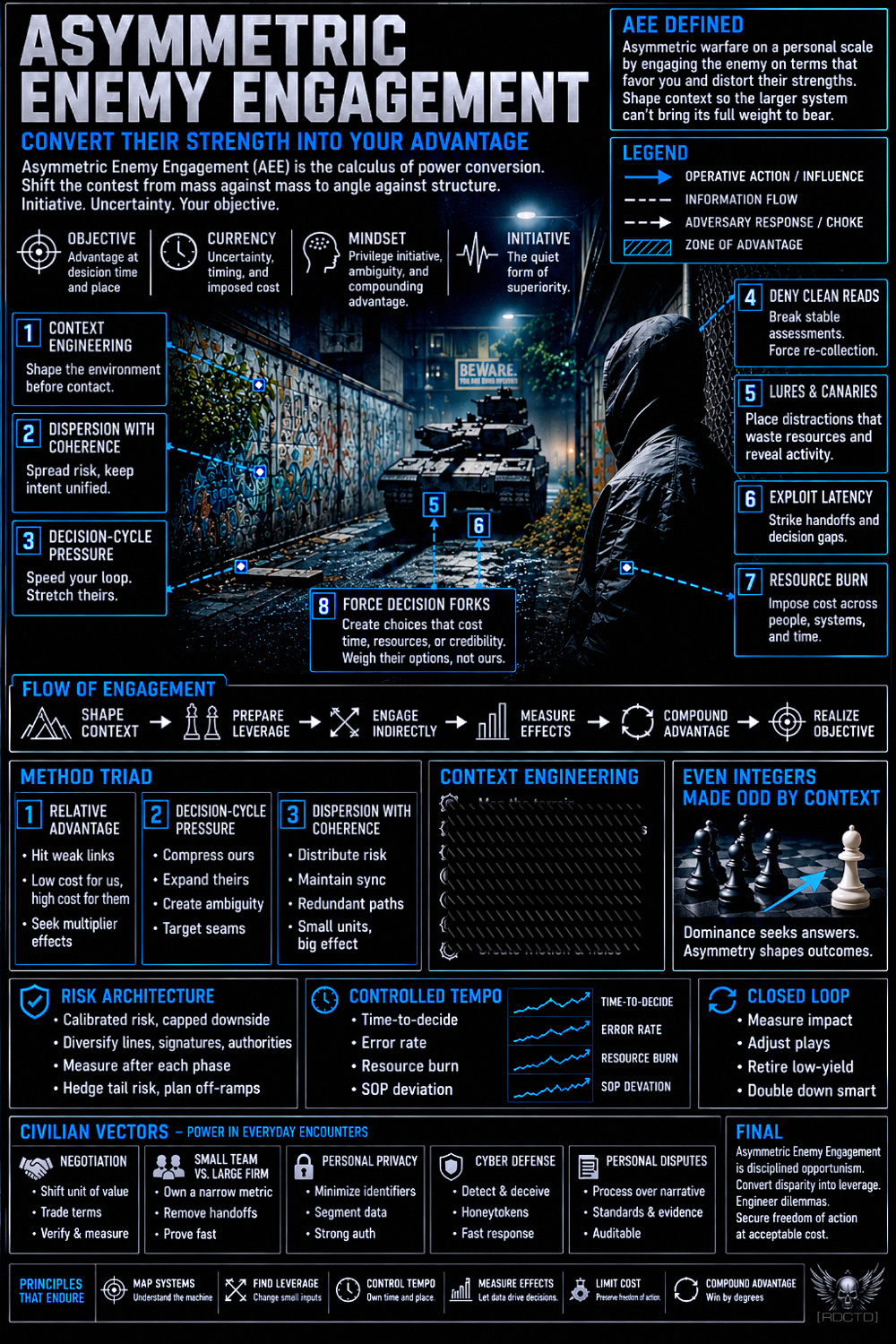
The objective is advantage at decision time and place. The currency is uncertainty, timing, and cost imposed on the adversary. This is asymmetric warfare scaled down to the personal, more intimate level of engagement.
[AEE] is ‘asymmetric warfare‘ on a personal scale by engaging the enemy on terms that favor you and distort the their strengths. It’s shaping context (timelines, perceptions, and decision space) so the larger system can’t bring its full weight to bear. You privilege initiative, ambiguity, and compounding advantage over parity or spectacle.
Each controlled exchange should narrow the adversary’s options while preserving your own mobility, deniability, advantage, and freedom to disengage. Success is measured by whether superior power becomes too slow, costly, or uncertain to apply effectively.
Initiative is the quiet form of superiority.
[ METHOD TRIAD ]
The strategy rests on three pillars that translate disparity into actionable leverage, aligning access, timing, and perception to offset gaps, impose decision stress, and shape outcomes before direct contact occurs. They define the shift from strength-on-strength to strength-on-weakness engagement. Each pillar is designed to be applied before contact.
Relative Advantage
Map the opponent’s effect chain and quantify costs at each link. Strike where your replacement cost is lowest and their recovery cost is highest. Favor actions that degrade their sensing, coordination, or logistics over attacks on hardened outputs. Seek non-linear effects: one low-signature input that multiplies their error rate, delay, or spend. Reassess after each exchange and roll pressure toward the next cheapest, highest-friction link.
Decision-Cycle Pressure
Compress your observe–orient–decide–act (OODA) loop while expanding theirs. Precompute plays, rehearse branches, and keep sensing continuous. Inject delay and doubt through ambiguity, timing offsets, and decoys that force re-collection. Target seams between orientation and decision, when leaders are most vulnerable to paralysis or stale orders. The aim is relatively simple, you choose the time and they inherit the tempo.
Dispersion with Coherence
Distribute risk, signatures, and avenues of approach, but keep intent tight. Use modular cells, cutouts, and redundant paths so failure localizes. Synchronize by intent and triggers rather than by fixed clocks. Maintain a feedback lattice – short, authenticated, and minimal – to prevent fratricide and keep effects cumulative. Coherence turns many small probes into one compounded result.
Tradecraft provides the tooling – sensing, misdirection, cutouts, and timing discipline. With application, these pillars yield initiative at acceptable cost.
Asymmetry replaces confrontation with orchestration.
[ CONTEXT ENGINEERING ]
Asymmetry is built before contact. Shape the contest so advantage accrues quietly and early. Handle “terrain” as every layer you can bias (physical, digital, social, cognitive) and apply tactics to preload those biases.
• Define The Terrain Stack: Enumerate physical choke points, digital control planes, legal authorities, social networks, and cognitive priors. Assign ownership, access paths, and detection surfaces to each layer. Mark which layers you can alter cheaply, and which impose high recovery costs on the adversary.
• Tilt the Field with Access and Pretexts: Acquire legitimate access that doubles as cover for collection and influence. Build credible pretexts tied to real workflows and identities. Stage narrative cues that make your presence and timing look routine, not exceptional.
• Seed Their Model with Structured Ambiguity: Place decoys, half-truths, and incomplete facts where their sensors already look. Calibrate each insert so it’s plausible enough to be logged, but incomplete enough to force re-collection. Let their existing priors do the distortion.
• Exploit Latency: Prioritize actions where seconds and minutes matter more than raw capacity. Hit handoffs, batch windows, and clearance cycles. Create timing offsets that make “now” a bad time for them and a good time for you.
• Deny Clean Reads: Break their ability to form stable, high-confidence assessments. Rotate modalities and pacing so signatures never stabilize. Use noise, shadow traffic, and benign lookalikes to lower their signal-to-noise at the decision point.
• Baseline Their Sensing: Learn what they monitor, how often, and what thresholds trigger action. Identify dead zones between tools, teams, or time blocks. Move just under those thresholds until you need to spike them by design.
• Place Noise Just Above Alert Lines: When you want to burn their bandwidth, ride slightly above trigger points. Generate alerts that require human adjudication without yielding decisive answers. Convert their responders into your resource sink.
• Preload Lures and Canaries: Prepare artifacts (files, routes, addresses, offers) that are attractive but instrumented. Use dead ends to waste cycles and canaries to reveal which path they probe. Tag each lure to attribute touchpoints to specific adversary units or tools.
• Partition Signatures: Split your operational footprint across identities, channels, times, and geographies. Ensure no single observation can resolve intent or link the whole. Make correlation require access the adversary doesn’t have or can’t obtain quickly.
• Force Decision Forks: Design every interaction to branch in your favor. Offer two or more plausible paths where each imposes delay, cost, or disclosure on them. Keep your own branch costs low and reversible.
• Compound Friction: Sequence small effects so each adds delay or uncertainty to the next. Drive them off their standard operating procedures one notch at a time. Track drift from baseline as proof the compounding is working.
• Measure Effect, Not Drama: Instrument the environment. Log added time-to-decide, elevated error rates, resources retasked, and SOP deviations. Use those metrics to retire low-yield plays and double down on high-yield ones.
The end state is prepared advantage at the moment of contact. You’ve biased the layers, constrained their options, and pre-arranged reads that favor your plan. When the engagement starts, the work’s already done – tempo and cost curves run your way.
Even integers of force can be made odd by context.
[ RISK ARCHITECTURE ]
Risk is managed as a calibrated portfolio rather than a single bet. Deliberate micro-risks are selectively accepted to cap downside loss and preserve long-term optionality. Exposures that compound, cascade, or scale non-linearly with adversary strength are deliberately screened out.
Risk appetite is formally codified in standing orders, predefined thresholds, and explicit red lines to prevent drift under pressure and other circumstances.
Time is viewed as an asset with yield; prolonged uncertainty degrades their logistics, compliance load, and leadership bandwidth. Asymmetry is evaluated by effects on systems, not spectacle. The after-action lens asks whether the opponent’s recovery options narrowed at each phase. Diversification is applied across lines of effort, signatures, and authorities to prevent correlated failure.
Position sizing, stop-loss thresholds, and preplanned off-ramps govern downside. Scenario trees and decision tables quantify path-dependent exposure across branches. Contingency liquidity (time, authorities, and trusted access) is preserved to purchase exits at known prices.
Tail risk is hedged with reversible actions, legal cover, and deniable pathways. Rebalancing cadence is tied to fresh collection, not calendar rhythm. Tradecraft provides the mechanics for measurement, attribution, and timely reallocation. Metrics are audited against baselines after each cycle to recalibrate priors and retire stale plays.
What can’t be dominated can be rerouted.
[ CONTROLLED TEMPO ]
Measurement completes the theory. Friction on the adversary side must be observable, attributable, and compared against baselines. Manage measurement as part of the operation, not an afterthought. Instrument the engagement so signal arrives fast enough to steer decisions in-contact.
Time-to-Decide

Error Rate
Resource Burn
Behavioral Drift from SOP

Close the loop with a matched cost ledger: exposure, signature, fatigue, and dependency on the operative side. Seek curves where small actions drive non-linear disruption there while costs remain capped here. Retire plays that stop moving the curves and reweight toward those that do.
Succeed by editing the problem, not by enlarging effort.
[ CIVILIAN VECTORS ]
Civilian engagements follow the same logic as covert operations. Power converts when contests are shifted from strength-on-strength to strength-on-weakness. The mechanisms are negotiation structure, cycle time, verification cost, detection asymmetry, and standards-based framing. Applied effectively, everyday interactions become controlled exchanges where marginal actions impose disproportionate friction on an adversary.
Negotiation // Shift the Unit of Value
Move discussion from headline price to terms the counterpart undervalues but can deliver high leverage: payment timing, acceptance criteria, delivery windows, service credits, termination-for-convenience, IP reuse, or exclusivity radius. Bundle issues so concessions trade across dimensions rather than within one axis. Quantify each term’s cost to your side and their recovery cost if it breaks. Prefer trades where your marginal cost is low and their contingency cost is high. Use verifiable milestones and objective metrics to reduce interpretive disputes and force the counterpart to price coordination drag.
Small Team vs. Large Firm // Compress Cycles & Coordination Tax
Own a narrow performance metric that incumbents can’t optimize without reorg-level change. Remove handoffs with automation and direct-to-decider communication paths. Publish short cadence roadmaps with explicit kill criteria, so sunk-cost bias is contained while the incumbent must convene committees to pivot. Validate with working artifacts and time-stamped results; proofs that settle arguments faster than the opponent can staff them.
Personal Privacy // Exploitable Surface & Verification Cost
Minimize persistent identifiers across accounts; rotate aliases tied to function, not persona. Segment data stores by purpose so correlation requires privileged access the adversary doesn’t hold. Prefer strong authentication and passkeys; disable recovery vectors that leak identity. Use signed, time-bound sharing links and watermarking to deter unauthorized reuse and to attribute touches. Low-value data for casual observers, high verification cost for motivated actors.
Cyber Defense // Weaponize Detection Asymmetry
One high-fidelity alert that exposes attacker tooling can invalidate months of their work. Instrument with honeytokens, canary documents, and decoy credentials embedded in likely collection paths. Maintain asset inventory, immutable logging, and rapid credential rotation so detection leads to immediate loss of attacker persistence. Track mean time to detect, contain, and evict. Bias investments toward controls that raise attacker reload cost and reveal tradecraft when tripped.
Personal Disputes // Reframe to Process and 3rd-Party Standards
Convert narrative contests into procedural checks: written scope, authenticated timestamps, chain-of-custody for evidence, and agreed escalation paths. Reference neutral benchmarks – industry specs, regulatory guidance, or documented house rules – to limit scope for interpretive aggression. Keep communications auditable and channel-bound to prevent selective quoting. Each step denies the aggressor “home-field” interpretation and forces choices that either concede facts or expose overreach.
Strategically engaging asymmetrically isn’t confined to covert operations, it travels well in daily life. The purpose stays constant – convert disparity into leverage, measure effects, and keep costs acceptable. When fieldcraft informs the structure of civilian exchanges, the result is initiative secured at decision time and place. This is opportunism executed with method.
Dominance is brittle, initiative is liquid.
[ FINAL ]
Asymmetric Enemy Engagement is disciplined opportunism. You design contests where your constraints become features and their strengths convert into liabilities. Instead of seeking dominance, you engineer dilemmas. The end state is freedom of action secured at acceptable cost.
This strategy applies on a street corner, in a boardroom, or during covert operations overseas. The mindset is clinical: map systems, find leverage, control tempo, and let tradecraft do the heavy lifting.
// Asymmetry is the art of converting scale into inertia, where engagement stops being a fight and becomes restructuring of a stronger adversary’s available options.
+ Covert Operative Kit [ ] gear shop »»
[OPTICS : Undisclosed, Bulgaria]