![[RDCTD]](https://rdctd.pro/wp-content/uploads/RDCTD-Covert-Operative-Tradecraft-Guide-LOGO-tk.png)
![[RDCTD]](https://rdctd.pro/wp-content/uploads/RDCTD-Covert-Operative-Tradecraft-Guide-LOGO-mobile.png)

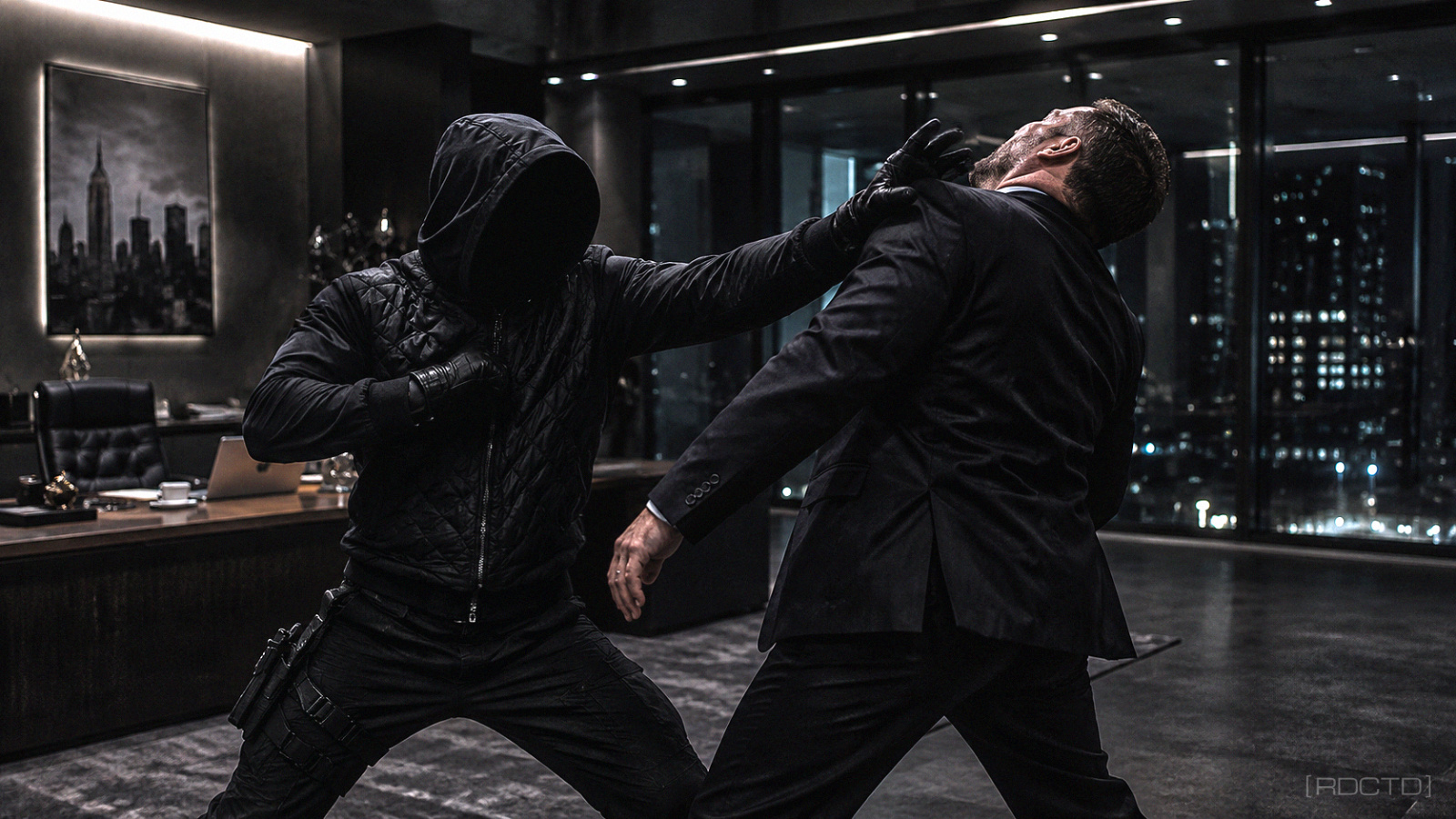
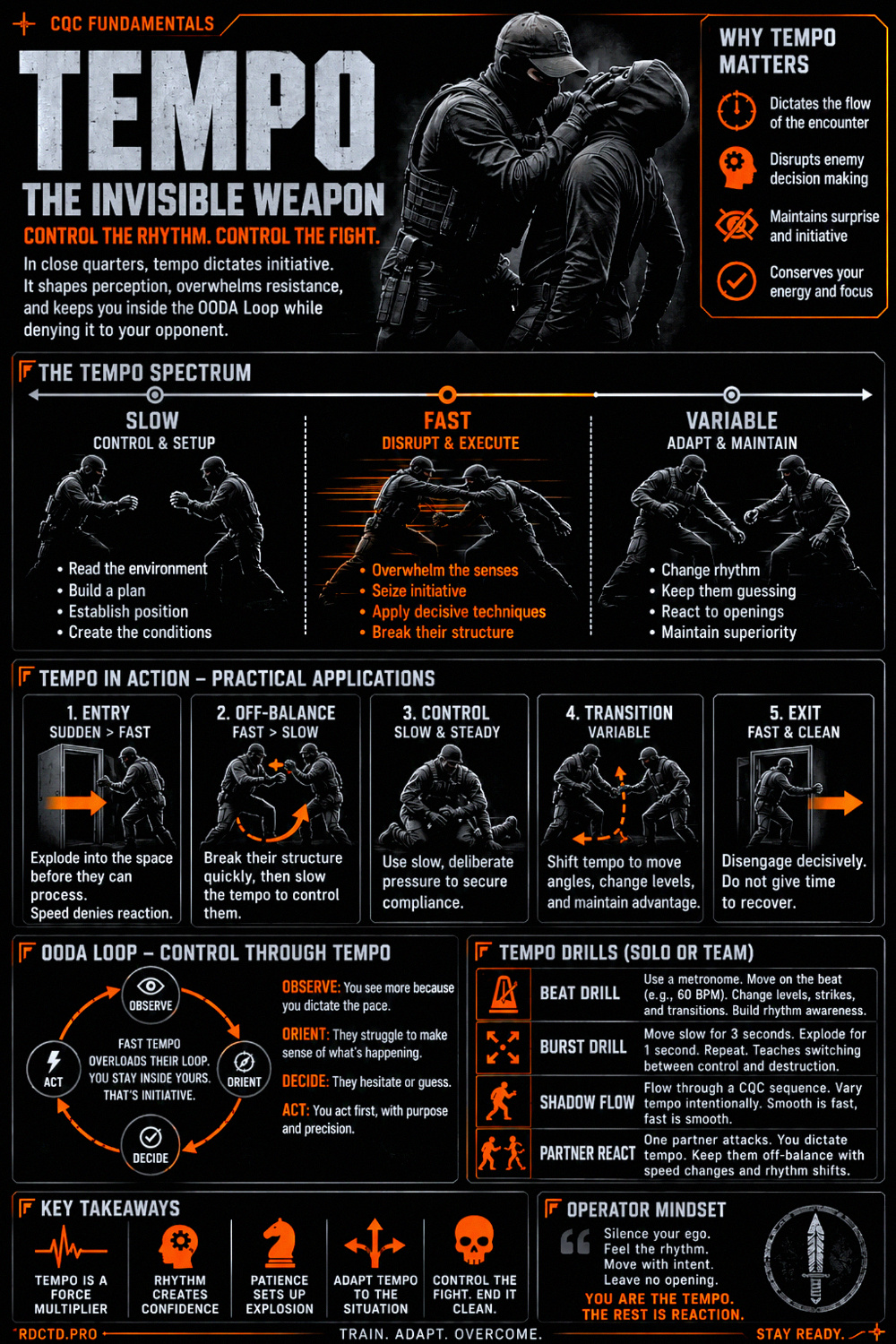 Close quarters combat tempo control is the regulation of speed, rhythm, and timing in an engagement to dictate – to a point – what the opponent perceives, when they can respond, and how the fight develops.
Rhythm decides more kinetic engagements than raw speed, because rhythm determines when speed gets used.
With tradecraft, tempo is the pace at which you force an opponent to process events. In close quarters, whoever sets that pace holds the initiative, acting while the other man is still interpreting. That delay becomes the opening, allowing each action to land before his response can stabilize.
The average person’s simple reaction time runs 200 to 250 milliseconds under ideal conditions. Add a critical decision between options and it stretches well past 400 – a gap wide enough to land two committed actions before the first response arrives.
Every technique gets delivered on a rhythm whether you manage that rhythm or not. Untrained fighters settle into a steady cadence within seconds of contact because the nervous system defaults to pattern. That default is a target.
Tempo control is tradecraft applied to violence. The same principle that governs a surveillance detection route governs a breach – you set the pattern, and you choose the moment it breaks. What follows covers the three tempo bands, the five-phase engagement sequence, OODA loop exploitation through pace, and the drills that turn tempo into a trained attribute.
Pair acceleration with an exhale and deceleration with nasal recovery breathing to prevent pace changes from destabilizing your own physiology.
[ THE TEMPO SPECTRUM ]
Tempo runs across three working bands. Each band has a job, but each fails when it’s applied at the wrong phase of an engagement. Control comes from shifting between them before the opponent can adjust to the change.
The transition itself often creates the opening, because most fighters prepare for speed but struggle to read sudden deceleration or broken rhythm.
Slow – Control and Setup
This is the assessment band. You’re gathering data, building position, and setting conditions while presenting nothing the opponent can time. The objective is to collect useful reactions without revealing the action those reactions are preparing. A controlled pace also prevents premature commitment, preserving options until the strongest opening is confirmed.
- Environmental Read — map exits, obstructions, surfaces, and third parties before committing; anything within reach is a potential weapon for either side.
- Plan Construction — pick the entry, the finishing position, and the exit in advance, then hold each loosely enough to adapt when contact rewrites them.
- Position Building — close distance in increments the opponent doesn’t register as aggression; angles cost less to take before contact than after it.
- Condition Setting — shape their stance, attention, and expectations so your first fast action arrives against unprepared position.
- Arousal Regulation — a slow external pace helps hold heart rate below the 145 to 175 bpm range where fine motor skill degrades; combat breathing extends that window.
These measures turn the slow band into an intelligence-gathering phase rather than passive delay. Every observation should either improve position, narrow uncertainty, or prepare the conditions for decisive acceleration.
Fast – Disrupt and Execute
This is the execution band. Its purpose is compressing the opponent’s processing window until nothing they attempt arrives on time. Speed must remain sequenced, with each action creating the position required for the next. The sequence ends once control is established, continued acceleration after the advantage is secured only creates unnecessary exposure.
- Sensory Overload — stack strikes, level changes, grips, and noise until discrete events blur into one unreadable stream; overload is a direct route to induced panic.
- Initiative Seizure — operate inside their reactionary gap; each landed action forces a reset, and each reset buys you the next beat.
- Decisive Technique — spend speed only on high-percentage tools; a fast tempo built on low-percentage technique burns your anaerobic reserve for nothing.
- Structure Breaking — attack posture and base first, since broken structure can’t generate force at any speed.
These measures turn the fast band into a controlled burst rather than uncontrolled acceleration. Every action should degrade the opponent’s position, preserve your own position, or close the exchange before speed becomes exposure.
Variable – Adapt and Maintain
This is the maintenance band. Once you hold the advantage, irregular rhythm keeps the opponent re-orienting and keeps that advantage from decaying. Brief pauses force them to question whether the exchange has slowed or another burst is forming. Each change in pace should protect position, disrupt prediction, or create a safer transition
- Rhythm Breaks — insert pauses and accelerations at irregular intervals so their timing never syncs to yours; the tactical pause is a weapon here when it’s used deliberately.
- Opening Exploitation — hit gaps at full speed while everything surrounding the gap stays measured.
- Pattern Denial — avoid repeating the same interval twice in sequence; predictability hands your timing to the opponent for free.
- Energy Management — bursts draw on a reserve measured in seconds; variable pacing spends it only where it converts to position or damage.
These measures turn the variable band into a timing-denial system rather than random movement. Every shift should preserve control, conceal intent, or force the opponent to reset before they can establish a usable rhythm.
Most trained fighters can go fast. Far fewer can stay slow under adrenaline, and the ability to move between bands on demand is rarer still – it’s the attribute that separates a trained operative from a conditioned athlete. Pressure-test yourself honestly: if your only answer to resistance is acceleration, you don’t control tempo yet.
Measure whether a rhythm change improves angle, balance, or escape access; if it improves none of them, it is movement without tactical value.
[ THE ENGAGEMENT SEQUENCE ]
A close quarters engagement breaks into five phases, each running its own tempo. The phase names matter less than the tempo assignments attached to them. Each phase creates a different timing problem – carrying the wrong pace forward can erase the advantage gained in the previous one.
Execution depends on recognizing the transition early and changing speed before the opponent can exploit the shift.
The sequence assumes you initiate. When you’re the one reacting, the first task is taking the rhythm back – covered in the OODA section below.
Methodology

The standard failure is running one tempo across all five phases. Constant speed exhausts the anaerobic system before the control phase and excessive caution concedes the entry to whoever wanted it more.
Rehearse the sequence as five tempo assignments rather than five techniques – the techniques change with context, the assignments don’t. In training, call each phase out loud as you enter it until the pacing runs automatic; under stress you’ll default to whatever you rehearsed.
Practice switching tempo from compromised positions, since pace control that only works from dominance will fail when contact begins badly.
[ OODA EXPLOITATION ]
Tempo is the mechanical input that breaks an opponent’s OODA loop. Every imposed rhythm change kicks them back to observe and orient while you keep operating from decide and act. The result is a widening delay between what they perceive and what they can effectively do about it.
The loop doesn’t get beaten once. It gets held broken, beat after beat, until their output is pure reaction. Each forced reset strips away another layer of deliberate thought and leaves fewer viable responses. With continued disruption, the more their actions become reflexive instead of intentional.
Overloading Their Loop
Overload occurs when the opponent is forced to process more changes than their decision cycle can absorb. The objective is to keep each phase of that cycle occupied while your own actions remain sequenced and deliberate.
Once their internal model falls behind, each new stimulus compounds the error created by the last one. The result is a growing delay between what they register, what they expect, and what they’re physically prepared to do.
Reading Their Tempo
Imposing tempo starts with measuring theirs. The read takes two exchanges at most, which is the same calibration you’d run on any target. The objective is to identify the interval they trust, then break it before that timing hardens into prediction. That interval becomes the reference point for every feint, pause, and acceleration that follows.

Don’t read these signals in isolation; combine timing, posture, breathing, and recovery into a single operating picture. One marker may be noise, but several appearing together reveal the opponent’s current processing limit. Once that limit is clear, change pace before they can rebuild a reliable pattern.
Judge every rhythm break by the reaction it produces. A stutter, a stance correction, or a reset grip means the change registered; no reaction means you supplied a rhythm the opponent can set a watch to, and a patient one will use the metronome you just handed him.
Practice entering on the opponent’s inhalation, weight transfer, or visual fixation rather than waiting for a fully formed opening.
[ TEMPO DRILLS ]
Under stress every attribute drops to its training floor, tempo is no exception. These drills raise the floor, because when it counts you’ll default to your training and nothing else.
- Beat Drill — set a metronome to 60 bpm and execute on the beat: strikes, level changes, footwork, transitions. Progress to the half beat, then deliberately off the beat. Builds a rhythm awareness free sparring never isolates.
- Burst Drill — three seconds of slow deliberate work, one second of full explosion, repeated for full rounds. Trains the neurological switch between the control band and the execution band.
- Shadow Flow — run a continuous CQC sequence while changing tempo on command. Precision built at slow speed is what survives conversion to speed under load.
- Partner React — one partner attacks at will while you dictate tempo, keeping him off-balance with speed changes and rhythm breaks rather than raw output.
- Broken Cadence Feeds — a pad feeder calls combinations at irregular intervals with random dead time; the drill punishes anticipation and rewards response to genuine stimulus.
Run tempo work early in a session while the nervous system is fresh. Rhythm precision is a coordination skill, of which trains poorly through fatigue.
Log which band breaks down first under pressure testing – most operatives lose slow before they lose fast – then give that band the next training block. A weakness in one band caps the value of the other two.
Measure contact quality at each speed band – higher output is useless when alignment and force transfer degrade.
[ FINAL ]
Most fighters, experienced or expert, own some speed with various degrees of technique, tempo determines when either one gets to matter. Train the three bands, master the movement between them, and open every engagement by setting the clock the other man has to survive.
// Tempo is the delivery system for every technique you own.
+ Covert Operative Kit [ ] gear shop »»
[TAG : CIA CQC]