![[RDCTD]](https://rdctd.pro/wp-content/uploads/RDCTD-Covert-Operative-Tradecraft-Guide-LOGO-tk.png)
![[RDCTD]](https://rdctd.pro/wp-content/uploads/RDCTD-Covert-Operative-Tradecraft-Guide-LOGO-mobile.png)


 All strategy = sequence: calibrated chains of moves that sets conditions, manages attention, and ensures the most optimal action occurs only when the environment has been shaped to support it.
Motion isn’t always progress, progress has an order. A plan is a list, strategy is its sequence that makes motion into progress.
Strategizing is a matter of sequencing – the first moves set the conditions, define the risks / opportunities, and determine what options remain when it’s time to commit. They’re shaped by order, and the same assets, people, tools, and information can produce success or failure depending on when each element is introduced, used, withheld, or repeated.
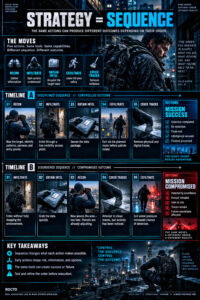
Strategy is a method for converting limited resources into a desired end state under constraints. So then exposure, optionality, cost, timing, and the shape of the adversary’s response. In other words, “Strategy = Sequencing” because sequencing is the control surface that actually steers the system.
A useful (strategic) opening move should improve the conditions for the next decision, whether by resolving uncertainty, securing a prerequisite, or preserving room to change direction. Committing resources before those conditions exist can turn a sound action into an expensive mistake. Judge each step by what it makes possible afterward, and revise the order when new information changes what the next move requires.
Engineer feedback surfaces. Embed structured checkpoints that expose weak assumptions quickly, so corrections happen while costs, exposure, and downstream risk are still low.
[ SEQUENCING ]
All strategy, regardless of the application, comes down to sequencing. Results aren’t produced by what gets done in isolation, but by when each move happens relative to everything else. Any objective sits behind dependencies, uncertainty, limited resources, and reactive friction.
A strategist’s actual work is to arrange actions so early steps set conditions, reveal information, and protect decision latitude. Later steps concentrate commitment when the picture is clear and leverage is highest.
Sequencing controls exposure, cost, timing, and the adversary’s response – since the first moves reshape the environment and determine which choices remain available later. The same people, tools, and tactics can succeed or fail purely based on order-of-operations: reversible moves first to learn and position, irreversible moves last to exploit a stable window.
When the sequence is in a “strategic” order, the decisive act stops being a gamble and becomes the final link in a chain that’s already been prepared.
Use constraint mapping first. List what can’t change (time windows, legal limits, capacity, authority), then design a plan that exploits what can move rather than arguing with physics.
[ POSITIONING ]
Sequencing works since the world has path dependence – what you do early doesn’t just add progress, it rewires what’s possible later. Early moves create or destroy later choices by changing the environment, the information available, and the costs you’ll pay to move again.
A strategist doesn’t just pick “good” actions, they protect freedom of action while steering the situation so the option set narrows toward the objective. That’s why the first steps in a strong strategy often look “too small” or “indirect,” because they’re doing condition-setting work that reduces uncertainty and prevents premature exposure.
In tradecraft terms, you’re buying time, building cover, setting up insurance, acquiring placement and access, and quietly shaping the operational picture before you commit. It’s also sequencing reversible moves up front – probes, tests, and soft entries – so you can learn without burning your position, then you escalate only when the signal is clear and the window is favorable.
In daily life terms, you’re gathering requirements, removing blockers, and creating slack before you take on irreversible “real” work.
Strategy is staging reversibility and commitment. You lead with reversible moves that let you learn and gain position, then you commit when uncertainty is reduced, leverage is strongest, and the next steps are locked in.
Build strategy around critical-path leverage. Identify the smallest set of prerequisites that governs all downstream progress, then sequence resources to shorten that path before optimizing anything else.
[ OPTIMIZATION ]
A covert operative’s way to frame sequencing would be to perceive it as an optimization problem under constraints. It’s dynamically balancing objectives that compete with each other – minimize risk, cost, and exposure while maximizing the probability of achieving the end state.
This is under hard limits like time, attention, access, and resource ceilings – plus the friction of an adversary that reacts. In that frame, sequence is the control variable that matters most, because it determines what information you’ll have before you commit and what signatures you’ll leave when you do.
Sequencing provides a framework for managing dependencies (A must precede B), decision gates (proceed only when condition X is met), and branching logic (if the environment shifts, take path Y instead of Z), with tempo and other factors intact.
It’s also how you preserve optionality by placing reversible moves early to learn cheaply, then you escalate commitment only after uncertainty compresses.
Good sequencing exploits asymmetry by front-loading low-cost actions that unlock disproportionate leverage later, like gaining access, reducing noise, or forcing the situation to reveal itself.
In operational terms, it’s the difference between entering a denied area with placement and access already established versus trying to improvise under pressure while your burned profile spikes.
Bad sequencing does the opposite – it spends scarce resources too soon, triggers resistance early, and locks you into brittle commitments that collapse when one assumption fails.
That’s why strategy can look like “common sense” after the fact – because the order did the heavy lifting, and everything else just rode the rails.
Create second-order effects on purpose. Prefer actions that alter incentives, reshape expectations, or change the payoff landscape, because those effects persist after the action ends.
[ PERSONAL ]
In normal life, the same sequencing logic shows up as ‘life hacks‘ or ‘productivity tactics‘ because the operating environment is still constrained. Time is finite, attention is perishable, and uncertainty creates friction.
The point isn’t to work harder. It’s to deliberately stack moves and actions so each step reduces risk, preserves / increases optionality, and makes the next step predictive, faster, cheaper, and more controllable.
Start with condition-setting – define the end state in plain language, verify assumptions fast, and remove obvious blockers before effort gets spent. Then consolidate – batch similar tasks, automate repeatables, and protect a clean runway so execution isn’t constantly reset by context-switching.
Daily sequencing should follow bandwidth, not convenience. High-cognition work goes early, before interruptions spike and decision fatigue starts taxing judgment. Task sequencing should follow dependencies and momentum – quick wins first when they unlock access, information, or resources. Heavy lifts only after prerequisites are staged and the path is clear.
Social sequencing matters the same way it does in tradecraft. Align the players early, lock constraints and commitments in “writing”, and eliminate mid-course negotiation that burns time and creates exposure.
Most productivity failures trace back to order-of-operations mistakes. Starting with irreversible steps, committing before the picture is clear, or doing the right task at the wrong time and paying for it twice.
When the sequence is built correctly, effort stops leaking, and results start compounding. This is how strategy is established.
Separate policy from tactics. Define the rules that won’t change (what gets prioritized, what never gets traded away), then let tactics flex freely inside those boundaries.
[ PROFESSIONAL ]
In covert operations, sequencing is explicit: shape → access → action → exploitation → exit → cover continuity. Each phase exists to set conditions for the next, so control increases as exposure decreases.


Even with identical personnel and tools, the plan that drives detection risk down over time – while increasing commitment only after conditions are set – tends to outperform, converting uncertainty into advantage.
Shape the information gradient. Stage steps so uncertainty collapses steadily over time, and never allow high-commitment actions to occur while key unknowns are still high.
[ EXAMPLES ]
These are real-world scenarios where Strategy = Sequencing is adapted for civilian and professional. The specific domain is irrelevant, the order-of-operations remains: condition-setting first, reversible moves early, commitment late, and a clean exit plan built into the sequence from the start.
Covert Operative
A clandestine meeting doesn’t begin at the table, it starts days earlier with sequencing that stabilizes the environment. Pattern the area at different times, establish what “normal” looks like, then select a window with predictable traffic and low anomaly detection. Build cover activity that justifies presence, run a light probe to confirm reactions, then move to the meet only after access, timing, and contingency routes are already rehearsed.
• The sequence ends with disciplined departure and a normal return-to-pattern so nothing about the event stands out in hindsight.
Civilian Individual
A dating strategy works best when it’s treated as a constrained sequencing problem, not a single moment of confidence. Start with requirements and boundaries (intent, values, non-negotiables), then run low-cost verification loops (short calls, low-stakes first meets, consistency checks across time) before investing heavy time, money, or emotional bandwidth. Only after signals align and red flags stay absent does commitment make sense.
• Align expectations explicitly, set a sustainable cadence, and define early checkpoints for exclusivity, conflict handling, and long-term compatibility.
The common thread is that strong outcomes usually come from front-loading information, access, and stability, then compressing the decisive act into a narrow window when conditions are favorable. That’s tradecraft scaled up or down – sequence learning first, commitment second, and the exit throughout, until strategy runs like a repeatable system.
Design failure-tolerant paths. Make the plan degrade in layers whenever possible, so a single miss triggers a controlled fallback instead of a total reset.
[ FINAL ]
By adapting “Strategy = Sequencing” into your tradecraft, you get a decision playbook: define the end state, list constraints, map dependencies, and then order actions to maximize learning early and commitment late. Put decision points on purpose, preserve options until the environment clarifies.
Force the world to reveal itself through small, low-risk probes, then escalate when the picture stabilizes – strategizing becomes second nature.
// Strategy is the order that turns effort into effect.