![[RDCTD]](https://rdctd.pro/wp-content/uploads/RDCTD-Covert-Operative-Tradecraft-Guide-LOGO-tk.png)
![[RDCTD]](https://rdctd.pro/wp-content/uploads/RDCTD-Covert-Operative-Tradecraft-Guide-LOGO-mobile.png)

 The art of timing is everything because it changes the conditions of action: the same (or better, stronger, etc.) move, with the same skill and resources, can succeed or fail solely based on when it’s executed.
Speed is usually vital but good timing is always final. Precision in entry matters more than haste in execution.
Timing is the one variable you can use to change the math of an entire situation without changing the pieces or the methods. In covert operations, the terrain, the adversary, and the friction are rarely selectable.
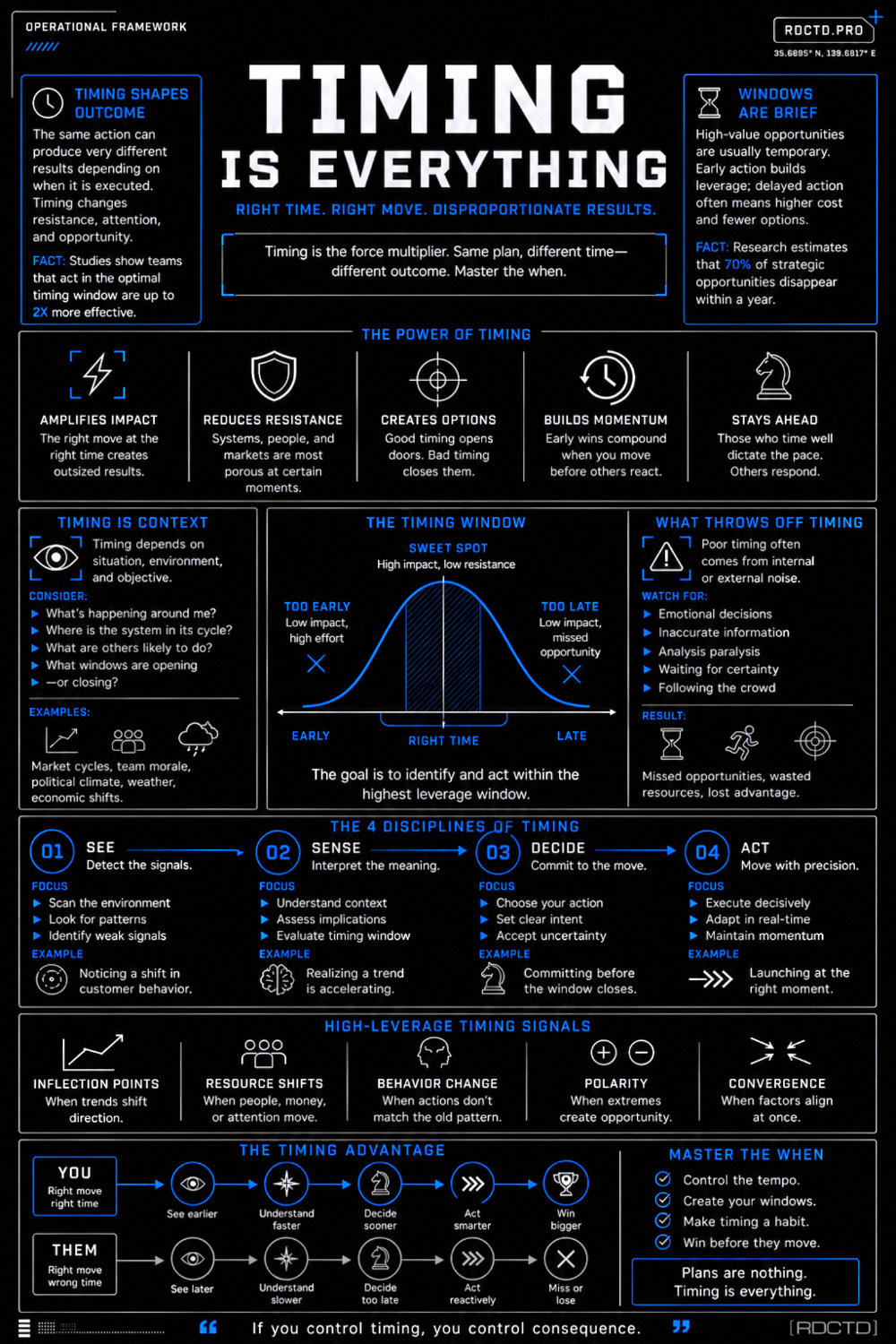
Even the objective is often assigned – what remains controllable is the window. This is the ability to shift the equation in your favor by moving when alignment breaks and resistance drops. Timing enables you to convert obstruction into opportunity by entering the window where structures are out of sync.
A technically inferior move executed at the right moment can outperform a technically perfect move executed at the wrong moment because the right moment reduces your restraints while compressing the adversary’s reaction time. That’s why timing is everything – it’s leverage applied to reality.
Separate signal from tempo. Fast environments are not always urgent; slow environments are not always stable – measure structural change instead of surface speed.
[ STATES ]

Timing is control over cycles – yours, theirs, and the environment’s. Every system has rhythms: human circadian lows, patrol patterns, meeting cadences, maintenance intervals, peak and off-peak traffic, alertness curves, and latency in communication chains.
If you act inside the gap between “stimulus detected” and “response organized,” you’re operating in the reaction lag, where your action is effectively unopposed. It’s the narrow interval where awareness exists but coordinated resistance has not yet formed. In that brief delay, structure exists but cohesion does not.
This is tradecraft at its most fundamental. It’s not defeating capability, but invalidating readiness. Readiness is always time-bound. Even highly skilled people can’t instantly reconfigure posture, focus, and coordination. Timing exploits that reconfiguration delay – and it compounds it by forcing rushed decisions, partial information, and sloppy handoffs up and down the chain.
Speed is almost always vital but the key is to move when the other side is between states – transitioning shifts, switching tasks, or reorienting attention. In that in-between phase, their sensors are noisy, their coordination is brittle, and their command-and-control is slow to synchronize.
When you consistently hit those transition seams, you don’t need superior force – it calls for clean execution inside a narrow window, again and again.
Maintain optionality until the last responsible moment. The more branches you preserve, the more precisely you can enter when conditions clarify.
[ INITIATIVE ]

Tactically, timing beats strength because it decides initiative. Strength is an attribute; initiative is a condition created in time. The operator who moves first inside a viable window dictates pace, framing, and sequence.
That control forces others into reaction, narrower than action. It compresses their decision space while expanding yours, forcing them to respond within constraints you initiated rather than conditions they prepared for.
If you’re early, you shape the field. You choose angles, set conditions, pre-position resources, and force others to operate inside your tempo rather than their preferred plan. You define what gets decided first and what gets delayed. That sequencing advantage compounds – small positional gains accumulate before anyone else fully registers the shift.
If you’re late, you inherit constraints instead of options. Doors close, bandwidth shrinks, narratives solidify, and resources are already committed along lines you didn’t choose. Late action means negotiating with established momentum instead of directing it. It forces you to operate within boundaries set by others rather than shaping them yourself.
The same action / same skill / same tools can be decisive or irrelevant depending on whether it lands before or after critical thresholds: before the crowd arrives, before the decision memo is signed, before the device is disarmed, before attention resets, before the opponent’s team synchronizes.
Once those thresholds pass, the operational geometry changes. Timing determines whether you enter a fluid environment or a locked one.
Calibrate against recovery and action time. The ideal window is when the other side can’t fully reset before your next move.
[ PRECISION ]

Strategic timing goes beyond simply being early or avoiding being late. Moving too soon can expose intent, trigger resistance, or force you to sustain pressure.
Moving too late means operating inside someone else’s established structure, where options have already narrowed. The objective is neither haste nor delay – it’s precision – entering before consolidation, when influence is still fluid and outcomes are not yet locked.
The operative advantage comes from being “right on time” or “just in time.” Entering at the moment when alignment is optimal and resistance is minimal. That moment often exists at the intersection of readiness on your side and vulnerability or transition on theirs. It’s the point where preparation has matured, intel has stabilized, and the environment hasn’t hardened. Arriving before that point wastes leverage; arriving after it forfeits leverage.
Being “just in time” is synchronizing capability with opportunity. It requires observation, patience, and the restraint to wait through incomplete setups. The ideal window is often brief and subtle. It opens when fatigue peaks, when attention drifts, when approvals are pending but not finalized, when narratives are forming but not fixed. Precision timing means recognizing that micro-window and committing without hesitation.
That’s why timing is everything. It’s not a factor of speed, it’s matter of synchronization. The right action, executed at the exact optimal moment, multiplies effect without increasing effort. In operations and in life, the highest leverage comes from doing it at precisely the right time.
Train decisiveness under incomplete information. Timing degrades when you require excessive certainty; establish minimum viable clarity before acting.
[ FORCE MULTIPLIER ]

Timing is a skill in its own – the ability to recognize windows, sequencing action, and committing at the exact moment when conditions favor you.
It requires pattern recognition, restraint, situational awareness, and the judgment to distinguish noise from true opportunity. You can train it, refine it, and apply it deliberately, just like any other capability.
However, timing operates above individual skills because it governs when and how those skills are expressed. Technical ability, strength, intelligence, and preparation only matter to the extent that they can be deployed under workable (or most optimal, advantageous) conditions.
If you act at the wrong moment, even high competence is throttled by resistance, distraction, and compressed reaction cycles. When you act at the right moment, average capability can outperform superior talent because the environment is aligned rather than opposed.
In that sense, timing is both a standalone competence and a multiplier of every other competence. It doesn’t replace skill, but it determines the return on skill. Mastery in operations is not just about what you can do, it’s about knowing when the system will let you do it with maximum effect.
Protect your own timing by controlling fatigue. Precision erodes under sleep debt and cognitive overload; degraded awareness leads to premature or delayed execution.
[ PRACTICAL ]

In problem solving and everyday life, timing determines whether you apply force blindly or guide outcomes with various levels of control. It decides whether resistance amplifies your effort or yields to it.
Cross the street too late, after a local street gang has already keyed in on you, and the movement confirms that you adjusted because of them. Cross too early and it reads as avoidance – an instinctive retreat that signals fear and marks you as reactive. But if you step off the curb at a natural transition point – at a light change, a break in traffic, a shift in pedestrian flow – it registers as ordinary behavior rather than evasive maneuvering. The timing preserves neutrality, and neutrality prevents you from being categorized as prey.
Say the right thing too early, before someone has fully revealed their position, and you risk exposing your leverage without gaining alignment. Say it too late – after their pride has publicly committed them to a stance – and your words collide with ego protection rather than logic. But if you speak at the moment when uncertainty is still present – before the room has emotionally solidified, while positions are forming but not defended – your input registers as constructive rather than confrontational. The timing preserves influence, and influence prevents your message from being framed as a threat.
Timing is everything because all outcomes are path-dependent. Once a system commits (emotionally, financially, procedurally) it becomes progressively more expensive to reverse. Decisions create momentum, and momentum creates inertia. The longer a direction is reinforced, the more psychological and institutional weight it carries.
Establish a “go / no-go” clock tied to external events, not internal emotion. When the trigger hits, execute automatically – don’t reopen debate.
[ METHODOLOGY ]

“Time” in general may be an abstract philosophy but “timing” specifically is not. It’s applied control over when force, influence, or effort enters a system.
In covert operations, the difference between friction and flow is often measured in minutes or seconds. Most failures are not failures of capability; they’re failures of synchronization. If you treat timing as a trainable skill rather than luck, you gain leverage without increasing effort.
To harness timing as a skill, approach it methodically:
I. Think in Windows

II. Identify Triggers
III. Map Cycles
IV. Pre-Stage Readiness
V. Control Tempo
VI. Hierarchy

It’s positioning yourself at the seam between instability and commitment. The quiet advantage that makes modest capability decisive and superior capability irrelevant. Mastery is not constant motion, it’s calibrated entry.
Track decision latency in key individuals. Some respond instantly under pressure, others stall; aligning your action with their predictable delay creates asymmetry.
[ FINAL ]
Timing is a form of judgment under uncertainty. It reflects how well you read movement before it becomes obvious, how patiently you hold position before you commit, and how cleanly you act once you decide. Most people chase better tools or greater force. Those who understand that timing is everything, refine their sense of when the environment is quietly yielding.
The advantage goes to the one who recognizes that decisive moments rarely announce themselves – they have to be detected, chosen, and used.
+ Helicopter EDC // gear shop »»
// If you control timing, you control consequence.
[INFO : Cold & Calculating Method]
[OPTICS : Undisclosed, Syria]