![[RDCTD]](https://rdctd.pro/wp-content/uploads/RDCTD-Covert-Operative-Tradecraft-Guide-LOGO-tk.png)
![[RDCTD]](https://rdctd.pro/wp-content/uploads/RDCTD-Covert-Operative-Tradecraft-Guide-LOGO-mobile.png)


 The tradecraft practice of monitoring, diagnosing, and regulating your own mental state as a covert operative applies the same to assessing a target – being your own psychologist when no other option exists.
Self-psychology is the strategic conversation between who you are, who you think you are, and who remains when both are questioned while perception and reality collide.
There’s no clinician waiting at the safe house. An operative under non-official cover can’t book a therapist, confide in a colleague and afford the paper trail either would create. The psychological load of sustained deception, isolation and threat exposure still materializes eventually.
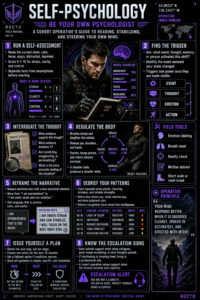
That leaves one qualified professional on site – you. Self-psychology tradecraft turns the assessment skills you already run on targets inward, so the operative maintaining the cover is as monitored as the cover itself.
The method runs the same intelligence cycle you’d run against any subject: collect, analyze, act, review. You collect data on your own states, analyze the reporting for accuracy and distortion, intervene with proven regulation techniques, and then audit the results.
None of it requires belief or introspection talent. It’s just a protocol – a fixed procedure you execute whether or not you feel like it, the same way you’d default to training under fire. This isn’t therapy replacement for the broken, it’s preventive maintenance for the functional – the same reasoning that puts a weapon through inspection before it fails, applied to the one asset that runs every operation you’ll ever touch.
Maintaining your own psychology gains a second-order edge: everything learned managing your own states sharpens your read on everyone else’s.
Avoid evaluating your mental state while physiologically activated – first lower the activation, then assess the reporting.
[ BASELINE SELF-MAPPING ]
Deviation detection only works against a known baseline – that’s true of an enemy and yourself. Before you can diagnose anything, you need a documented picture of your own normal: sleep duration and quality, resting irritability, decision speed, appetite, social tolerance and physical output.
Most operatives can recite a HUMINT asset or enemy target’s pattern of life in detail and have never once written down their own.
Daily Marker Selection
Select four to six markers and log them daily in shorthand. Use indicators that can be tracked quickly, compared, and measured over time:
- Sleep Duration
- First-Hour Mood on a 1–5 Scale
- Decision Friction
- Patience Threshold
- Motivation to Initiate Routine Tasks
- One Physical Indicator (resting heart rate, appetite, or muscle tension)
Together, these markers create a reliable baseline for most operatives. Don’t confuse this with journaling, the objective is a compact stream of measurable observations that can be reviewed without interpretation or emotion. A complete daily entry should take less than a minute.
Weekly Deviation Review
Review the log weekly for two-marker deviations:
- One marker drifting is usually environmental noise.
- Two markers shifting together within the same week deserve attention.
- Three markers moving together justify immediate investigation before judgment, timing, and emotional control begin to deteriorate.
View these patterns the same way as changes in a target’s surveillance tracking. Isolated anomalies rarely justify action. Multiple independent indicators moving in the same direction usually signal an underlying change.
The payoff is early warning. Degradation in judgment, awareness, and impulse control shows up in the markers days before it shows up in your decisions.
Catching the shift at the marker level costs a log entry, missing it can cost an operation. That is the operational value of baseline work: it turns vague self-awareness into an early-warning system.
Keep the log in shorthand only you can parse – a clean-reading psychological record on your person is a counterintelligence gift.
Build a personal “psychological signature” by identifying the first subtle behavior that reliably appears before every significant cognitive decline.
[ AFFECT LABELING ]
Putting a precise name on an emotional state measurably reduces amygdala activation and increases prefrontal control. This is affect labeling, the fMRI research is some of the most replicated in emotion regulation.
Emotions as Tactical Alerts
Handle emotional states as field indicators: incoming data that requires identification before it requires action. A feeling is not an order, it’s raw reporting that still needs source-checking before it drives movement.
- An unnamed state runs you.
- A named state becomes reporting you can evaluate.
Precision Labeling
Use two-word labels with a modifier and a state. This format forces precision because the first word defines intensity or origin, while the second identifies the emotional state itself.
- Acute Frustration
- Anticipatory Dread
- Residual Resentment
- Defensive Pride
- Quiet Contempt
- Post-Success Overconfidence
Generic labels like “stressed” carry little diagnostic value and produce weak regulatory effect. A precise label gives the state a shape, a category, and a handling protocol.
Decision Rule
Label before deciding. Under load, the label buys the two-second gap between stimulus and response where the OODA loop actually gets to run.
- Name the state.
- Check what triggered it.
- Separate signal from impulse.
- Then decide.
Pleasant-State Check

This works where your cold / calculating method runs – negotiations, interrogations, family arguments. Precision naming converts emotional weather into actionable intel on the one subject you can’t recruit a source against.
When alone, label out loud – vocalization recruits more regulatory circuitry than silent naming and the effect is stronger.
Track recovery velocity rather than emotional intensity – faster return to baseline is a better measure of resilience than lower peak stress.
[ DISTANCED SELF-TALK ]
A psychologist’s advantage over a patient is distance – he’s outside the problem looking in. You can manufacture the same distance linguistically.
Referring to yourself by name or 3rd person during self-talk drops emotional reactivity and improves performance under stress, with almost no cognitive cost. It’s the cheapest regulation tool in the inventory. It pairs with body language neutralization when composure has to read from the outside too.
Assessment Voice
Assess yourself in the third person, using your name or callsign:
- “He’s rattled because the meet slipped.”
- “He’s compensating with speed.”
- “He needs a second confirmation before moving.”
This frame turns the operative from the subject of the crisis into its case officer. Distance improves judgment because the event becomes something to assess, not something to survive.
Command Voice
Instruct yourself in the second person:
- “You hold position.”
- “You wait for the second confirmation.”
- “You slow the tempo before the tempo owns you.”
Second-person language works best for immediate control. It gives the mind a straight order instead of another emotional report.
Debrief Voice
First person belongs in the after-action account, where ownership matters more than distance. The grammar sounds minor until a genuine spike hits. Under pressure, pronoun control becomes mental tradecraft.
It also transfers to output – operatives report faster recovery from stalled starts and interpersonal friction when the internal handler does the talking.
Build the distanced voice during calm periods with low-stakes reps – a voice you’ve never rehearsed won’t answer under real pressure.
Revisit your strongest convictions after a full sleep cycle – certainty degrades less reliably than accuracy under fatigue.
[ THE SELF-DEBRIEF ]
Every operation gets an after-action review. Your psychology deserves the same, on the same clock. Memory is a hostile editor – within a day it smooths the account, assigns neater motives and deletes the moment you nearly lost it.
Self-Debrief Purpose
The self-debrief captures raw reporting before memory rewrites the file. This is where self-knowledge actually accumulates.
Run it after any significant event:
- An Operational Act
- A Confrontation
- A Failure
- A Gut Alarm That Fired Without Obvious Cause
Four-Question Debrief
- What did I feel? Use the precise labels from your affect-labeling work.
- When did it start? Trace the state back to its first physical or situational marker.
- What triggered it? Separate the actual trigger from the convenient story built around it.
- What did it cost? Assess the damage in decision quality, timing, tells you may have leaked, or opportunities missed.
Debrief Standard
Put it on paper. Writing forces sequence, exposes gaps and produces a record your recall systems can’t quietly revise. Six weeks of debriefs gives you something no external psychologist gets on a first consult – longitudinal data on exactly one subject, in that subject’s own hand.
Debrief the wins with the same rigor as the failures – unexamined success calcifies into superstition, and superstition doesn’t replicate.
Separate identity from performance metrics – poor execution reflects a process failure before it reflects a character failure.
[ COGNITIVE AUDIT ]
Your thoughts are reporting from a single source with a known agenda – you’d never accept that from an asset without grading the source.
The cognitive audit applies intelligence-vetting standards to your own internal reporting. The target set is predictable:
- Catastrophizing – One bad indicator becomes total mission failure.
- Mind-Reading – Assigning motives without collection.
- Emotional Reasoning – feeling exposed gets mistaken for being exposed.
- Overgeneralization – One blown approach gets treated as proof the skill is gone.
Each distortion degrades judgment the same way bad intelligence degrades an operation.
Audit Sequence
Verdict Protocol
- A plausible claim may justify contingency planning.
- An uncorroborated claim gets watched but not obeyed.
- A fabricated claim gets discarded before it burns attention, timing, or composure.
Four distortions. One grading standard. One verdict per thought.
The audit doesn’t argue with the thought or suppress it – suppression rebounds, and the research on that is consistent. It refuses to task resources against unverified reporting, freeing capacity for threats that grade out as genuine. That is the same triage logic that drives strategy sequencing.
Audit recurring thoughts first – anything that returns three times in a week is a pattern requesting attention, and patterns are where distortions hide.
Deliberately expose yourself to boredom without stimulation – the thoughts that repeatedly surface often reveal unresolved priorities.
[ CONTROLLED EXPOSURE ]
A psychologist prescribes exposure therapy – you can run the field-expedient version on yourself. Stress inoculation is graduated, deliberate contact with stressors under conditions you control, so the regulation skills above get trained before an operation grades them.
Controlled Exposure Purpose
This is training as code that rewrites you. Each controlled exposure widens the arousal band where clear thinking still functions. That’s the mechanism behind every operative who seems prepared for anything.
Exposure Categories
- Physical Stressors – cold-water immersion, breath-hold work under a hard protocol, and training to genuine fatigue while executing a fine-motor task.
- Social Stressors – engineered friction, such as returning items without a receipt, negotiating where concession would be easier, or holding eye contact past comfort in crowded social terrain.
- Cognitive Stressors – hard time pressure on complex tasks, decision drills with incomplete information, and deliberate interruption mid-task with a forced clean restart.
Execution Standard
Run each exposure under control:
- Choose one stressor.
- Set the duration before starting.
- Define the stop condition.
- Track the emotional state during the exposure.
- Record recovery time afterward.
The target isn’t suffering for the sake of it, it’s to adapt under measured load. Raise pressure slowly enough that the nervous system learns capacity instead of rehearsing panic.
Operational Rule

During each exposure, run the full stack live – label the state, deploy the distanced voice, log the recovery time. Recovery time trending down across cycles is your objective progress metric, and it transfers directly to output: faster composure recovery means less time lost to every setback a working day throws at you.
Raise one variable per cycle – intensity, duration or unpredictability – and hold the other two constant, or you’re training panic instead of capacity.
Watch for sudden certainty after prolonged uncertainty – rapid cognitive closure often signals relief seeking rather than genuine understanding.
[ FINAL ]
You’re the only clinician guaranteed to be present at every crisis of your life and profession, so build the qualification. Baseline, label, distance, debrief, audit, inoculate – run the cycle as standing procedure. The operative doing the work stays as maintained as the tradecraft he carries.
// An operative who can’t read his own mind will misread everyone else’s.
+ Covert Operative Kit [ ] gear shop »»
[OPTICS : Undisclosed, Norway]