![[RDCTD]](https://rdctd.pro/wp-content/uploads/RDCTD-Covert-Operative-Tradecraft-Guide-LOGO-tk.png)
![[RDCTD]](https://rdctd.pro/wp-content/uploads/RDCTD-Covert-Operative-Tradecraft-Guide-LOGO-mobile.png)


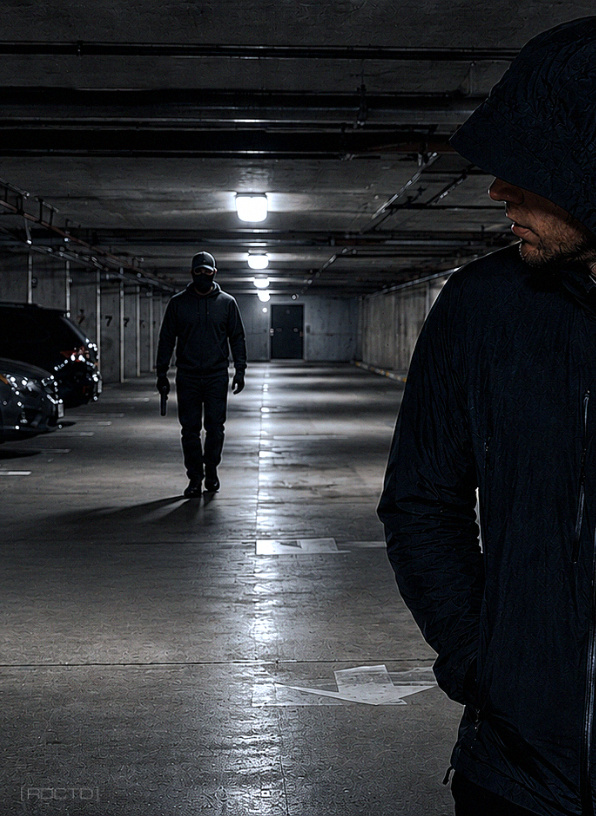 The operational skill of strategically controlling how you enter, move through, and exit transitional spaces – especially when your awareness and options are restricted by design or incident – for personal security.
The boundary between two environments is where your guard goes down and a potential assailant’s goes up. Close that gap and most of the threat closes with it.
A transitional space is any point where you move from one environment into another — a building entrance, lobby, elevator, stairwell, parking structure, the gap between a doorway and your vehicle, and so on.
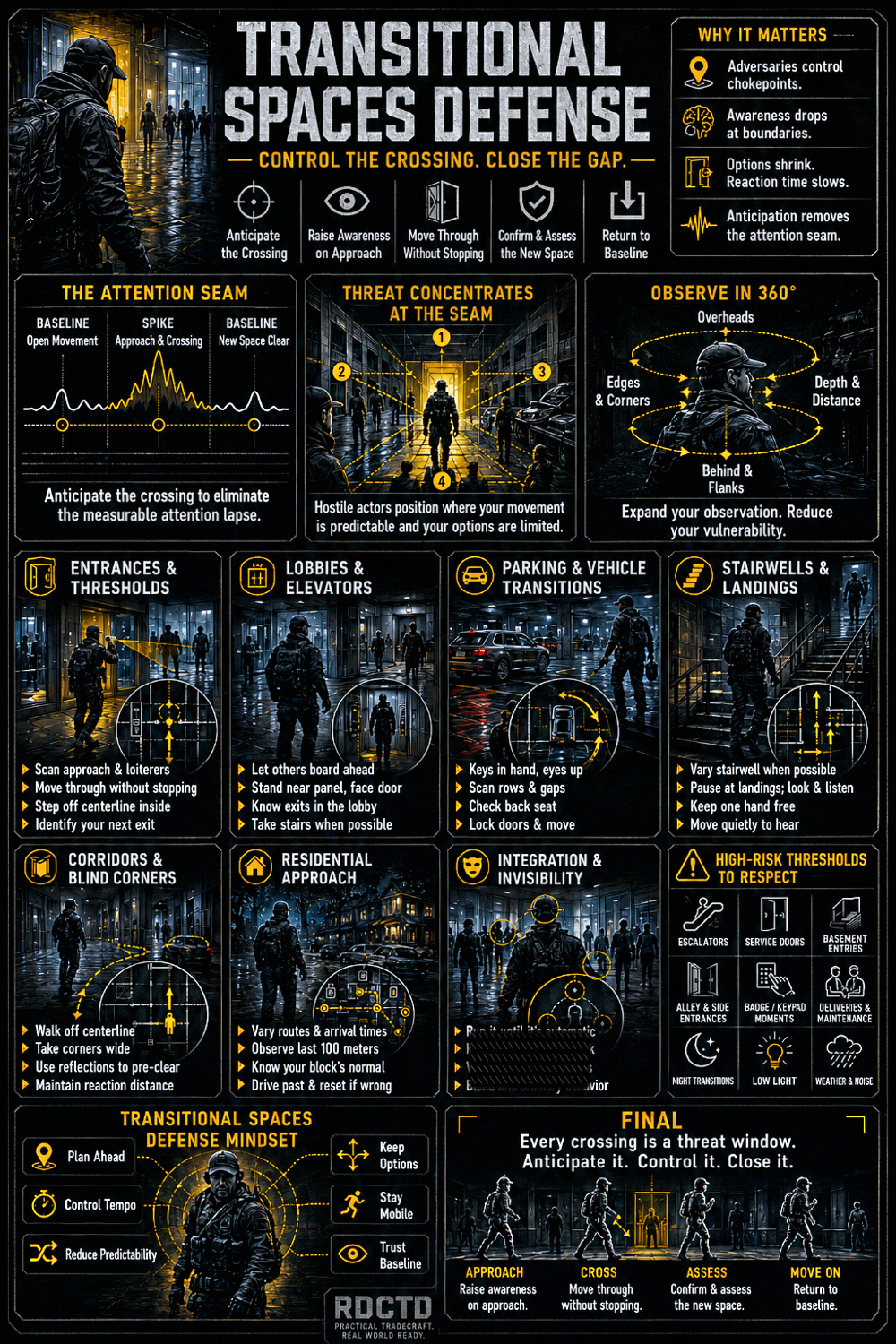
Hostile surveillance teams, fixed ambush positions, and opportunistic criminals all concentrate their effort at these chokepoints – these types of layouts favor whoever arrived first and the target’s attention reliably drops at the boundary.
// This is the tradecraft of managing each crossing as a discrete threat window and adapting your posture, tempo, and observation across it. //
These spaces draw aggression for reasons embedded in physics and human behavior. They funnel movement into narrow, predictable channels, which lets an adversary anticipate where you’ll be and when. They reduce your available exits, lighting tends to be poor, and concealment favors a waiting position.
There’s a measurable attention lapse at the boundary, the instant a person files one environment as finished and hasn’t yet engaged the next. Reaction time runs slowest in that seam. Everything in this protocol works to eliminate it by anticipating the crossing instead of stumbling into it.
Most hostile approaches inside structures happen from oblique angles rather than directly ahead – peripheral recognition is slower during movement transitions.
[ THE ATTENTION SEAM ]
The protocol uses controlled shifts in awareness rather than exhausting constant vigilance. A high state of situational awareness held all day burns you out and degrades within hours. You want a low, comfortable baseline during open movement, a deliberate spike as you approach each transition, and a return to baseline once the new environment reads clear. Anticipation is what removes the lapse. You’re engaging the next space before you’ve finished the last one, so the boundary never catches you flat.
Execution:

• The spike has to be selective to survive. An operative who tries to hold maximum alert across an entire day stops registering anything by noon. Spend the attention where the terrain earns it.
If someone repeatedly appears on the far side of multiple transitions ahead of you, view the pattern itself as intel even if each individual appearance looks innocent.
[ ENTRANCES AND THRESHOLDS ]
A doorway is a fatal funnel in close-protection terms – a point that channels you and fixes you in place for a moment. Crossing one indoors also cuts your sightline for a second or two while your eyes adjust to the interior light level, and stepping out of one frames you backlit against the opening. Both states are observable and exploitable. An adversary doesn’t need much time at a threshold because the space briefly strips you of mobility, concealment, and visual control all at once.
Execution:
• Never freeze in a doorway to read a phone or get your bearings. That’s the one place you’re channeled, lit, and predictable all at once. Get your orientation done on the far side.
Escalators expose your lower body movement and lock your direction of travel, so use the side panels and upper landing reflections to read who entered behind you.
[ LOBBIES & ELEVATORS ]
A lobby is a staging area an adversary can occupy with a legitimate reason to be there. An elevator is the worst case in the building: a sealed box with one exit, no maneuver room, and a forced proximity to whoever rides with you. You give up nearly every defensive option the moment the doors close. Even a minor problem inside an elevator escalates fast because there’s almost no room to create distance, break contact, or leave on your own terms.
Execution:
• Position near the panel buys you the doors and the alarm. If something develops, you can hold the car at the next floor and step out rather than ride to a destination someone else selected.
Watch for individuals who hold position without interacting with the environment around them; most legitimate occupants naturally anchor themselves to a task.
[ PARKING STRUCTURES & VEHICLE TRANSITIONS ]
Parking structures combine isolation, broken sightlines, and the universal vulnerability of a person fumbling with keys or a screen. The walk from the building to the vehicle and the seconds spent entering it are when most lot assaults initiate. A person settling into a parked car in an empty structure is easy to approach and box in. The vehicle only becomes an advantage once it’s moving – until then, it’s a fixed container with predictable doors and limited angles.
Execution:
• Park for egress on the way in. Nose-out, close to a ramp or exit, under a working light. The thirty seconds it costs at arrival buys you a clean departure when you may not have thirty seconds to spare.
Transitional spaces with competing noise sources force the brain to filter aggressively, which is why subtle anomalies often register first as instinct rather than conscious recognition.
[ STAIRWELLS & LANDINGS ]
A stairwell hands an adversary a position above or below you with a clean angle and an escape route you can’t see from where you stand. Sound carries in concrete shafts, which works for you and against you. Many stairwells double as service routes, so the foot traffic reads as normal even when it isn’t. The confined spacing also limits your ability to change direction quickly once contact develops.
Execution:
• The landing is your only natural pause point in a stairwell. Use it to gather information, not to rest. A predictable rhythm on the stairs tells anyone listening exactly when you’ll reach them.
Most people accelerate through uncertainty without realizing it, which is why abrupt pace changes near choke points deserve attention.
[ CORRIDORS & BLIND CORNERS ]
Interior corridors look benign and rarely get the attention they warrant. Walking the exact centerline makes your path perfectly predictable, and every blind corner hands an advantage to whoever’s waiting on the far side of it. Corners are where a developing problem becomes a contact at zero range. Long hallways also compress your options into forward or backward movement, which limits how quickly you can break line of sight once something turns hostile.
Execution:
• Cutting the corner wide costs you a few extra steps and gives you reaction distance. Hugging the inside edge saves the steps and surrenders the distance. The math favors the steps.
Transitional environments magnify fixation errors, which is why operators deliberately scan depth, edges, and overheads instead of locking onto the obvious path forward.
[ RESIDENTIAL APPROACH ]
The approach to your own residence is often the highest-value moment for anyone surveilling or targeting you. Your address is fixed, your arrival is patternable, and the final stretch to the door is where you’re most relaxed and most expected. Anyone who’s run pattern-of-life on you starts here. Most hostile surveillance operations eventually narrow down to the residence because every other movement pattern radiates outward from that anchor point.
Execution:
• You can only spot the anomaly if you’ve built the baseline. Spend a week consciously cataloguing what normal looks like on your street before you trust your instinct to flag what isn’t.
In mixed-use buildings, delivery personnel and maintenance workers gain near-universal access through familiarity bias, which makes impersonation harder to challenge in transitional areas.
[ INTEGRATION & INVISIBILITY ]
The protocol only works when it’s automatic to you and invisible to everyone else. Two failure modes end the value of it. The first is performing it – an operative who obviously sweeps every room and checks every back seat advertises training and draws the wrong attention. The second is letting the behavior harden into a fixed routine an observer can read, which rebuilds the exact predictability you’re working to remove. Good tradecraft blends into ordinary behavior so completely that nobody remembers seeing it happen.
Execution:

• The objective is a silent edge nobody sees. The moment your awareness becomes visible, you’ve traded a defensive advantage for a label, and the label invites exactly the attention you were avoiding.
Attention narrows during badge swipes, keypad entries, and phone unlocks because the brain temporarily prioritizes task completion over environmental processing.
[ FINAL ]
Transitional Spaces Defense is a way of reading the built environment that turns the places designed to slow you down into areas you’ve accounted for. The threat concentrates at the seam, so you close it. Trained until it runs on its own, it gives you a measurable head start at every crossing.
// Most people look for danger inside the room, trained operators study the approach to it.

+ Covert Operative Kit [ ] gear shop »»
[TAG : Transitional Space]