![[RDCTD]](https://rdctd.pro/wp-content/uploads/RDCTD-Covert-Operative-Tradecraft-Guide-LOGO-tk.png)
![[RDCTD]](https://rdctd.pro/wp-content/uploads/RDCTD-Covert-Operative-Tradecraft-Guide-LOGO-mobile.png)

 To be prepared for anything is the tradecraft of building cognitive readiness that doesn’t depend on predicting the event — the trained capacity to register reality fast, recalibrate, and act under load.
Readiness begins where the need for certainty ends.
You can’t anticipate every contingency. The variables run too high – a compromised meet, a tail you didn’t spot, a source who turns, a border guard who pulls you into secondary. What you can train is the underlying state that lets you function when the situation deviates from plan.
This is psychological flexibility paired with acceptance: the ability to take in new information, recalibrate, and move while the picture’s still changing around you. The objective’s never to memorize responses to a hundred scenarios, but to condition the operating system that runs all of them, so the unexpected is a familiar category.
// Most failures under pressure trace to one place – the gap between when reality changes and when the operative accepts it. Untrained, that gap stretches – disbelief, bargaining, the quiet refusal to let go of the plan you walked in with. Trained, it collapses to near zero. //
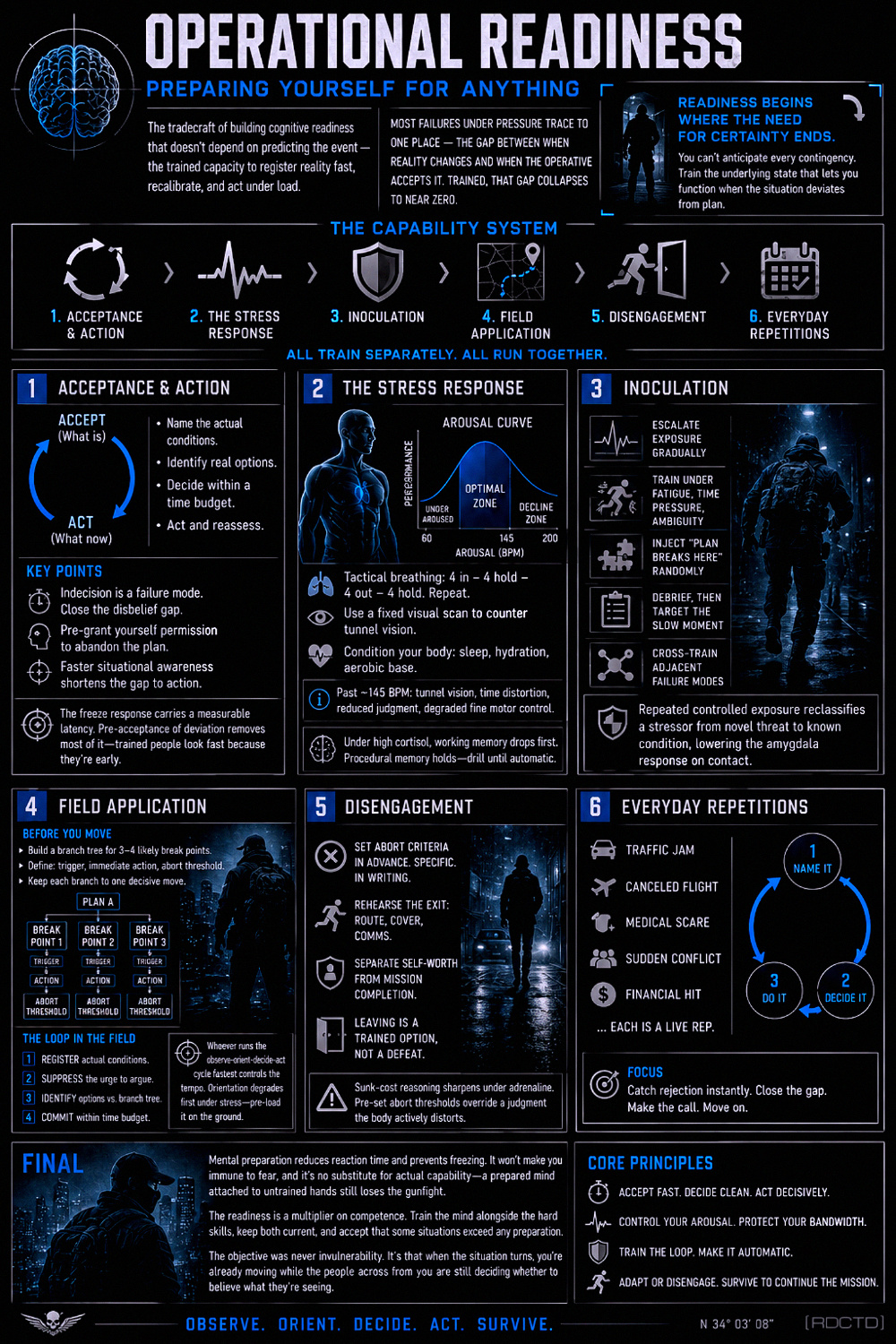
Capability is broken up into its working parts – the acceptance-action loop, the physiology of arousal, inoculation through exposure, field execution, the discipline of disengagement, and the daily repetitions that keep all of it current. Each part trains separately and runs together.

The prepared mind doesn’t fear change in conditions because change was built into the plan from the beginning.
[ ACCEPTANCE & ACTION ]
The capability rests on two linked components. The first is acceptance: the immediate, unemotional registration that the situation is what it is, not what you wanted or expected. The second is decisive action inside that acceptance: once you’ve read the actual conditions, you commit to the best available course, whether that means engaging or breaking contact.
They depend on each other. Acceptance with no action becomes paralysis with false calm. Action with no acceptance becomes momentum pointed at the wrong problem. Both halves get trained, because under real duress only the trained half shows up.
Run the loop deliberately in low-stakes moments so it’s available in high-stakes ones. When something deviates, name the actual conditions to yourself in plain terms – not the conditions you planned for, the ones in front of you. That naming step forces the registration and shortens the disbelief window. From there, identify your real options and pick one inside a fixed time budget, to stop you orbiting the decision while the situation degrades.
Tie this to your situational awareness baseline – the faster you read a room or a street, the earlier the acceptance step can fire, and the more time you buy for the action step. View indecision as its own failure mode and train against it.
• The operatives who freeze rarely lack a plan 0, it’s that they don’t have “permission” to abandon the one that just stopped working. Pre-grant yourself that permission before you ever step off.
The freeze response carries a measurable latency between stimulus and movement. Pre-acceptance of deviation removes most of it, which is why trained people look fast when they’re really just early.
[ THE STRESS RESPONSE ]
Mental preparation is partly a physiology problem. Acute stress dumps adrenaline and cortisol, narrows your visual field, degrades fine motor control, and impairs the prefrontal functions you need for judgment.
Past roughly 145 beats per minute, complex motor skill and rational processing fall off sharply, and you get tunnel vision and time distortion. The trained operative keeps arousal in the band where performance peaks instead of letting it spike into that critical zone. The stress response remains a permanent part of your physiology, so the objective is to regulate its intensity and keep it within the range where performance, judgment, and decision-making remain effective.
Tactical breathing is the primary lever: four counts in, hold four, four out, hold four, repeated until your heart rate settles. Handle it as an intentional intervention on your autonomic state (not a relaxation exercise) — it buys back the cognitive bandwidth stress strips out. Drill it until it runs without conscious attention, because under real duress you won’t have spare attention to allocate to it.
Pair it with a fixed visual scan to counter tunnel vision – break fixation and sweep your peripheral field on a set cadence, since the narrowing happens whether you notice it or not. Build the habit of one slow exhale at the moment you register a problem. That single breath often covers the exact window where untrained people lock up.
Condition your body alongside it – sleep, hydration, and aerobic base all raise the arousal ceiling you can operate under before performance breaks.
• Run your breathing drill cold, in a parking lot or a stairwell, not just in calm settings – you want the technique anchored to ordinary environments so it surfaces on its own when one of them turns hostile.
Under high cortisol, working memory drops first. Sequences stored in procedural memory hold up far better, which is the argument for drilling responses until they leave conscious control.
[ INOCULATION ]
Visualization alone won’t build this. You need stress inoculation – controlled, escalating exposure that teaches your nervous system the conditions until it stops filing them as novel threats. The brain logs repeated exposures as familiar, which lowers the threat response on contact.
This is why realistic training outranks classroom hours by a wide margin. The unexpected becomes a known category only after you’ve met enough versions of it under load.
Rehearse under fatigue, time pressure, and ambiguity – beyond clean repetitions in good conditions, which build false confidence. Configure scenario work so the plan deliberately breaks mid-execution – the meet site goes hot, comms drop, the contact doesn’t show, the route’s closed. The training value sits in forcing you to adapt rather than complete a script you’ve already memorized. Escalate gradually so the exposures stay productive instead of overwhelming; an inoculation dose that spikes panic teaches the wrong lesson.
Debrief every run for the specific moment your decision-making slowed, then target that moment in the next iteration. Cross-train the failure modes from adjacent skills – surveillance detection gone wrong, a blown cover story, a workaround that has to be improvised on the spot — so your adaptation reflex generalizes instead of staying bolted to one scenario type.
• Build a “plan breaks here” injection into every rehearsal as standard practice, randomized so you can’t pre-position for it. The goal’s a nervous system that handles disruption as the expected texture of an operation.
Repeated controlled exposure reclassifies a stressor from novel threat to known condition. The amygdala response on contact measurably drops once the brain has filed enough prior encounters.
[ FIELD APPLICATION ]
In the field the application turns concrete. Before any operation you war-game the failure modes – what you do if the meet site’s surveilled, if your cover gets questioned, if comms go down, if you’re detained.
You don’t memorize these as fixed responses but use them to map decision points and rehearse the act of choosing under load. When the unplanned hits, the trained sequence runs on its own.


• Write your abort thresholds before the adrenaline’s in your system. Deciding when to quit is far cleaner at a desk than it is mid-operation, when sunk cost and arousal both push you to stay.
Train yourself to recognize when the objective remains valid but the method no longer is. The faster that distinction is made, the less time gets wasted defending a failing approach.
[ DISENGAGEMENT ]
Disengagement earns its own section because the prepared mind manages it as a legitimate outcome. Ego’s a liability here. The operative who can’t accept breaking contact, abandoning a meet, or aborting a mission will push into compromise to protect their self-image – that’s a failure mode pretending to be committed.
Mental preparation means pre-deciding that survival and the long-term objective outrank any single operation. You rehearse walking away with the same care you give to engaging.
Set the abort criteria in advance, in writing, and make them specific enough that you’ll recognize the moment when it arrives. Vague intentions to “leave if it gets bad” fail under sunk-cost reasoning, which intensifies under adrenaline exactly when withdrawal’s the correct call. Rehearse the disengagement physically – the route out, the cover for action that explains your departure, the comms you send and the ones you don’t.
Practice it until leaving feels like a trained option rather than an admission, because the hesitation that burns operatives comes from improvising the decision to quit while the clock’s running. Separate your self-worth from mission completion as a standing habit. An operative whose identity rides on every op finishing will rationalize staying past the point of recovery.
The asset’s still there next month. You being free and unblown is what makes that possible.
• The cleanest exits are decided in advance and executed without internal debate – by the time you’re weighing whether to abort, the conditions that should’ve triggered it have usually already passed.
Sunk-cost reasoning sharpens under adrenaline, pushing toward commitment at the precise moment withdrawal’s correct. Pre-set abort thresholds exist to override a judgment the body’s actively distorting.
[ EVERYDAY REPETITIONS ]
You don’t get field-level stressors daily, so build the capability on the smaller disruptions that do show up – a canceled flight, a medical scare, a sudden conflict, a financial hit. Each one’s a live repetition in acceptance and recalibration.
The everyday application is the training ground that keeps the field version sharp, which runs on the same operating system under lower stakes. The field version isn’t a separate skill you switch into – it’s this same loop, running hotter.
Handle ordinary disruptions as drills, despite them feeling like annoyances. The instant something goes sideways, catch the moment you start rejecting the reality of it (the internal “this can’t be happening”) and deliberately close that gap. Name the actual situation, identify what the moment requires, and make the decision without the emotional detour.
Over enough repetitions this becomes your default response pattern, which is the entire objective: you want the loop wired in before the stakes are lethal. Keep your physical baseline up, because a depleted body produces a brittle mind, and your tactical mindset degrades fast when sleep and conditioning slip.
Log the disruptions where you handled the acceptance step poorly and treat them as after-action items, the same way you’d debrief an operation that nearly came apart.
• The civilian frustrations most people waste energy resenting are free reps – every traffic jam, delay, and bad-news phone call is a chance to drill the gap between event and acceptance down toward zero.
The response pattern you run on small disruptions is the one that surfaces under real threat. There’s no separate emergency self waiting in reserve – you get whatever you’ve rehearsed daily.
[ FINAL ]
Know the limits of this so you apply it honestly. Mental preparation reduces reaction time and prevents freezing. It won’t make you immune to fear, and it’s no substitute for actual capability – a prepared mind attached to untrained hands still loses the gunfight. The readiness is a multiplier on competence. Train the mind alongside the hard skills, keep both current, and accept that some situations exceed any preparation.
The objective was never invulnerability. It’s that when the situation turns, you’re already moving while the people across from you are still deciding whether to believe what they’re seeing.
// You can’t script the event, but you can condition the system that runs every event. That system is what keeps working when the plan stops.

+ Covert Operative Kit [ ] gear shop »»
[OPTICS : New York City]