![[RDCTD]](https://rdctd.pro/wp-content/uploads/RDCTD-Covert-Operative-Tradecraft-Guide-LOGO-tk.png)
![[RDCTD]](https://rdctd.pro/wp-content/uploads/RDCTD-Covert-Operative-Tradecraft-Guide-LOGO-mobile.png)

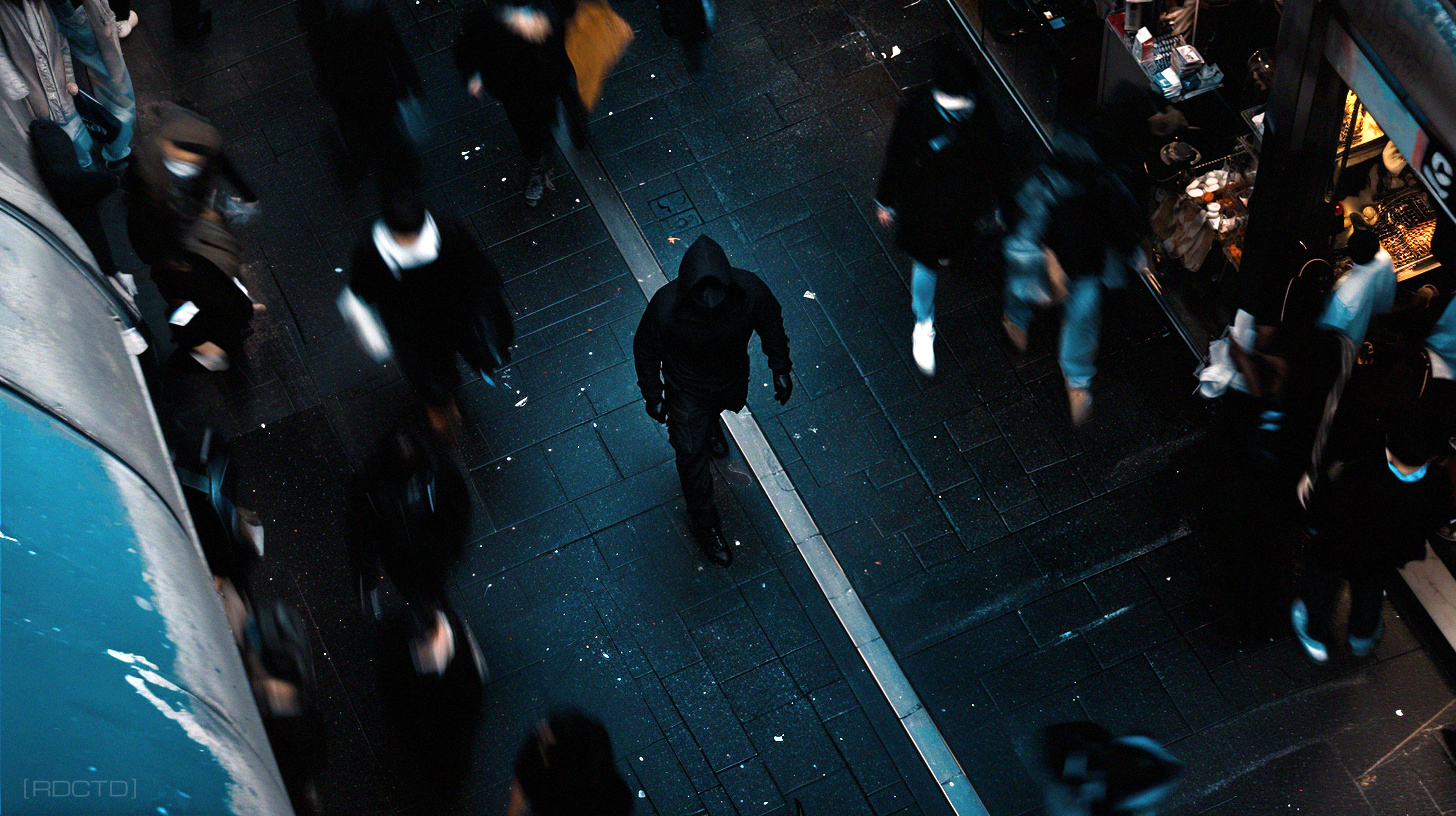
 Street-level situational awareness is the continuous processing of (urban) environmental data to establish baseline conditions, detect anomalies, and maintain decision advantage in any operational area.
Being street smart is seeing the setup before the outcome so you can set up for the outcome – or better adapt to it.
This is a cognitive posture to operate as a perceiving instrument rather than a passive occupant of any given city space / populated area. Most people move through their environment as tourists in their own lives and work, processing only what intrudes on their attention. The covert operative inverts this – as the one doing the looking, assigning meaning, and whose internal state determines what gets noticed and what gets discarded.
This mindset isn’t threat fixation or hypervigilance – both burn out the operator within hours and produce false positives that corrupt your judgment. What you’re developing is a sustained, low-amplitude engagement with reality, the mental equivalent of an idling engine. Cooper’s Yellow, held indefinitely, becomes a personality trait rather than a tactical state.
Prioritize hands and waistlines in your scan cycle – they resolve intent faster than facial expression or clothing.
[ MODELING ]
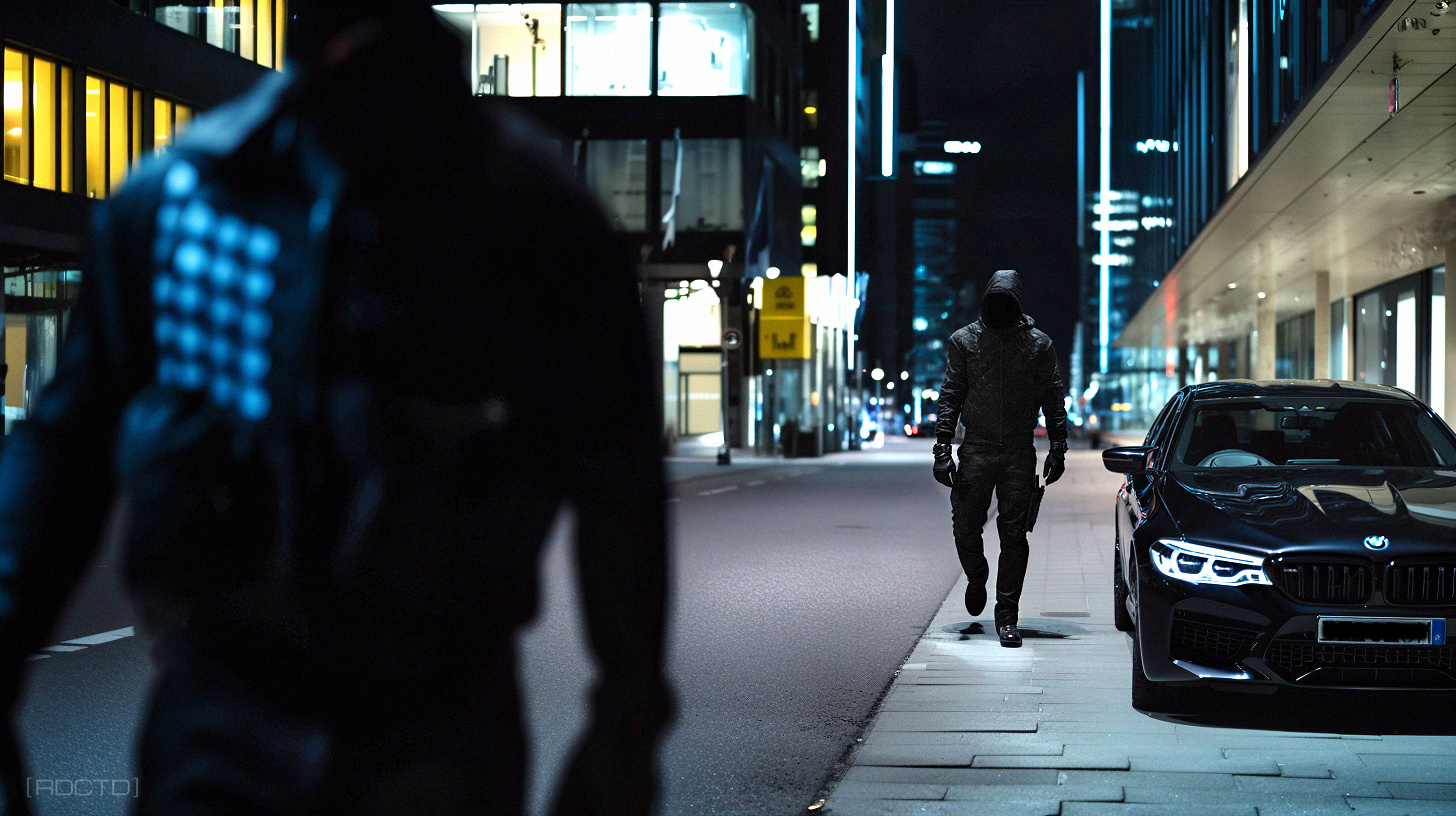
The technical foundation of this mindset is predictive cognition. Your brain is a prediction engine running continuous models of what should happen next. Awareness is the practice of consciously comparing predictions against observations.
When the model and the environment diverge, that gap is information.
Untrained people experience this gap as a vague unease and rationalize it away. The operative handles it as actionable signal. This means it goes beyond memorizing details to building and updating internal models of normal: the rhythm of a street, the social geometry of a café, the behavioral grammar of a transit hub. Once those models are running, anomalies surface on their own without conscious effort.
The cognitive load drops dramatically because you’ve offloaded perception to pattern recognition, which the human brain executes faster than deliberate analysis. This is why experienced operatives appear relaxed in environments where junior personnel look strained.
Their advantage comes from operating at a different layer of processing, where pattern recognition is doing more of the work than conscious effort.
Monitor pace irregularities, acceleration or deceleration outside local rhythm often precedes decision points.
[ AREA CONTROL ]
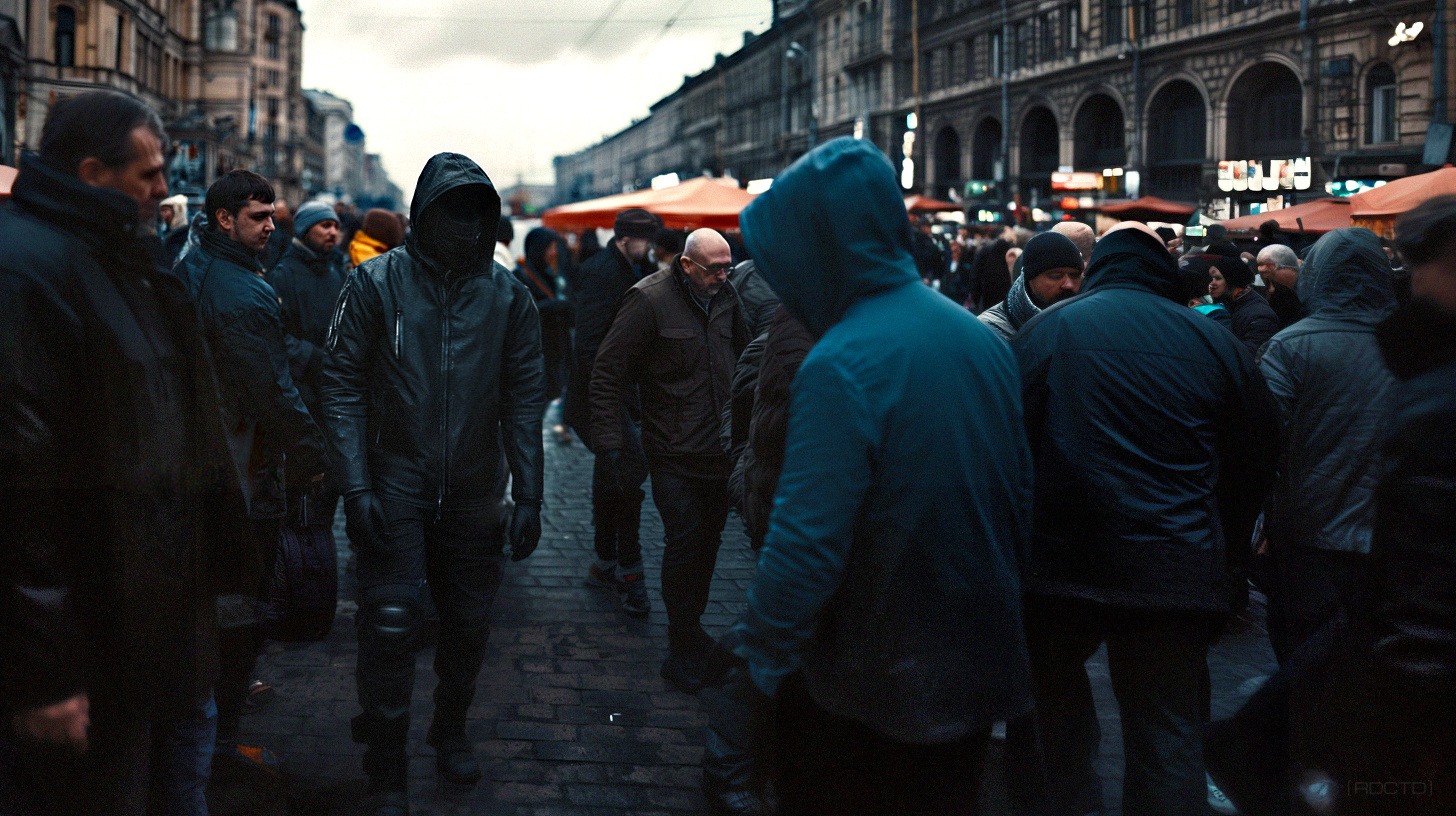
Environmental ownership is the psychological transition that turns awareness into an active process, assigning your attention a task rather than leaving it reactive to whatever surfaces.
When you enter a room, street, or situation, you mentally assign yourself responsibility for reading that space until you leave it – building a working map of exits, movement, rhythm, people, and anomalies.
That mental claim improves observation by giving your attention defined terrain. Instead of scanning randomly, you begin reading posture, direction, spacing, pace, hands, eye-line, and intent as connected data. The environment becomes a live system – your job is to notice when something moves outside its expected pattern.
This changes your physical signature as well. Focused awareness sharpens attention allocation and produces subtle changes in posture, movement, and orientation without requiring visible aggression. You appear less passive, distracted, and available to anyone screening for easy access.
Predators, criminals, and surveillance teams all look for the same thing: disengagement. They notice the person whose attention is elsewhere, body language is soft, route choices are automatic, and cognitive perimeter is undefended. Environmental ownership reduces that signature by making you harder to read and select.
The objective is to be observant without projecting it. You become situationally uninteresting to amateurs and readable as competent to professionals, both of which serve the operator.
Anchor your position relative to exits and hard cover so movement options remain precomputed, not improvised.
[ COGNITIVE STATE ]
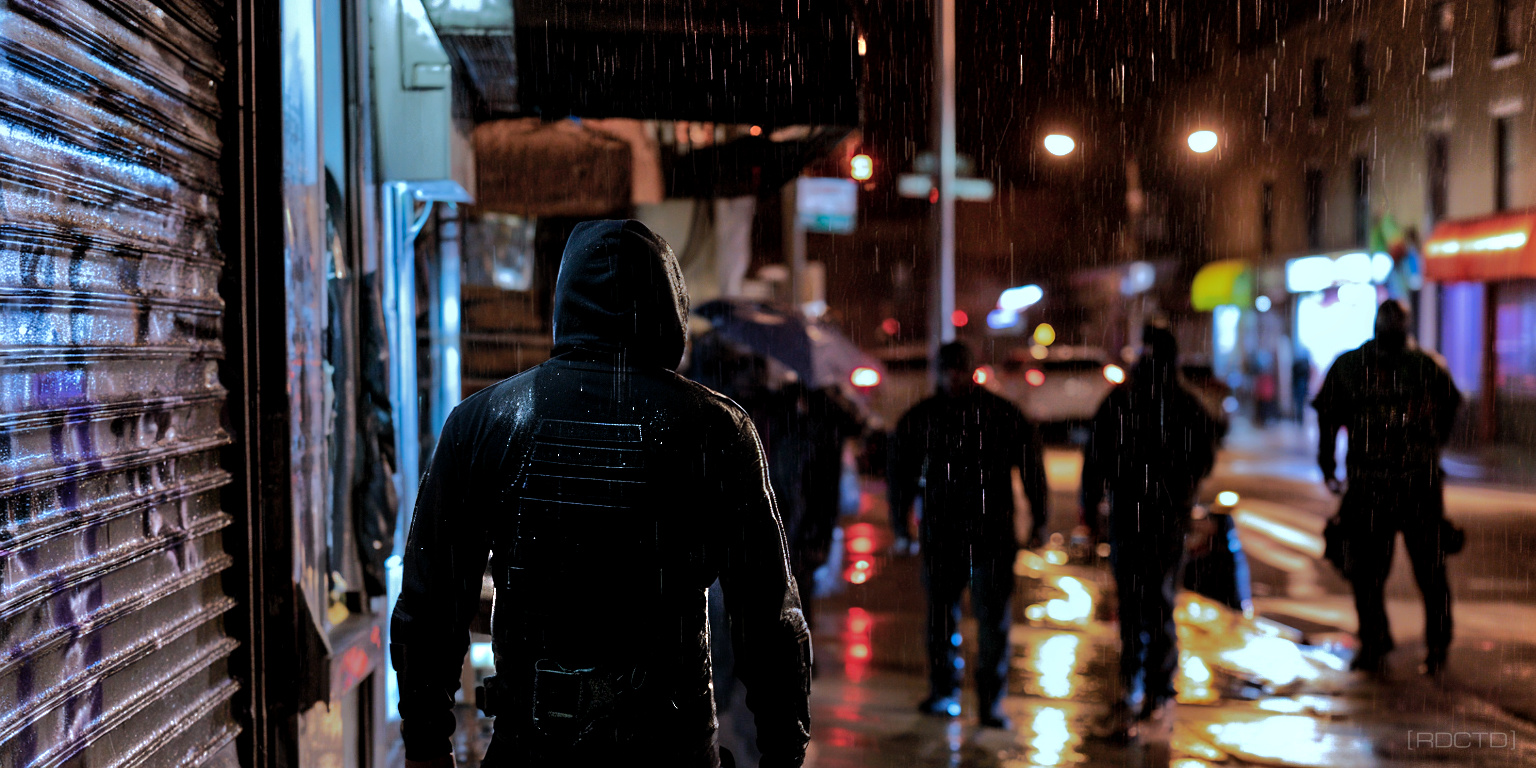
The most critical part of this tradecraft is managing your own internal readiness. Awareness degrades from the inside long before it’s defeated from the outside.
Fatigue, frustration, hunger, emotional residue from a difficult call, the afterglow of a successful meeting, anticipation of going home – all of these compress your perceptual field and slow your anomaly detection.
Adversaries who know what they’re doing time their approaches to your low points, when you seem to be operating below baseline. The mindset requirement is honest self-assessment in real time. You learn to ask yourself, with no ego in the answer, where you actually are on the awareness curve at this moment, and you adjust accordingly.
Sometimes that means delaying a movement by ten minutes to eat and reset, or accepting that you’re at sixty percent and tightening your operational margins to compensate. The operative who pretends he’s always at one hundred percent is the one who gets caught off baseline.
Scan for attention mismatches – individuals whose gaze does not align with their direction of travel. Detect “pre-event stillness,” where movement pauses unnaturally before a decisive action.
[ METHODOLOGY ]

Calibration against the environment is what keeps street awareness sustainable over years instead of days. You don’t run the same internal setting in every place, at every hour, under every condition.
A quiet Tuesday morning in suburban Long Island doesn’t require the same awareness posture as a Friday night in Caracas – and the most experienced operatives know how to scale perception without drama.
Read The Environment First

Scale Awareness to Actual Risk
Watch For Over-Tuning
Watch For Under-Tuning
Adjust For Social Density
Adjust For Operational Tempo
Protect Cover Requirements
Avoid Importing Yesterday’s Setting

Make Calibration Automatic
The standard is to read the environment, set the internal dial, then operate. Every place gets its own calibration. When performed optimally, this adjustment becomes so automatic that you stop noticing yourself doing it, but the environment still feels legible before trouble has time to form.
Segment the environment into sectors and cycle through them systematically to prevent fixation gaps.
[ FIDELITY ]

The deepest aspect of this mindset is accepting that awareness is a moral commitment to reality. Agreeing, as a matter of personal operational covenant, to see what’s actually there rather than what’s convenient, comfortable, or consistent with your assumptions.
That sounds abstract until you’re on a street and your gut’s telling you something’s wrong while your conscious mind’s generating reasons to dismiss it. The operative who survives that moment is the one who’s already decided, long before the moment arrived, that he’ll trust observation over narrative.
Train this by managing every environment as a live problem, even the ones that don’t matter. Run the models on your street, office building, or any parking lot. The point isn’t that those locations are dangerous but that the mindset has to be continuous. This is how awareness becomes reflexive over context-dependent, by rehearsing perception in everyday spaces so it remains available when the environment turns hostile.
The moment you partition awareness into operational and non-operational time, you’ve created a seam, which is where you fail. Tradecraft at this level is something you’ve become instead of a thing you’re doing.
Identify repeated proximity without interaction, recurrence without context is a higher-value signal than one-time anomalies.
[ FINAL ]
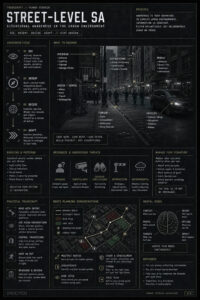 Street-level situational awareness, taken to its full extent, is a way of moving through the world with consistent clarity. The environment begins to present structure, signals, and early warnings that most people miss. When this becomes habitual, your margin for error increases without visible effort, and your decisions start happening earlier in the timeline.
That timing difference is where advantage resides – once internalized, it remains with you regardless of location, role, or pressure.
// Situational awareness is silent dominance over your environment.
+ Covert Operative Kit [ ] gear shop »»
[OPTICS : London, England]