![[RDCTD]](https://rdctd.pro/wp-content/uploads/RDCTD-Covert-Operative-Tradecraft-Guide-LOGO-tk.png)
![[RDCTD]](https://rdctd.pro/wp-content/uploads/RDCTD-Covert-Operative-Tradecraft-Guide-LOGO-mobile.png)


 An tradecraft framework that governs how a covert operative processes the environment, allocates attention, and converts perception into decisive action under pressure, uncertainty, and changing conditions.
The tactical mind does not (and can not) wait for certainty – it moves on probability, pattern, instinct, and timing.
The tactical mindset runs as a background process while you engage in a firefight, order coffee, run an SDR, or sit across from an asset. The seven elements in this protocol map to distinct cognitive and behavioral systems we rely on in the field. Each is a separate skill. Together they form a single operating system – degradation in one element degrades the rest.
Build a sensory baseline first, then audit deviations by channel – visual, auditory, spatial, behavioral, and timing-based.
[Situational awareness] is the input layer. Observe, Orient, Decide, Monitor – derived from Boyd’s OODA loop, with Monitor reinforcing the cyclical structure of the process. Observation has to be active scanning, with intent. You’re collecting baseline data: who’s present, what they’re doing, where options exist, what reads as anomalous against the established pattern.
Orientation is recognition against that baseline. Decision is triage – you weight what matters because you can’t act on everything at once. Monitor closes the loop and forces continuous reassessment. An operative who orients once and stops has already lost the contact. Static awareness creates blind spots – which is where surveillance, deception, and threat vectors take root.
Manage attention as a finite resource and assign it deliberately between near-field threats, mid-field movement, and far-field exits.
[Thinking in advantages] is the calculus of asymmetry. Information, position, timing – three levers that decide most engagements before physical contact occurs. Each one shifts the operating field before force is required. Control those variables, and the moment begins with leverage already built.
Information means knowing the terrain, the target, and the supporting elements better than they know you. Accurate information reduces uncertainty before movement ever begins and exposes vulnerabilities before they become visible to everyone else.
Position is geometry – angles of approach, cover, lines of sight, and control of egress. Superior positioning lets an operative shape the encounter before the other side fully understands the situation.
Timing’s the variable amateurs ignore; the right move at the wrong moment is a failed move. Timing determines whether information and position create leverage or collapse into wasted opportunity.
Stack any two of the variables and the probability curve tilts in your favor. With all three the opposing side’s decision space begins failing before action is initiated. Information identifies the exploitable asymmetry, position controls the geometry, and timing determines when pressure is applied. Synchronized, resistance becomes reactive, delayed, and easier to dominate.
Use micro-pauses to interrupt automatic reaction and force the brain back into assessment mode before commitment.
[Planning with flexibility] is your hedge against entropy. The PACE methodology — Primary, Alternate, Contingency, Emergency — exists because plans degrade on contact with reality. The protocol compresses this into three layers, which is operationally sound for solo movement. Every layer should have a trigger point – ambiguity wastes time when conditions deteriorate. What matters more than the routes themselves is the mental rehearsal.
You should execute the contingency without conscious processing because it takes seconds you might not have. The decision threshold should already be defined before pressure arrives. Rehearsal turns a backup plan into a conditioned response. Anticipate obstacles, adapt in real time, improvise with purpose, and overcome without hesitation. That sequence runs automatically when the primary plan dies.
Handle uncertainty as a data gap – then reduce it through observation, repositioning, delay, inquiry, or disengagement.
[Risk management is the triangle]: threat, capability, vulnerability. The value of the model is that it keeps fear from becoming the decision-maker. Each risk is broken down into observable parts, measured against the mission, and controlled before movement commits you to consequence.
Threat is what the environment can do to you. It includes people, terrain, timing, weather, surveillance, local pattern shifts, legal exposure, and anything else with the capacity to disrupt movement or compromise the mission. A threat doesn’t need intent to matter; a locked door, dead phone, crowded exit, or bad sightline can change the field just as fast as a hostile.
Capability is what you can do back. This includes training, tools, physical condition, communication access, mobility, mental control, and the quality of your planning. Capability is not just force or skill – it’s the practical range of actions still available when pressure arrives. The wider that range, the less dependent you become on perfect conditions.
Vulnerability is where you’re exposed regardless of capability. It may be a blind angle, a predictable route, a weak cover story, a visible routine, an unsecured device, or an emotional tell under stress. Vulnerability matters since strong capability can still fail through one unprotected opening. The objective is to identify those openings before the environment or the opposition does.
The triangle gives risk framework: threat defines pressure, capability defines response, and vulnerability defines exposure. Once those three points are visible, decisions become cleaner by measuring the field. You calculate it, accept what you can’t reduce, and control where it lives. Reducing exposure increases options, every action gets measured against this triangle first.
Separate readiness from aggression – readiness preserves options, while aggression often burns them too early.
[Execute] with intent. This is the conversion phase, where planning becomes behavior. Focus means task lock – you finish what you started before allowing distraction. Control is internal regulation – heart rate, breathing, micro-expressions, voice cadence. Half-measures are the most common cause of operative casualties – commit fully or hold position.


Follow-through extends past the action itself. You secure the egress, verify, and exit cleanly. Emotional noise inside the body broadcasts outside, and the quiet operative is the one still working tomorrow.
A tactical mindset is strongest when it can downgrade cleanly from action to observation without pride interfering.
[Operating in the gray] is the signature you leave behind – social and professional. The objective is controlled ambiguity – visible enough to belong, indistinct enough to resist recall. Blending requires environmental calibration – dress, gait, posture, language, and cadence of movement all matched to the surrounding population / working environment.
Pattern breaks make you predictable to surveillance teams, so vary your routes, timing, transport, and communication windows. Consistency is useful only when it supports the local pattern – outside that pattern, it becomes an indicator. Leave no trace covers physical and digital footprints alike – fingerprints, fibers, metadata, geolocation, transaction records.
Protecting the mission (and yourself) means ego stays out of the decision loop. A clean profile gives the opposition fewer handles to manipulate and take advantage of. Deny value by carrying nothing you can’t afford to lose. Be gone before the environment registers your presence.
Prioritize control of distance before control of dialogue – proximity changes the threat equation faster than words.
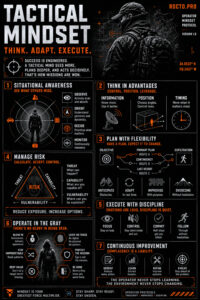 [Continuous improvement] is the maintenance cycle. Debrief honestly after every operation. Extract specific lessons, refine tradecraft, systems, cover, and gear. Evolve faster than the environment evolves around you. Complacency kills experienced operatives more often than inexperience kills new ones. Mindset’s the multiplier, which depreciates without maintenance.
// Instinct becomes reliable only after observation, repetition, and consequence have trained it.
+ Covert Operative Kit [ ] gear shop »»
[OPTICS : Tactical Mind Visualized]