![[RDCTD]](https://rdctd.pro/wp-content/uploads/RDCTD-Covert-Operative-Tradecraft-Guide-LOGO-tk.png)
![[RDCTD]](https://rdctd.pro/wp-content/uploads/RDCTD-Covert-Operative-Tradecraft-Guide-LOGO-mobile.png)

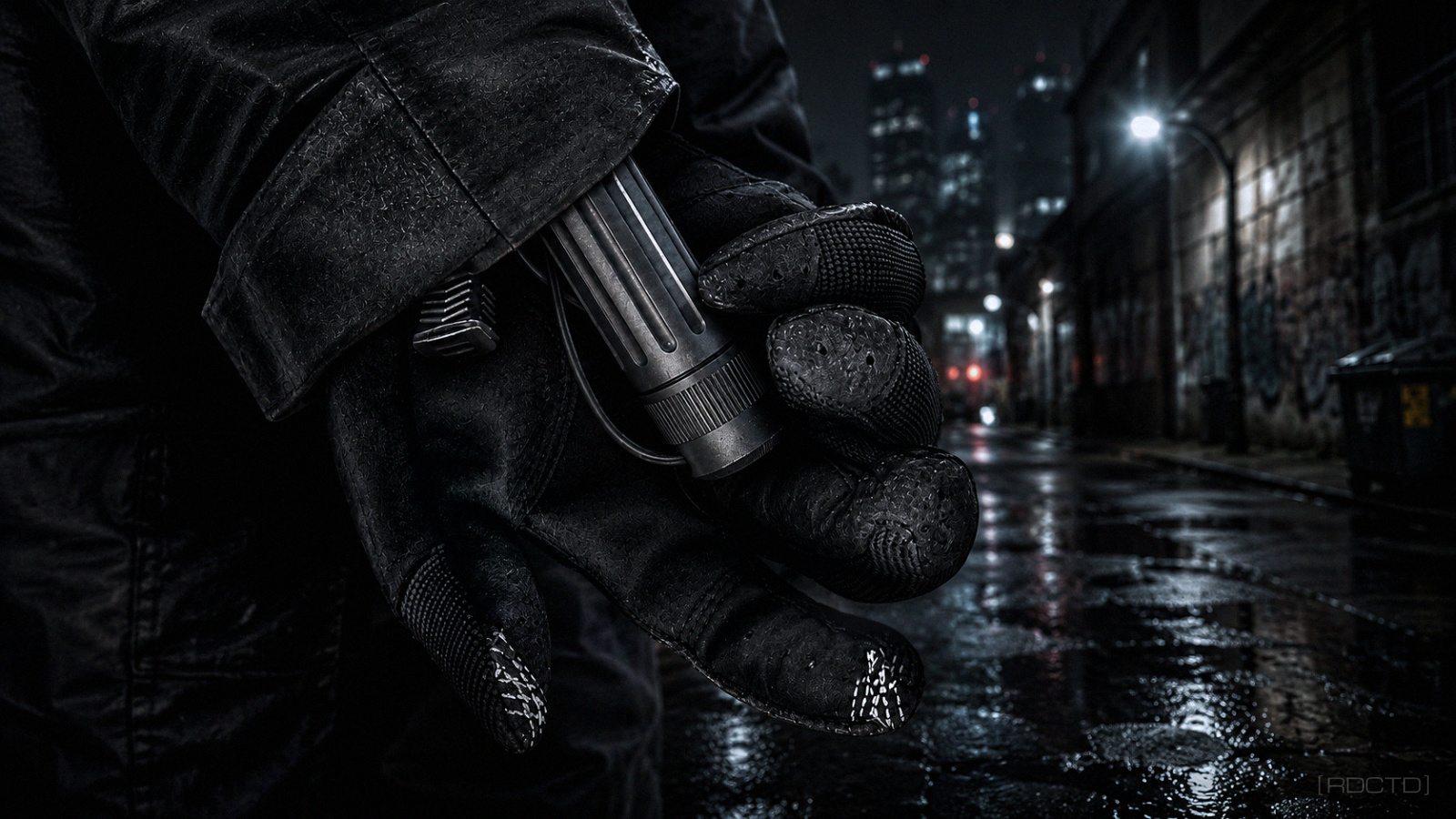
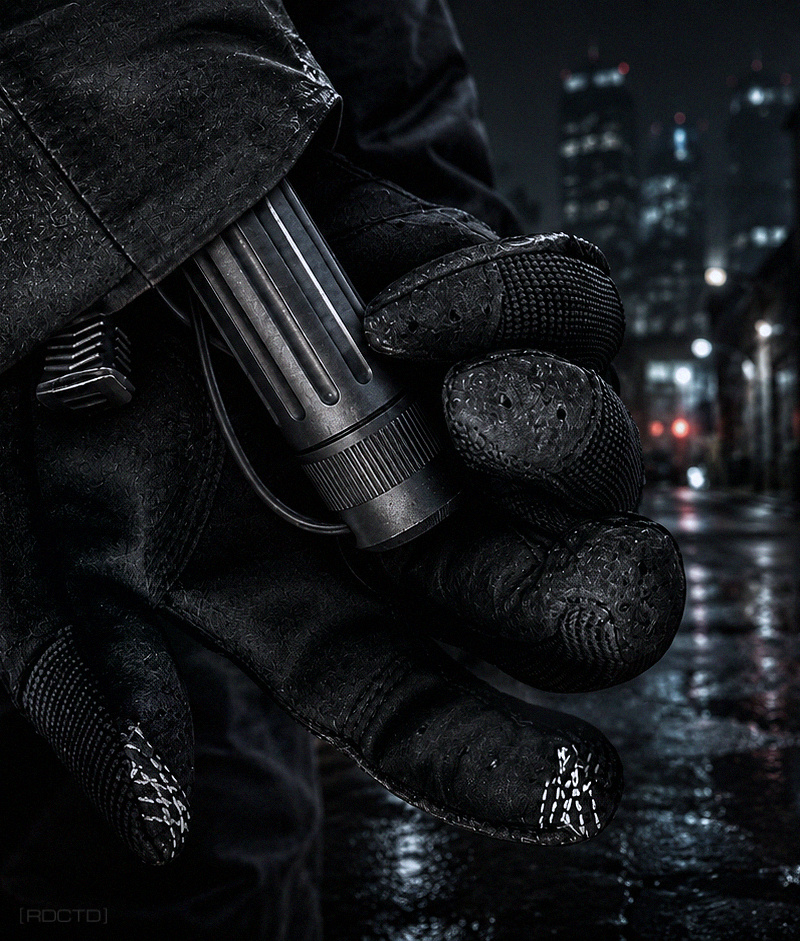 The tradecraft mindset of always having a trick up your sleeve is being able to engage any scenario (not exactly prepare for every specific scenario) – it’s retaining the capacity to build one on contact.
Operational improvisation for generating usable options to keep initiative when a plan fails. It’s the habit of reading an environment as a set of manipulable tools and assembling a tailored play on demand instead of only retrieving a memorized one.
[ THE ILLUSION OF BEING PREPARED ]
Why an accumulated catalog of methods keeps failing at the moment it’s needed.
Most operatives who wash out in the field aren’t necessarily undertrained, it’s that their training is built around the wrong model. They’ve spent years assembling a catalog – entry techniques, evasion patterns, elicitation scripts, weapon retention sequences – and they carry that catalog into the field as though the field will present problems in a format the catalog recognizes.
It rarely does. The ground offers something adjacent, something malformed, something that resembles three entries at once and matches none of them.
What happens next is worse than having no method at all. Under load, a mind holding a catalog will force the nearest match onto an incompatible problem – acting on a bad fit feels better than admitting the file is empty. That’s the failure mode you see in after-action reviews where the sequence was executed cleanly and the outcome was still a compromise. Nobody hesitated, everybody applied the wrong tool with total commitment.
Specific skills have a narrow window of relevance but most of them never open. The reflex that builds a solution on the spot opens constantly, in every environment, at every threat level, including the ones where nothing is happening. That’s the asymmetry worth understanding before anything else here makes sense. A catalog is inventory, improvisation is capability. They’re related, though only one of them keeps producing when conditions stop resembling the syllabus.
None of this argues against training breadth. A wider catalog feeds better raw material into the improvisation. An operative who’s drilled reaction speed, deception detection, and heuristic decision-making assembles faster and better than one who hasn’t. Keep learning, just understand what you’re building – the components, not the machine.
An operative’s skill inventory works optimally when he can construct inside any window the situation allows. Audit your training by asking which entries you’ve actually deployed in X amount of time, then ask what you did instead on the occasions that mattered.
Degraded Rehearsal // Run reps under sleep deficit, poor light, in bodily pain, and restricted mobility, since those are the conditions the option will actually meet.
[ THE WORLD AS OPEN INVENTORY ]
Why an accumulated catalog of methods keeps failing at the moment it’s needed.
There’s a perceptual change that happens to an operative at some point and it doesn’t reverse once it does. Rooms stop being rooms. A café becomes a set of sightlines, exits, sound-masking surfaces, objects with mass, people with predictable movement vectors, and a handful of thresholds where observation degrades. After a while it requires no effort. It presents itself with the room, the way weight registers the moment you pick up an object.
See everything around you as a potential tool, therefore the entire world as a giant box of tools. Scattered pieces of potential devices that can be put together despite how innocuous or irrelevant they may seem to each other.
The word that matters in that framing is scattered. Improvisation isn’t recognition of a tool sitting there labeled as one but the assembly of function from parts that carry no relationship to each other until you impose it. A door wedge, a delay device, a distraction, an improvised weapon, a plausible reason to be somewhere – most of these are combinations of things that individually mean nothing. Environmental weaponology works on this premise, and so does most of what an operative does that never involves violence at all.
What blocks this in people is “category thinking”. Objects come pre-labeled by function, and most minds accept the label as the limit. Breaking that habit is largely a matter of repetition – walking into ordinary spaces and forcing the inventory read until the labels stop dominating. It’s the same conditioning underneath awareness activation, taken past threat detection and into materials assessment.
Do this long enough and the environment becomes more than a place you happen to be in. It presents as a set of things you can act through, becoming the “tricks” up your “sleeve”. That’s a permanent change to how you occupy space, it’s the substrate everything else in this discipline sits on.
The operative who sees material where others see furniture is working from a larger problem space, which produces more options per unit of time. Run the inventory read in familiar environments first (your own residence, your regular routes) because familiarity is where perception quietly stops updating.
Reversibility Ranking // Order your set by what each costs if it’s wrong and spend the recoverable ones before the irreversible ones.
[ SPATIAL ARITHMETIC ]
Why an accumulated catalog of methods keeps failing at the moment it’s needed.
Improvisation gets mistaken for instinct because it happens fast. It’s computation. The operative is running distance, timing, mass, occlusion, and probability against a moving picture, while below the level of conscious narration. Nothing explicable is occurring, the processing has just been rehearsed until it longer needs language.
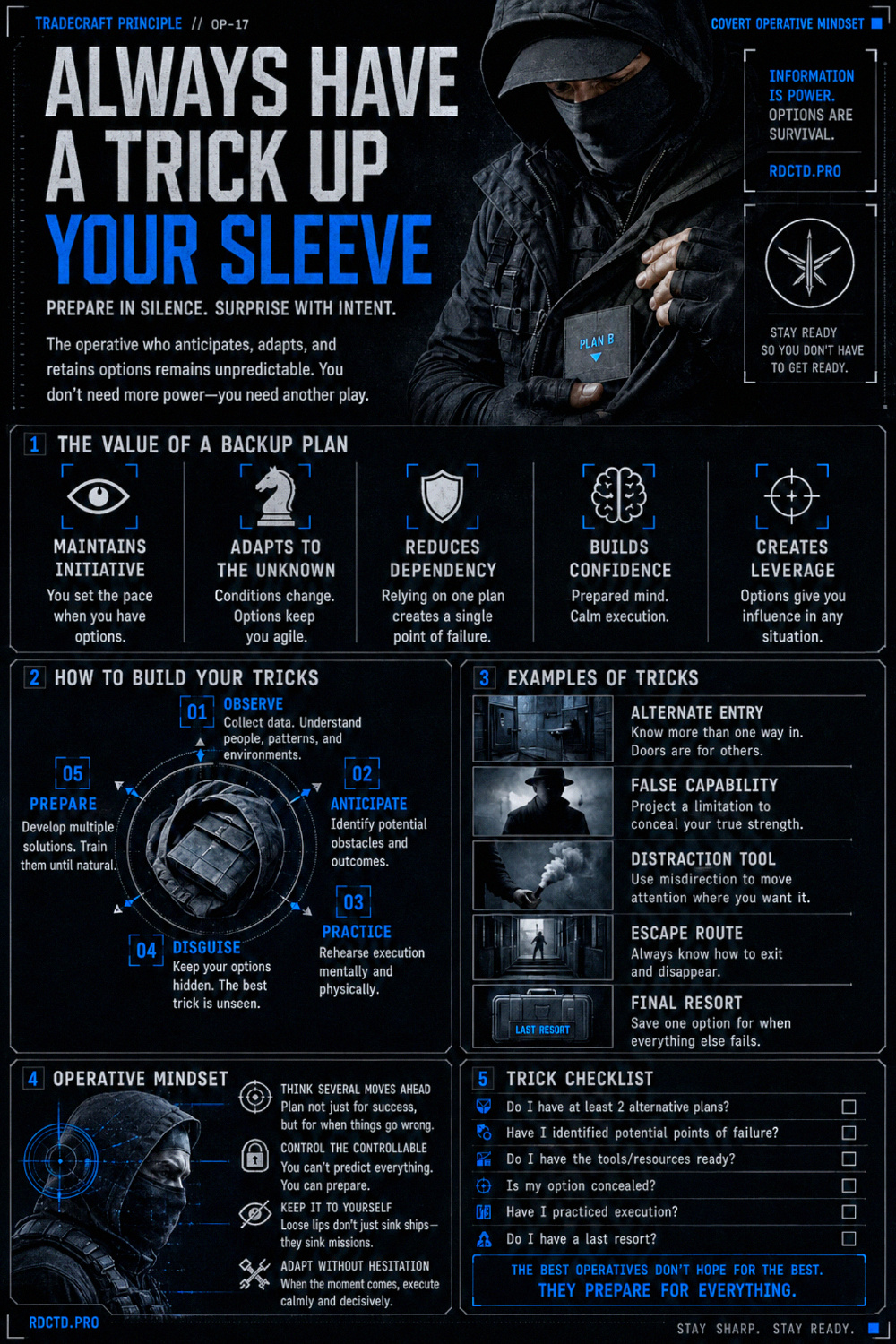
The arithmetic is spatial rather than numerical. Where the fixed elements are, how they constrain movement, what changes if a variable moves two meters left, how long a given path stays viable, what the probability distribution of the next thirty seconds actually looks like.
Movement geometry is this same computation expressed as terrain, and pattern of life analysis is it expressed as time. The trick is holding both simultaneously, modeling the environment beyond merely observing it.
Adding and subtracting elements is the base methodology. Remove the vehicle and what remains. Add a second person to the room and what breaks. Assume the primary exit closes at minute four and rebuild from there. Done continuously, this produces a rolling set of options that exist before they’re needed, which is the practical content of contingency work and the reason the observation loop gets treated as a cycle.
The speed comes from load reduction. An operative who’s already modeled a space isn’t solving a problem when something breaks but selecting from a set he built during the silent part. That’s why rapid decision-making looks like reflex from the outside and feels like retrieval from the inside.
Speed under pressure is almost always pre-work made visible. Model the space before anything is happening, because the modeling capacity degrades hard once cognition narrows.
Trigger Anchoring // Bind each option to an observable environmental condition rather than to a judgment call you’d have to make under load.
[ THE TRICK UNSEEN ]
Why an accumulated catalog of methods keeps failing at the moment it’s needed.
An option the opposition can see has been priced into their plan and no longer belongs to you. This is the part operatives tend to get wrong, usually out of ego. Capability wants to be visible. Demonstrated capability earns standing, deters some categories of threat, and feels like leverage. It also converts a live option into a known quantity that gets planned around, which removes the only property that made it valuable.

An unseen option is a live asset, a demonstrated one is a spent asset that hasn’t been paid out yet. Store the final resort physically apart from your working kit, because anything within reach gets deployed early under load.
Decision Latency Cap // Hold three actionable options maximum, as selection time scales with count and a fourth costs more in delay than it returns in coverage.
[ THE TRICK HELD ]
Why an accumulated catalog of methods keeps failing at the moment it’s needed.
The logic of always keeping a trick in reserve can take longer to understand. The alternate route, the second plan, the held reserve – most of them never get used. Their function was never deployment. It was what holding them did to the operative’s internal state during the hours they sat unused.

There’s a cost to accept. Most rehearsed options never pay out, and the habit feels wasteful for long stretches. That’s the normal economics and why people abandon it. The ones who don’t are the ones still moving when conditions change, which is the only measurement that ends up mattering.
Arousal Field Loss // Sympathetic response reduces peripheral vision and fine motor control, meaning any option depending on wide scanning or dexterity fails above a certain heart rate.
[ FINAL ]
This mindset is a way of occupying space that views every environment as material, every constraint as a variable with a range, and every plan as one branch among several you’ve already sketched. Some of what you build gets deployed, most of it sits there doing quiet work on your composure, reading, and willingness to walk into a room you don’t control.
That’s why an operative who anticipates, adapts, and retains options stays unpredictable long after obvious techniques have been read and countered.
// Preparedness is more than a library of answers you carry into the field, it’s the quality of mind that manufactures one from whatever the ground gives you.
+ Covert Operative Kit [ ] gear shop »»
[TAG : Trick up Your Sleeve]