![[RDCTD]](https://rdctd.pro/wp-content/uploads/RDCTD-Covert-Operative-Tradecraft-Guide-LOGO-tk.png)
![[RDCTD]](https://rdctd.pro/wp-content/uploads/RDCTD-Covert-Operative-Tradecraft-Guide-LOGO-mobile.png)

 A HUMINT protocol to be a good judge of character for determining who a person actually is through baseline observation, pressure testing and behavioral pattern analysis – to trust on some level / to a point.
A single conversation with a target may reveal personality, it takes observing repeated behavior to reveal character.
Vetting an asset, sizing up a liaison contact, choosing a business partner or deciding who watches your kids – it’s the same problem at different stakes. You need to know what a person will do before circumstances prove it, and HUMINT tradecraft solved that problem a long time ago: never weigh what people claim and always collect what they repeat.
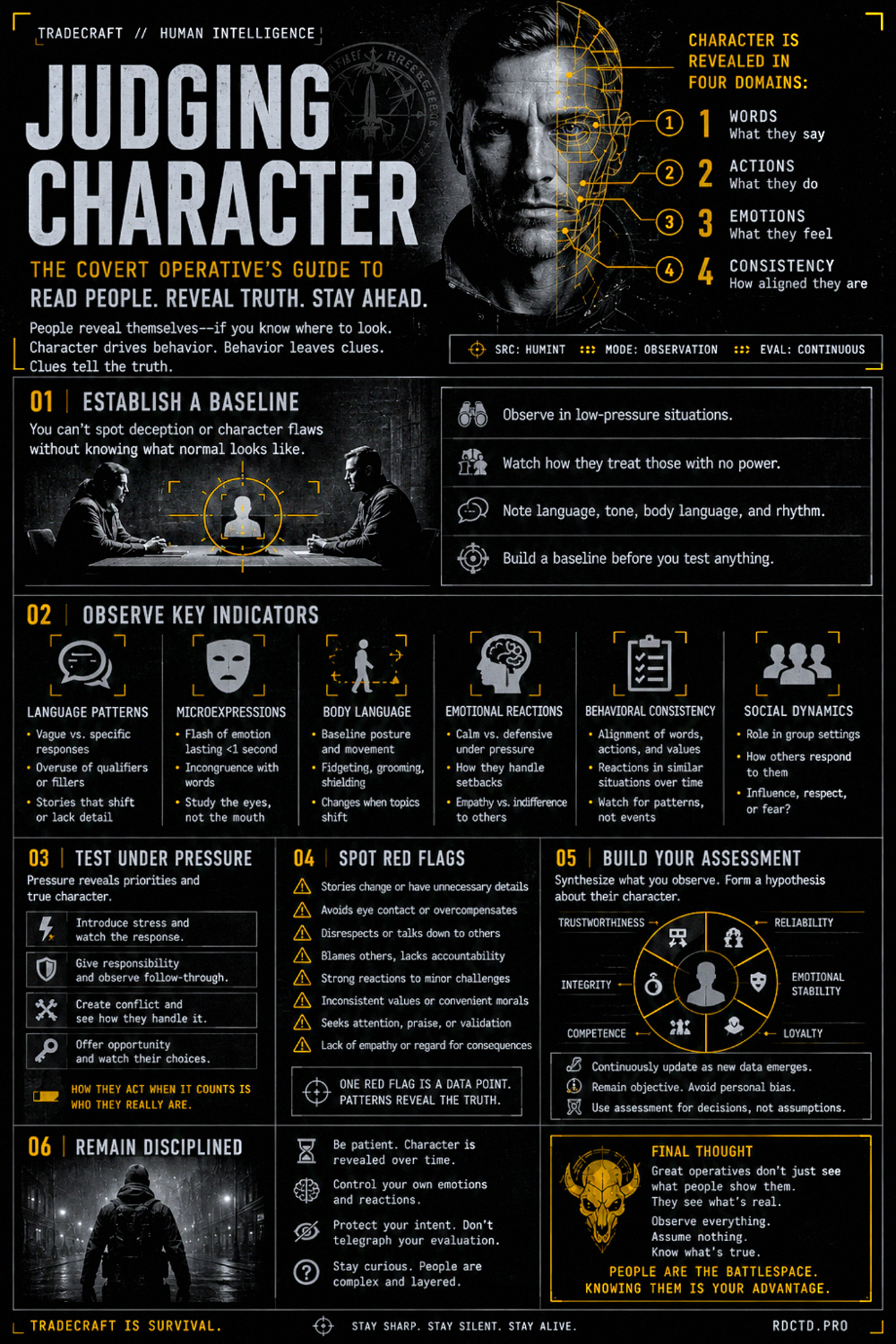
Character is a pattern, of which can be collected, tested and scored like any other intelligence product. Character surfaces in four collectible domains:
Words (what they say and how they say it), Actions (what they actually do), Emotions (what leaks when control slips) and Consistency (how well the first three hold alignment over time). The final domain is the Crosscheck, where independent observations from different people, settings and timeframes are compared against each other to confirm that the pattern is real rather than situational or staged.
Anyone can perform one or two convincingly for an afternoon. Almost nobody holds all four in alignment for extended periods of time, which is why this method views time as a collection asset instead of a delay.
Snapshot reads like reading a room in 3 seconds or a hand
shake threat assessment can get you through the door. However, this method is to judge character – a running file, built and updated with every data point, and used to make real decisions about access, exposure and delegation.
Separate capability from intent in every assessment – a trustworthy but incapable person and a capable but untrustworthy person create fundamentally different operational risks.
[ BASELINE ]
You can’t score deviation without knowing normal. Every meaningful read – stress leakage, deception cues, topic sensitivity – is a delta read, a departure from that specific person’s default behavior.
Skip the baseline and you’ll misread introverts as evasive, anxious people as deceptive and smooth liars as honest – because smooth liars deviate the least. The baseline is the reference trace everything else gets measured against.
Low-Pressure Observation
Collect the baseline where nothing’s at stake. Low-pressure settings produce low-management behavior, that’s the raw material.
- Neutral Venues — coffee meets, casual meals, shared errands; environments where they’ve got no reason to perform for you.
- Speech Mechanics — pace, qualifier density, filler rate, and how much incidental detail they volunteer in routine stories.
- Motor Defaults — resting posture, gesture envelope, self-touch frequency, where the eyes settle when they’re thinking.
- Social Defaults — interruption habits, humor style, who they orient toward in a group and who they ignore entirely.
- Response Latency — how fast they answer easy questions; that number becomes your reference clock for the hard ones.
The No-Power Test
The fastest single window into character is how someone treats people who can’t punish or reward them. Everyone manages behavior upward. Almost nobody budgets performance for the waiter, the driver or the junior staffer – so the behavior you see there runs closer to unmanaged than anything they’ll ever show you directly.
- Service Failures — a wrong order or a late car is a free stress probe you didn’t have to run; log the reaction.
- Name Retention — whether low-status names get learned and used, or replaced with “hey” and hand signals.
- Credit Routing — who gets mentioned when something goes right, and who absorbs it when something doesn’t.
- Audience Dependency — tone changes the moment the important people leave the room.
Building The File
Run at least two exposures in different settings before you test anything. A single calm meeting gives you posture and cadence; you need variance across contexts to know what’s stable. Log it the way you’d log any collection – short, dated, factual entries kept separate from your conclusions. Face filing covers the recall mechanics; the point here is that a baseline you didn’t record is something your memory will quietly edit.

Baseline work feels slow because it produces nothing quotable. It’s also the step that makes every later read mean something to judge character.
Score behavioral latency as well as behavior itself; responses that appear only after social cues often indicate calibration rather than authenticity.
[ INDICATORS ]
With the baseline logged, you’re reading six channels in parallel. No single channel convicts anyone. You’re building convergence – independent indicators from separate channels pointing at the same conclusion. A cue from one channel is noise; the same story told by three channels means something.
Language Patterns
Words are the cheapest channel to fake, yet most people still fail at it, because content is easy to script while delivery mechanics aren’t. Reading between the lines starts with these markers.
- Specificity — truthful accounts carry incidental, useless detail; constructed ones stay clean, general and oddly efficient.
- Qualifier Spikes — “honestly,” “to be fair,” “believe me” rising above their baseline rate flags a managed statement.
- Story Drift — details that change between tellings; genuine memory errors cluster at the edges of a story while construction errors show up in the middle of it.
- Pronoun Distance — “I” dropping out of sentences around a specific event signals someone standing away from it psychologically.
Microexpressions
Facial control runs on a delay. The genuine reaction fires first in under a second, the managed expression loads over it. You’re reading the gap. The deceptive smile is the canonical case.
- Leakage Window — flashes under one second, usually at the moment a topic lands, before the face catches up.
- Incongruence — a flash of contempt during a compliment outranks both the compliment and the smile that follows it.
- Eyes Over Mouth — the mouth takes orders; the muscles around the eyes mostly don’t, so score the upper face.
- Timing Errors — expressions that arrive late, hold too long or cut off mechanically are being run manually.
Body Language
Posture and movement only mean something against baseline. Crossed arms on a person who always crosses their arms is furniture. The same posture appearing the moment you mention money is a flag on the play, the kind of input your something-is-off sense runs on.
- Pacifiers — neck touches, grooming, clothing adjustments climbing during specific topics.
- Shielding — objects migrating between you, torso angling toward exits, sudden deep interest in a phone.
- Topic-Locking — a behavioral change that repeats every time one subject surfaces; that subject is your dig site.
- Freeze and Recovery — gesture envelopes that collapse under a question, then restore once the subject moves on.
Emotional Reactions
Emotions are telemetry. You’re logging what triggers them, how large the response runs against the trigger, and how fast the person recovers. Emotions as tactical alerts covers your own instrument; this points it outward.
- Pressure Posture — whether challenge produces thinking or counterattack.
- Setback Handling — cancellations, small losses, minor humiliations; watch recovery time and where blame travels.
- Empathy Tracking — genuine registration of other people’s states, or indifference wearing a toughness costume.
- Proportionality — reactions far larger than the trigger mark a pressurized subject underneath; note it and route around it until you need it.
Behavioral Consistency
Consistency is the domain that convicts. Anyone performs well inside a window; the question is variance across windows.
- Word-Action Gap — commitments made against commitments executed, tracked over weeks and scored like a ledger.
- Cross-Context Stability — the same human at dinner, in traffic, on a deadline and around their boss.
- Values Pricing — stated principles that hold right up until holding them costs something.
- Pattern Over Incident — bad days happen; repeated behavior was a decision.
Social Dynamics
People who’ve known your subject for years have run collection you can’t replicate. Read their behavior around the subject and you inherit the dataset – the same triangulation logic that drives pattern of life analysis and social intelligence work.
- Assumed Role — where they settle in a group when nobody assigns positions.
- Second-Order Flinches — hedging, careful phrasing and managed silence from long-term contacts is a report in itself.
- Absence Compliance — whether people follow their lead once they’ve left the room.
- Influence Type — the room moving because it wants to, or because it’s afraid of the alternative; both work, and only one holds without maintenance.
Score each channel on its own before you combine anything. Reads that contaminate each other feel like conviction and behave like bias.
Track the frequency of self-correction, as people who voluntarily repair small inaccuracies without prompting generally require less impression management.
[ PRESSURE ]
Comfort is a mask everyone can afford. Pressure prices behavior which is the only kind worth filing. The tradecraft here is controlled, deniable pressure – small enough to read as ordinary life, real enough that the response costs the subject something to fake.
The Four Probes
Run these as normal circumstances, never as visible tests. Each probe targets a different load-bearing trait.

Reading The Response
The probe is the cheap part, the read is in the follow-through.
One probe per meeting, maximum. Stacked tests raise pattern visibility, a subject who’s caught you reading them starts feeding you performance instead of behavior. From that point your file collects fiction.
Pressure testing sounds manipulative until you notice that life runs these probes anyway. You’re just positioned to watch when it happens – or arranging for it while the stakes are still small.
Behavior observed immediately after perceived success often reveals priorities more accurately than behavior observed after failure.
[ RED FLAGS ]
A red flag is a data point. It gets a date, a context and a file entry – never an immediate verdict, because everyone produces flags under enough load. Patterns produce verdicts. The list below carries the highest predictive weight across deception work and long-cycle assessment.
- Story Mutation — accounts that change between tellings, or arrive with rehearsed detail nobody asked for.
- Gaze Management — avoidance, or the overcorrected version: locked, unblinking eye contact held like a task.
- Downward Contempt — disrespect aimed at anyone structurally unable to retaliate.
- Accountability Deflection — failures that always route to someone else’s desk, the market, the weather.
- Disproportionate Response — outsized reactions to minor challenges, which usually marks a self-image under guard.
- Convenient Morals — values that reprice depending on the audience and the cost.
- Validation Hunger — approval as a primary drive; it’s a steering handle, and you won’t be the only one who finds it.
- Consequence Blindness — no registration of what their choices do to other people, including you.
Weighting Flags
Weight by severity, frequency and context. A snapped answer during a brutal week discounts heavily; the same snap as a monthly rhythm doesn’t. Integrity flags outrank competence flags every time – training closes a skill gap, while a character gap just waits quietly for higher stakes. Experience consistently shows the same outcome: systems can compensate for an unreliable but capable person, but no system survives a disloyal one.
Flags don’t accumulate into drama or grudges, but into access decisions.
Monitor what information the subject remembers about others – memory naturally prioritizes whatever they unconsciously consider important.
[ ASSESSMENT ]
Collection without synthesis is a diary. The assessment converts logged behavior into a working hypothesis about who this person is and what they can be trusted with – written, dated and built to be revised. Six axes cover the terrain.
The Six Axes
Score each axis separately, in writing, with the file entries that justify the score sitting underneath it.
Continuous Update
The assessment is a hypothesis under permanent review. New data moves the score, including data you don’t like, and especially data that contradicts a read you’ve already acted on – that’s the entry your bias will fight hardest to discard. Run the file like an after-action process: what did I predict, what happened, what does the delta say about my instrument.
An assessment you can defend line-by-line changes how you delegate, negotiate and share – quietly, and across everything you run.
Assign greater weight to decisions made under ambiguity, since they reveal judgment before outcomes distort the subject’s own narrative.
[ CONTROL ]
When it comes to being a good judge of character, the assessor is an instrument, which naturally drifts. Everything above degrades fast when your own reactions leak, your own biases score the data, or your evaluation becomes visible to the subject. This section points the method at yourself.
Protecting Intent
A detected evaluation converts your subject into a performer. Concealing intent is standard tradecraft, it applies at dinner parties exactly the way it applies in the field.
Assessor Bias
Bias corrupts the file upstream of every decision – it’s more dangerous than any lie a subject tells you because it comes pre-installed.

Patience does the rest. Character surfaces on its own schedule, over time, in ordinary circumstances – it appears reliably for whoever’s still watching by then. People are complex and layered; stay curious about the layers instead of relieved by the first coherent story.
View unexplained improvements in behavior with the same scrutiny as unexplained deterioration – both may reflect a change in incentives rather than character.
[ FINAL ]
People broadcast who they are constantly, in a language of repeated behavior. Most stay illiterate in it by choice, reading it takes patience and profiling. Every consequential relationship you’ll have, professional or personal, runs better on a read you built than on a story you were handed.
// Character is the prediction engine behind future behavior.
+ Covert Operative Kit [ ] gear shop »»
[TAG : How to be a Judge of Character]