![[RDCTD]](https://rdctd.pro/wp-content/uploads/RDCTD-Covert-Operative-Tradecraft-Guide-LOGO-tk.png)
![[RDCTD]](https://rdctd.pro/wp-content/uploads/RDCTD-Covert-Operative-Tradecraft-Guide-LOGO-mobile.png)

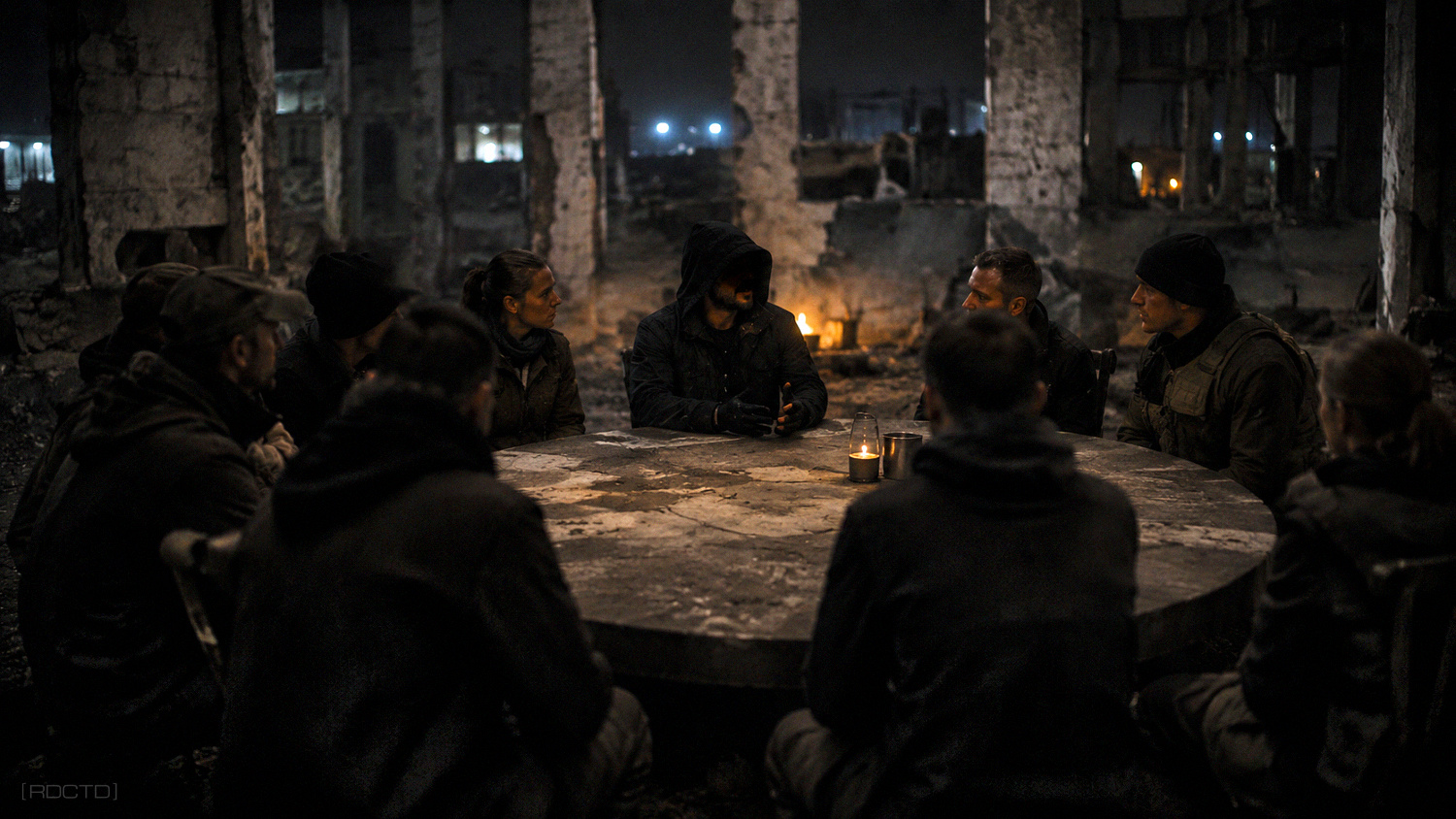
 The tradecraft method to implementing groupthink – a failure mode where a group’s drive for consensus overrides accurate appraisal of its options – the conditions that produce it can be installed strategically:
A group never resents the operative who made agreement feel like its own idea, which is why authorship of the consensus as a whole must always appear internal.
Groupthink can be a state you wait to observe in a target group or one that can be deliberately engineered. The practical advantage lies in recognizing the conditions early enough to exploit or counter them.
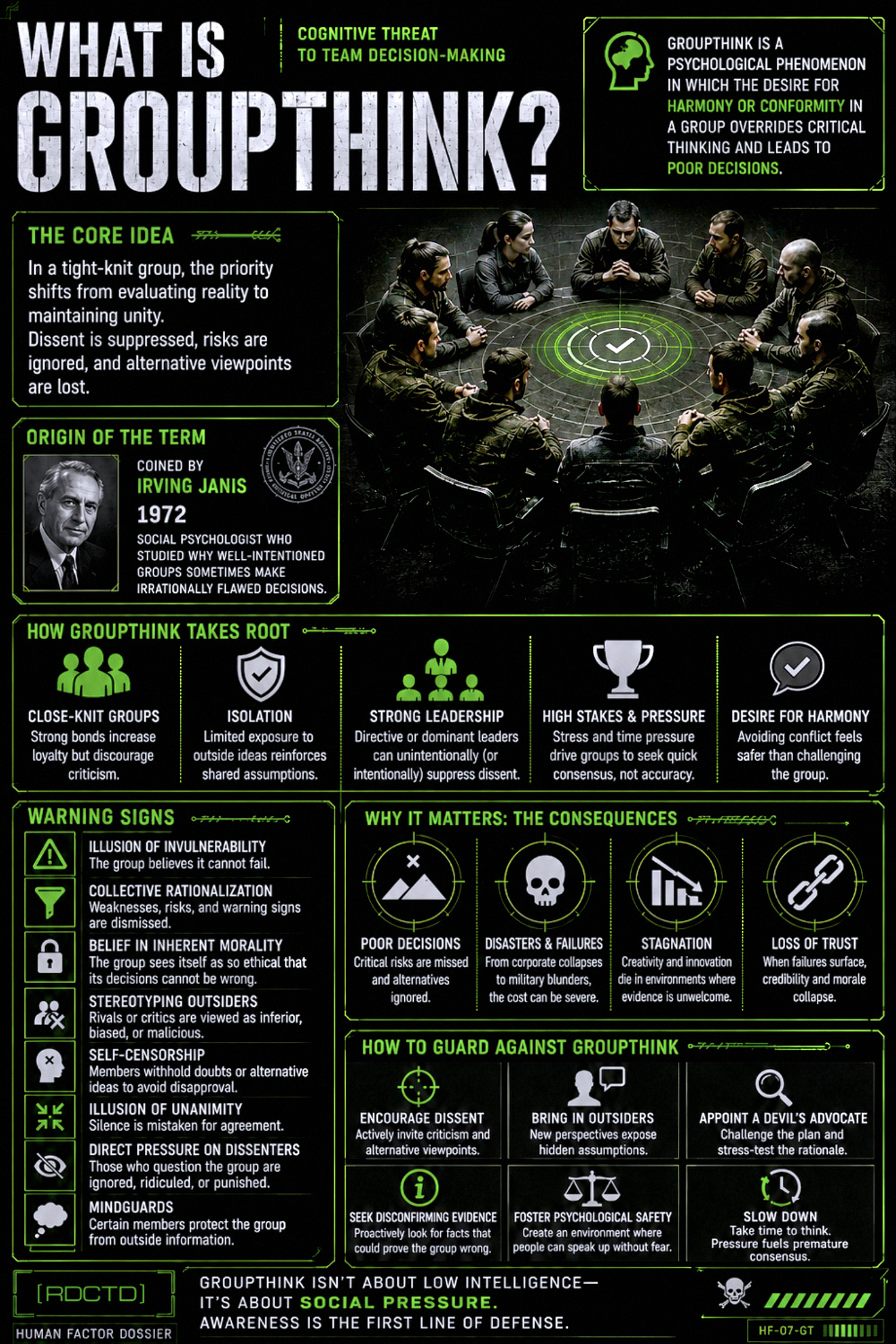
Janis catalogued the symptoms in 1972, of which the practical extension for an operative runs the other direction – given the antecedents he documented, how do you install them in a group that doesn’t show them. Treat the antecedents as inputs you control.
The method is sequential. You raise cohesion, cut external correction, anchor a preferred read early, neutralize whoever would challenge it, then manufacture the appearance of unanimity.
Run in order, as each step lowers the cost of the next. What follows is the process – step by step, with the leverage point for each stage marked. Skipping a stage weakens the sequence and makes the underlying influence easier to detect. Each completed stage narrows the group’s perceived options before the next pressure is applied.
The process of groupthinking runs on plausible deniability, so every move should survive being noticed in isolation while only the pattern reveals intent.
[ TARGETING THE GROUP ]
Begin by scoring inducibility. Some groups arrive most of the way there, your work being mostly maintenance. Others resist, and forcing the process burns time you may not have. Read four variables before you commit: baseline cohesion, degree of insulation, the leader’s style, and ambient stress.
A tight, insulated groupthink under a directive chair is near-ready. A loose, externally networked group with a leader who genuinely solicits dissent will fight you at every stage. Grade the target on each axis:
• Cohesion – does dissent already carry a social cost here?
• Insulation – how much outside review reaches them now?
• Leadership – does the chair signal preference early?
• Stress – is there a deadline, threat, or failure to exploit?
A group rating high on three of four is worth the effort. Lower than that, you’re building the preconditions from scratch, the timeline stretches accordingly.
For efficiency, targeting saves the largest share of effort across the whole operation. Pick a group already drifting toward consensus and your remaining moves are amplification instead of construction. That’s where the method pays the most for the least exposure.
Score before you act. A group that’s nearly there needs a nudge; one that isn’t needs a campaign. Misjudging that threshold wastes effort and increases the chance of exposing the influence.
Each stage should leave a cover story the group can tell itself about why it chose freely – a member who can rationalize the pressure won’t go looking for its source.
[ RAISING COHESION AND CUTTING CORRECTION ]
The first active stage tightens the group and seals it from outside input. Cohesion rises when a group shares a threat, an identity, or an enemy, so you supply or sharpen one. A clear out-group makes internal disagreement feel like betrayal, which is exactly the pressure you want.
Insulation matters as much. Every external reviewer the group still consults is a correction channel that can break your work. You degrade those channels by raising their cost, latency, or credibility in the group’s eyes. Reframe the outside expert as uninformed, slow, or compromised, and the group stops listening on its own.
Methodology

The mechanics are unglamorous. Encourage closed meetings, reward speed over consultation, and let the group’s own pace argue against checking with anyone outside. You don’t have to “seal the room”, just make leaving it feel inefficient.
Strategy
Measured against the operation, this stage is the multiplier. A sealed, cohesive group processes your later inputs without resistance, so cohesion and insulation are the two stages worth the most attention. Get them right and the rest moves fast.
Don’t attack the external reviewers. Make consulting them feel like a waste of the group’s time. When outside consultation is repeatedly framed as inefficient, handle it as a warning that corrective channels are being specifically narrowed.
Influence degrades the moment it’s hurried, so pace the sequence to the group’s natural rhythm rather than your operational clock.
[ ANCHORING THE PREFERRED READ ]
Next you set the anchor. Whoever states a confident position first in a deliberation biases everything after it. So you arrange for the position you want to be the position spoken earliest, by the most authoritative voice available.
The cleanest route is a directive leader who already leans your way. Reinforce his standing, feed him the framing, and let him open the discussion with it. If no such leader exists, elevate the member whose certainty is loudest, because confident assertion reads as competence to a group under pressure.
The anchor doesn’t need to be correct, it should be early and unhedged. Once it’s on the table, the group’s energy goes toward justifying it rather than testing it. Every later contribution gets measured against that first claim.
Methodology
In throughput terms, a well-placed anchor reduces deliberation time, which is what the group experiences as decisiveness. They’ll credit themselves for moving fast. You’ve simply chosen the direction they moved.
First and confident beats late and correct. Own the opening claim and you own the frame. Once accepted, that frame becomes the reference point through which every later argument is judged.
The method works best on competent, confident groups, since their self-trust is the exact mechanism that stops them auditing how they reached agreement.
[ NEUTRALIZING THE SKEPTIC ]
The skeptic is the single point that can break an emerging consensus, so this stage gets the most care. One credible dissenter who finds an ally can reopen the whole question. Your task is to keep that pairing from forming. Identify the doubters early through careful observation of who hesitates, who qualifies, who goes quiet.
Then isolate rather than confront. A skeptic argued down in the open can become a martyr; a skeptic quietly sidelined just fades. Reduce his airtime, route decisions around his function, and let the group’s pace leave his objections unaddressed. The ‘mindguards’ – members who shield the group from contradictory input – will do much of this for you once cohesion is high. Identify them and feed them.
Watch for coalition. The danger isn’t one doubter, it’s two who discover each other. Keep skeptics busy, separated, and uncertain whether anyone shares their view, and the dissent stays private, which means it stays harmless.
Strategy
For output, neutralizing dissent quietly costs far less than suppressing it loudly. Visible suppression alerts the group that something’s being managed. Quiet isolation keeps the process feeling organic, which is the condition you need it to keep.
The doubter you let speak alone is contained. The two you let pair up are a reopened decision. Once dissenters discover shared ground, private hesitation becomes organized resistance and the manufactured consensus begins to fracture.
Measure success by how little you have to touch the group, not by how much, since a consensus that runs on its own is the only one that’s truly secured.
[ MANUFACTURING UNANIMITY ]
With the anchor set and dissent contained, you build the illusion of unanimity. The illusion holds because each member reads the others’ silence as agreement. So you make agreement visible and disagreement invisible. Surface and amplify every member who concurs – let the quiet ones stay quiet and assume the room is with them.
Feed the groupthink confirming information on a steady cadence and withhold or discredit the disconfirming. A group already rationalizing accepts confirming data without scrutiny, so this is low-effort once the earlier stages hold. Social proof does the rest – three open agreements pull the undecided fourth into line.
Silence is your ally here. You never need every member to actively endorse the decision. You want them to believe everyone else already has. That belief converts passive members into a wall the remaining doubters can’t get past.
Methodology
The efficiency payoff is that the groupthink now polices itself. Members enforce the consensus on each other, and you can step back from active management. A self-sustaining consensus needs far less input than one you have to push at every meeting.
Make the agreements loud and the doubts private. Perceived unanimity becomes real unanimity. Once silence is viewed as consent, the group stops measuring agreement by manufacturing it instead.
The same antecedents you’re installing are the ones to watch in your own element – anyone running this against you will move through the identical sequence.
[ THE LOCK AND THE WINDOW ]
You’ll know the process has taken when the symptoms appear without your pushing. The groupthink develops an illusion of invulnerability and accepts risk it would once have rejected. It rationalizes warnings away. It assumes its own good judgment without testing it. At that point the decision tree has been reduced to one branch.
That reduction is the payoff. A locked group is predictable, so you can model its next moves and stage your own actions ahead of them. Read the sequence the consensus commits them to, then time your contact, placement, or withdrawal to the window their own momentum opens.
Hold position once it’s locked. Over-managing a self-sustaining consensus risks exposing the hand that built it. Light maintenance keeps it running – an occasional confirming input, a quiet check that no skeptic coalition is forming.
Methodology

The operational return is a target spending its own resources to move where you wanted it, on a timeline you can largely anticipate. That’s the whole purpose of the method. Everything before it exists to produce this predictability.
When the symptoms run on their own, stop pushing. A managed consensus that’s noticed becomes a reversed one. The moment the group detects an external hand, its shared loyalty can redirect against the operator.
Consensus is cheaper to build than to fake. Set the conditions and the group supplies the rest.
[ ASSESSMENT ]
The induction is a strategic sequence – target, seal, anchor, isolate, manufacture, then hold. Each stage lowers the cost of the next, and the same antecedents that let you build a consensus tell you how to protect your own element from anyone running the method against you. The operative who can install groupthink can also spot it being installed.
// Groupthink rarely forms by coercion, it arrives as efficiency, loyalty, and momentum.
+ Covert Operative Kit [ ] gear shop »»
[TAG : Using Groupthink]