



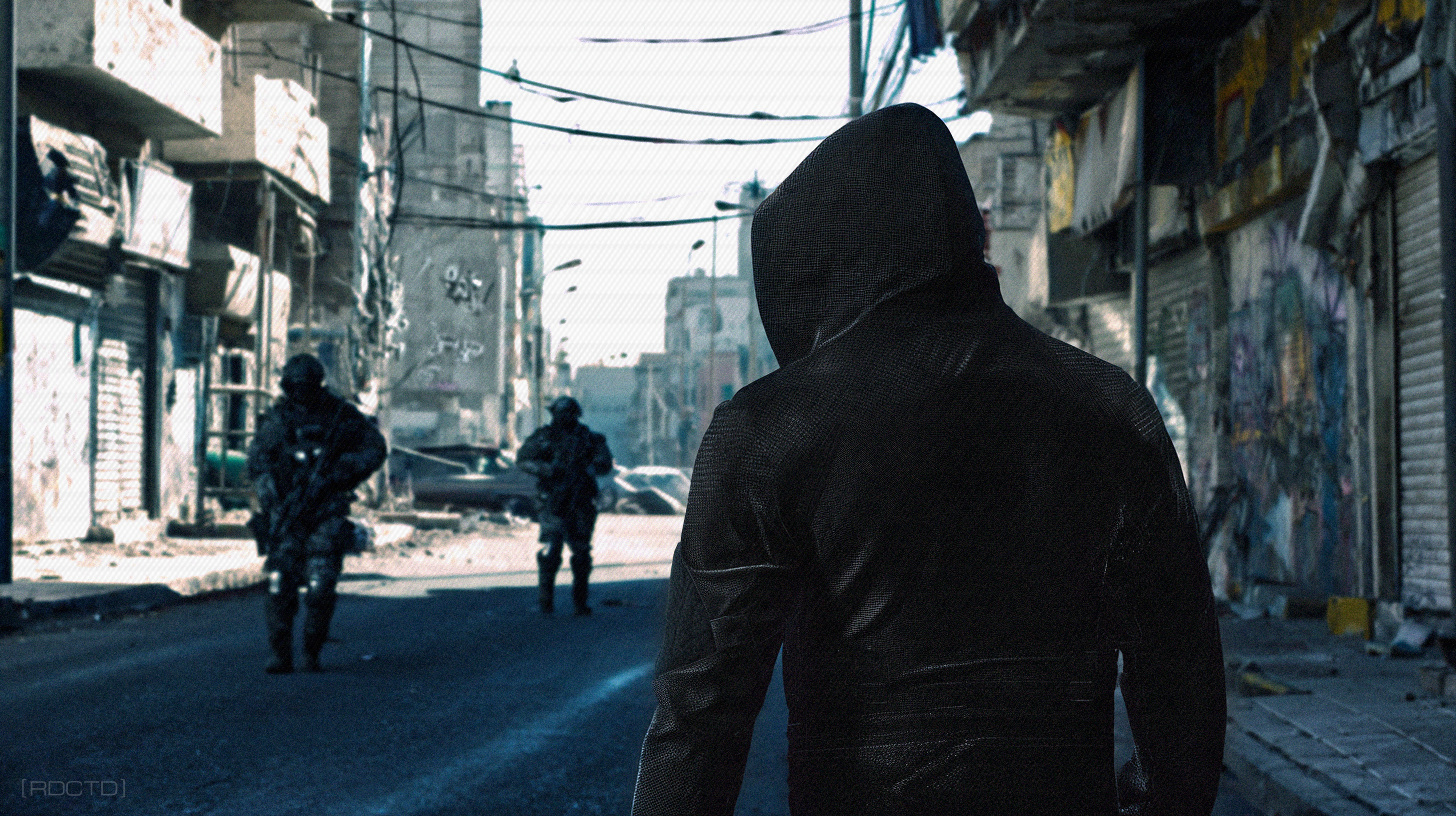
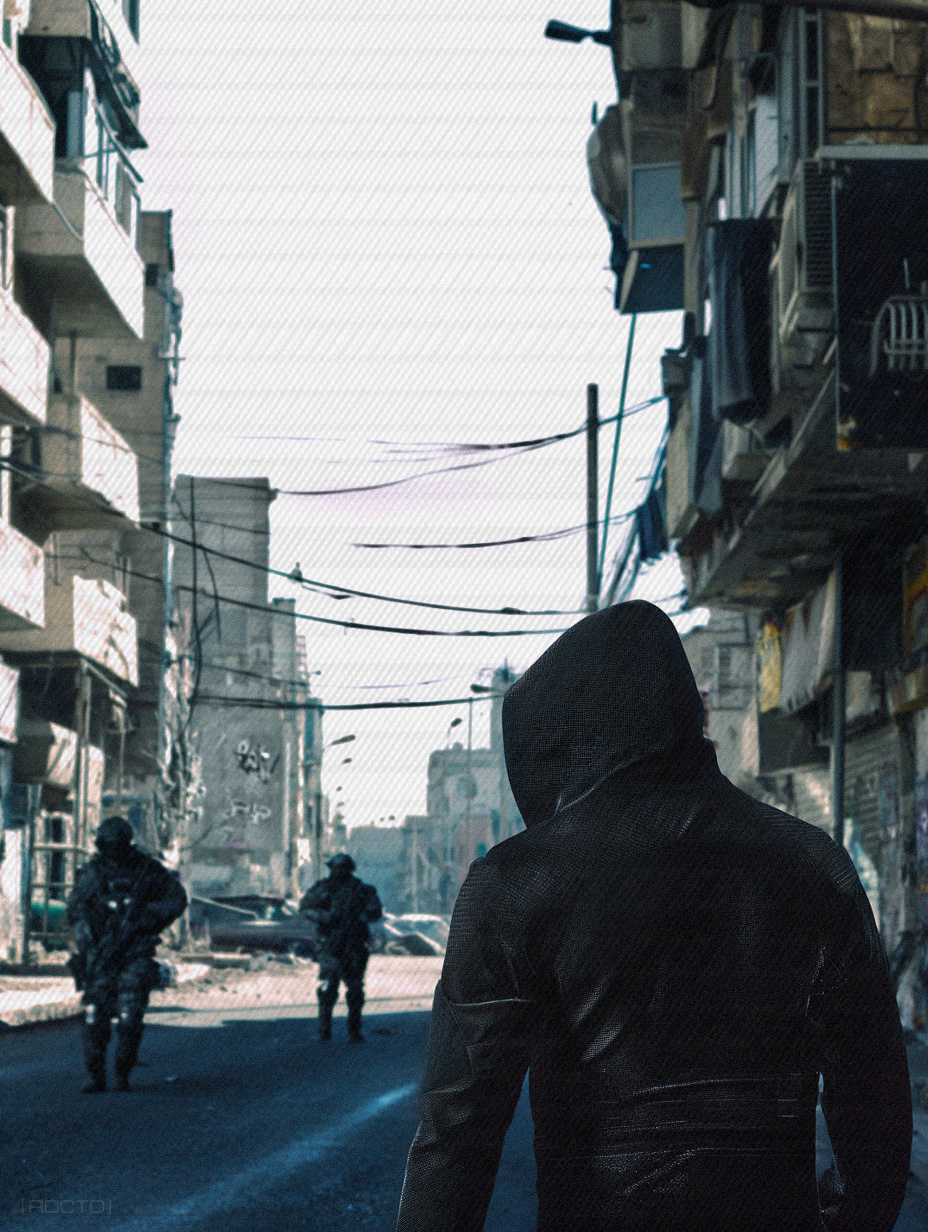
 The tactical assessment of how an individual’s movement changes their access to you when in the same relative space – to identify developing close-contact risk quickly and respond / engage optimally.

Before accepting a conversation with an unknown at close range, check whether stopping would leave you inside a doorway, between vehicles, or against a fixed boundary.
Close-quarters combat can begin with a positioning failure. Someone approaches, your attention stays on their face, and you allow the available space to disappear. By the time they become openly hostile, you’re managing contact from a position you accepted without assessment. Street situational awareness must include the movement that creates that position.
An operative reads an approach as a changing relationship. Track where your paths will meet, how soon that could happen, and which routes remain available if the person keeps closing. Those observations support an immediate decision about your own movement, they can’t establish another person’s intent with certainty.
Intentional approach also includes ordinary contact: someone asking directions, returning a dropped item, or approaching a service counter beside you. The tactical problem develops when unwanted proximity persists, your route becomes obstructed, or behavior indicates an immediate threat. Aggressive defensive action means taking available space early and moving decisively.
This is pre-contact tradecraft. Its purpose is to keep an unfamiliar person’s approach from determining your position, attention, and next action. A useful assessment preserves your ability to complete the movement safely, without turning every pedestrian encounter into an incident.
Reassess an approach after a vehicle, doorway, or group temporarily blocks your view; the last observed position is already out of date.
[ READING APPROACH LINES ]
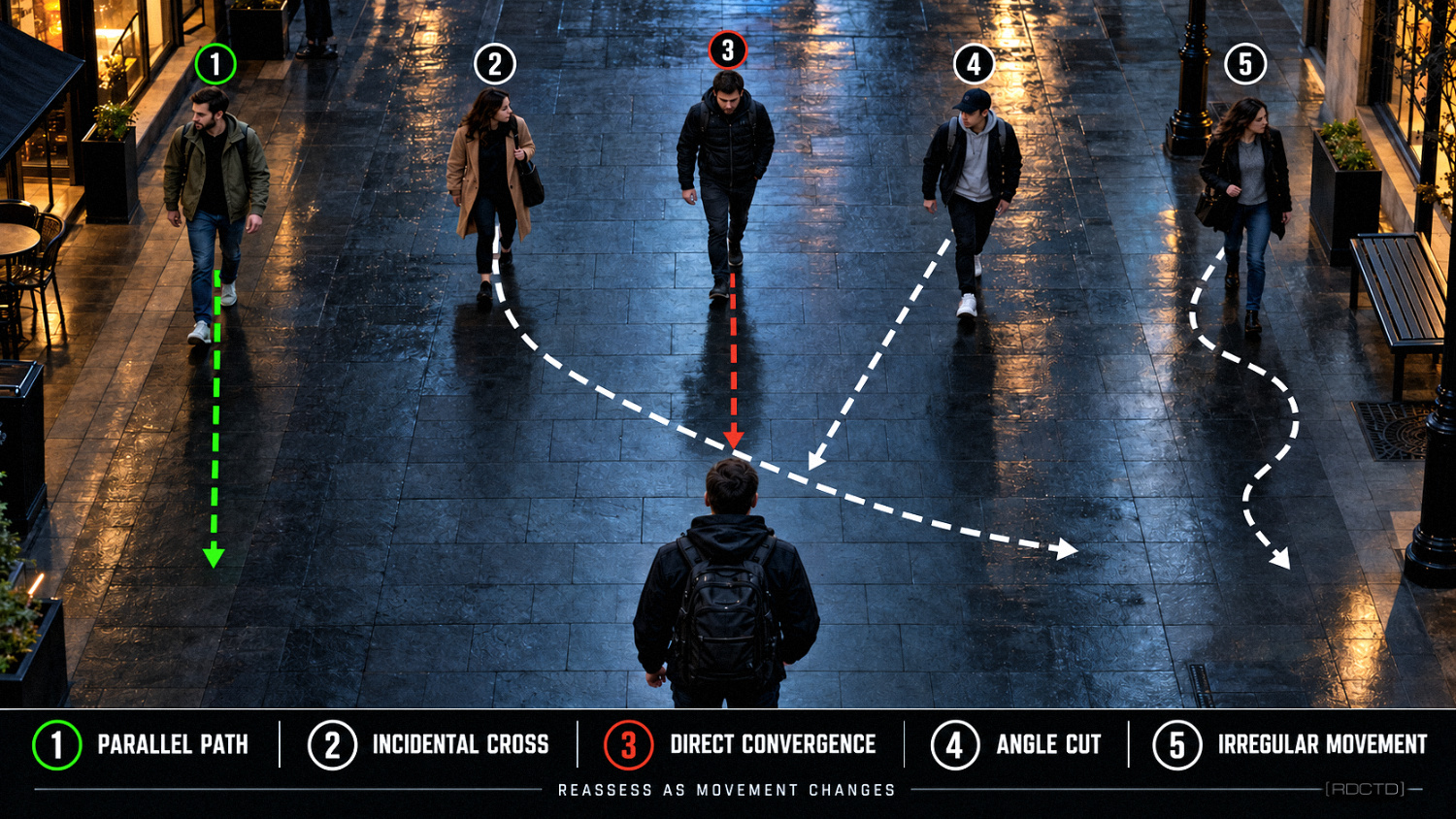
An approach line is the path someone appears likely to take relative to your position – it changes as either of you moves. Use the five patterns to organize observation, then update the assessment against actual behavior.
A parallel path can become an interception, and direct convergence can have an ordinary explanation. Apply this by preserving an accessible exit and creating separation before continued convergence restricts your movement.
- Parallel Path — the person travels beside you or in the same direction while maintaining separation. Immediate contact risk is usually lower while that gap remains stable. Watch for a turn toward you, a narrowing passage, or a speed change that brings them alongside. Shared direction alone provides little information about intent.
- Incidental Crossing — your routes intersect briefly because the environment places people on crossing paths. Normal collision avoidance includes yielding, passing, and continuing away. Give sufficient room to pass. Reassess if the person abandons their onward route and continues toward your new position.
- Direct Convergence — the person’s movement progressively closes the gap with you. This demands attention because proximity is developing quickly. Identify their apparent destination and your available exit. If they’re addressing you, you can acknowledge them while retaining space, courtesy doesn’t require accepting close contact.
- Angle Cut — the person takes a diagonal route toward a point you’re approaching. Pedestrians routinely cut corners toward entrances and crossings. Concern increases when their route continues to intersect yours after you move toward a different, clearly available destination.
- Irregular Movement — the person’s direction or pace changes without a clear destination. Navigation errors, distraction, intoxication, and mobility limitations can all produce irregular movement. Allow extra space for unpredictability. Avoid treating an unfamiliar movement pattern as evidence of aggression.
Read the next likely intersection, including the one your own movement creates. A step around a parked vehicle can put you into a cyclist’s path, an abrupt stop can cause the person behind you to collide with you. Your defensive movement must account for the whole route.
Manage path geometry as a prompt for assessment. The operative’s advantage comes from acting on available space before uncertainty becomes a close-contact problem.
When several people converge beside a timetable, ticket machine, or entrance, identify the shared destination before assigning significance to their approach.
[ INTENT INDICATORS ]
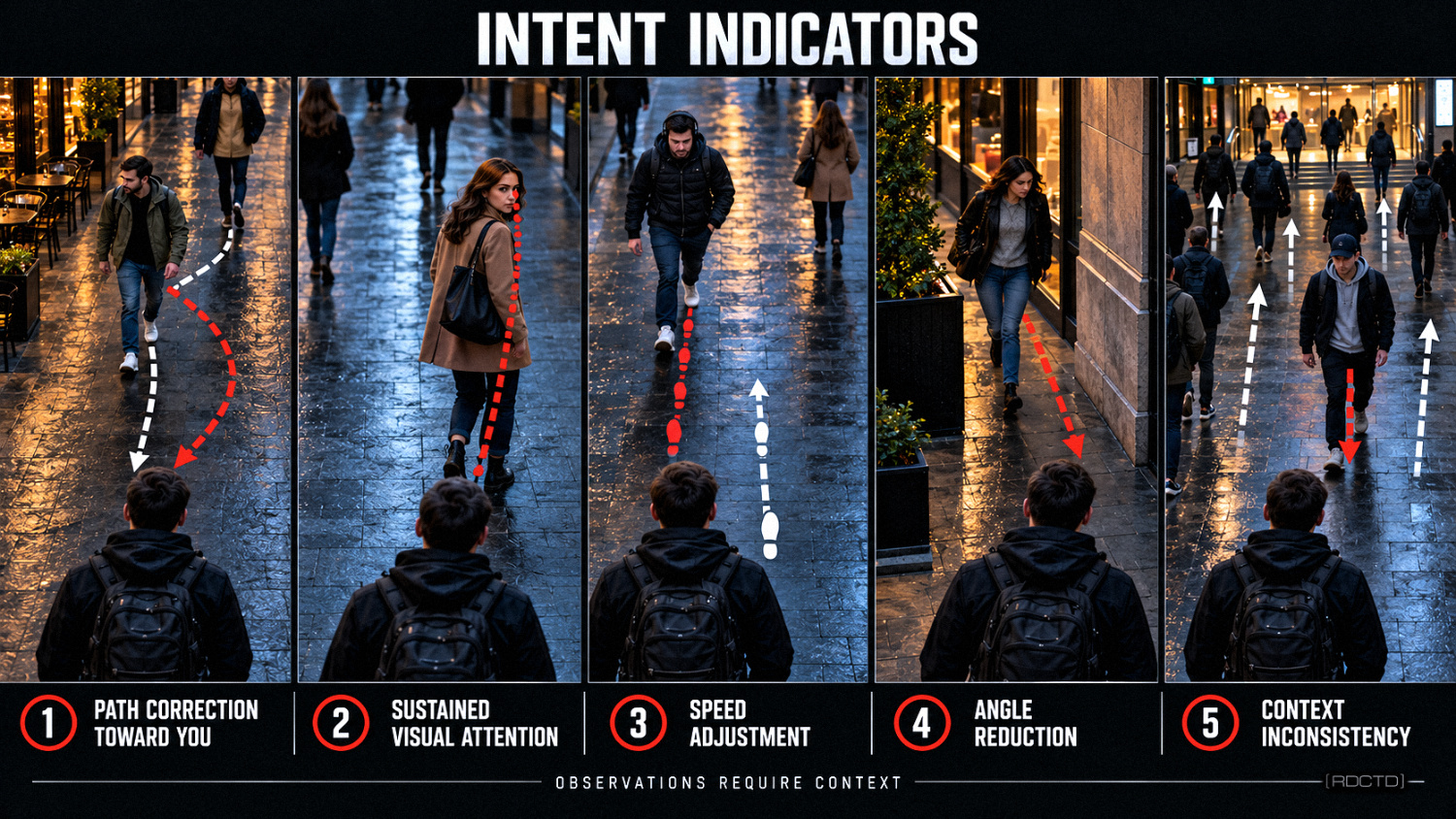
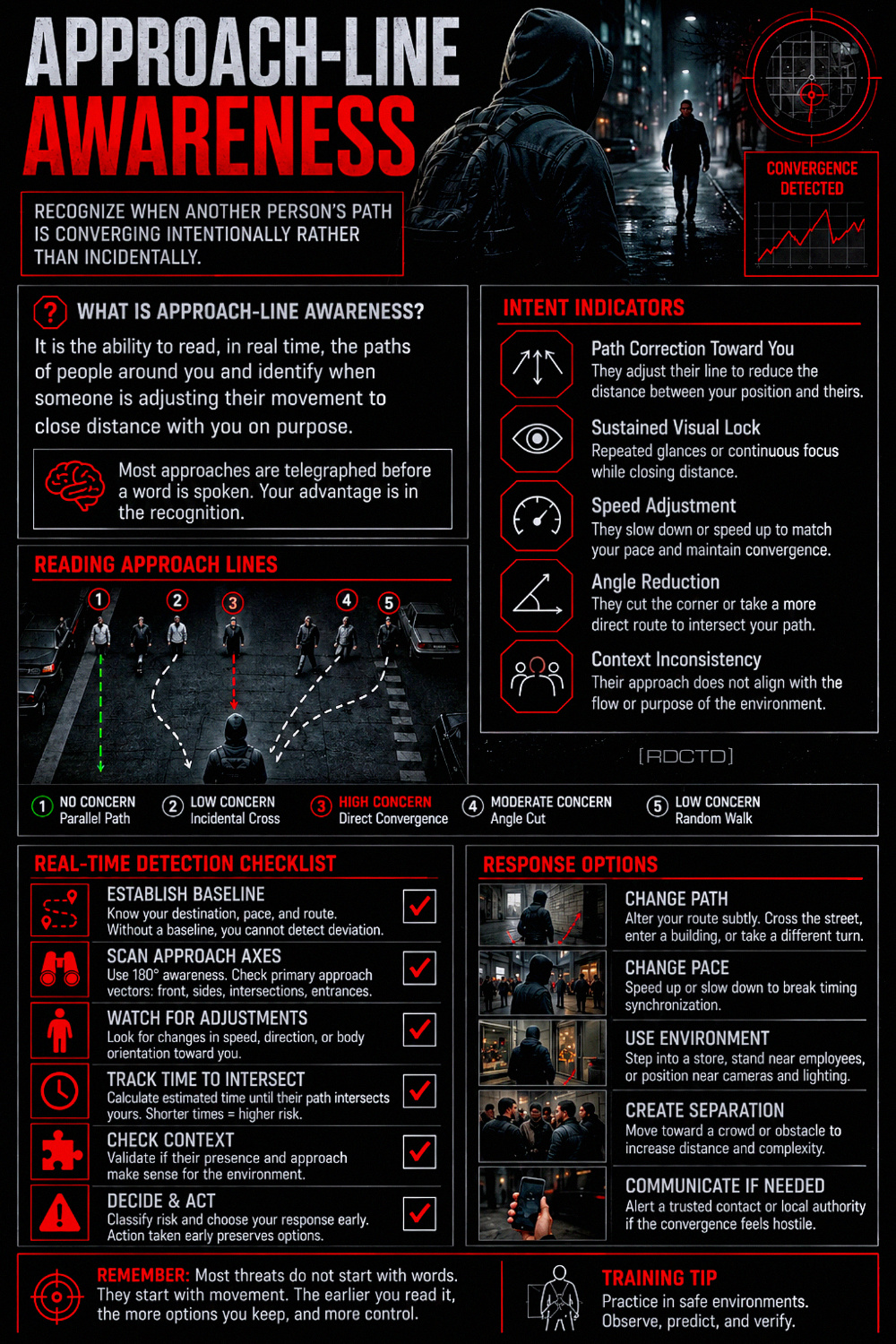
There are five useful observations in approach-line tradecraft. Assess them together, accounting for the environment and how the person responds to available space. A fixed number of cues can’t establish hostile intent.
An explicit threat can require immediate action, while repeated glances may still have an ordinary explanation. Give greater weight to behavior that persists after you’ve created separation or clearly requested space. Preserve a usable exit while you assess the approach, and move before continued convergence restricts your options.
Path Correction Toward You
Register whether someone redirects toward your new position after you’ve moved to an open, safer route. The observation carries more weight when the surrounding pedestrian flow doesn’t explain it. Repeated correction can indicate that reaching you is their objective, although the reason remains unknown. Use the information to increase separation and reach tactical advantage. Don’t remain exposed to collect another confirmation.
Sustained Visual Attention
Repeated looks can establish that someone has noticed you, but they carry limited meaning by themselves. Combine attention with closing movement, obstruction, words, and visible actions. Avoid prolonged eye contact that turns observation into confrontation. Clothing, ethnicity, apparent social status, and unfamiliar mannerisms aren’t substitutes for behavior.
Speed Adjustment
People change pace for traffic signals, crowds, and obstacles. Notice whether the adjustment follows an environmental event or appears to preserve proximity to you. If your safe movement toward an advantage is followed by renewed closing, respond to the resulting distance. You don’t need to establish exactly why the person accelerated before protecting your route.
Angle Reduction
A person may move toward the space ahead of you while remaining several meters away. That path can reduce your options sooner than a direct approach from the same distance. Check whether the projected meeting point is a doorway, stair landing, or narrow section. Move toward an available opening before entering the restriction. Don’t step into traffic to defeat an otherwise manageable approach.
Context Inconsistency
Compare movement with what the location requires. Someone moving against a departing crowd may be reaching a colleague. Someone approaching a closed entrance may have made a mistake. Describe the actual discrepancy and keep alternative explanations available. Behavioral assessment becomes unreliable when unfamiliarity alone is treated as danger.
// Give immediate threatening behavior priority over subtle cues. An attempt to grab you, an explicit threat, or persistent obstruction of your exit can justify urgent protective action without a prolonged assessment of gaze or walking pattern.
When an observation supports several explanations, select a protective action that remains useful under each explanation, such as moving toward an occupied service point.
[ REAL-TIME DETECTION & OODA ]
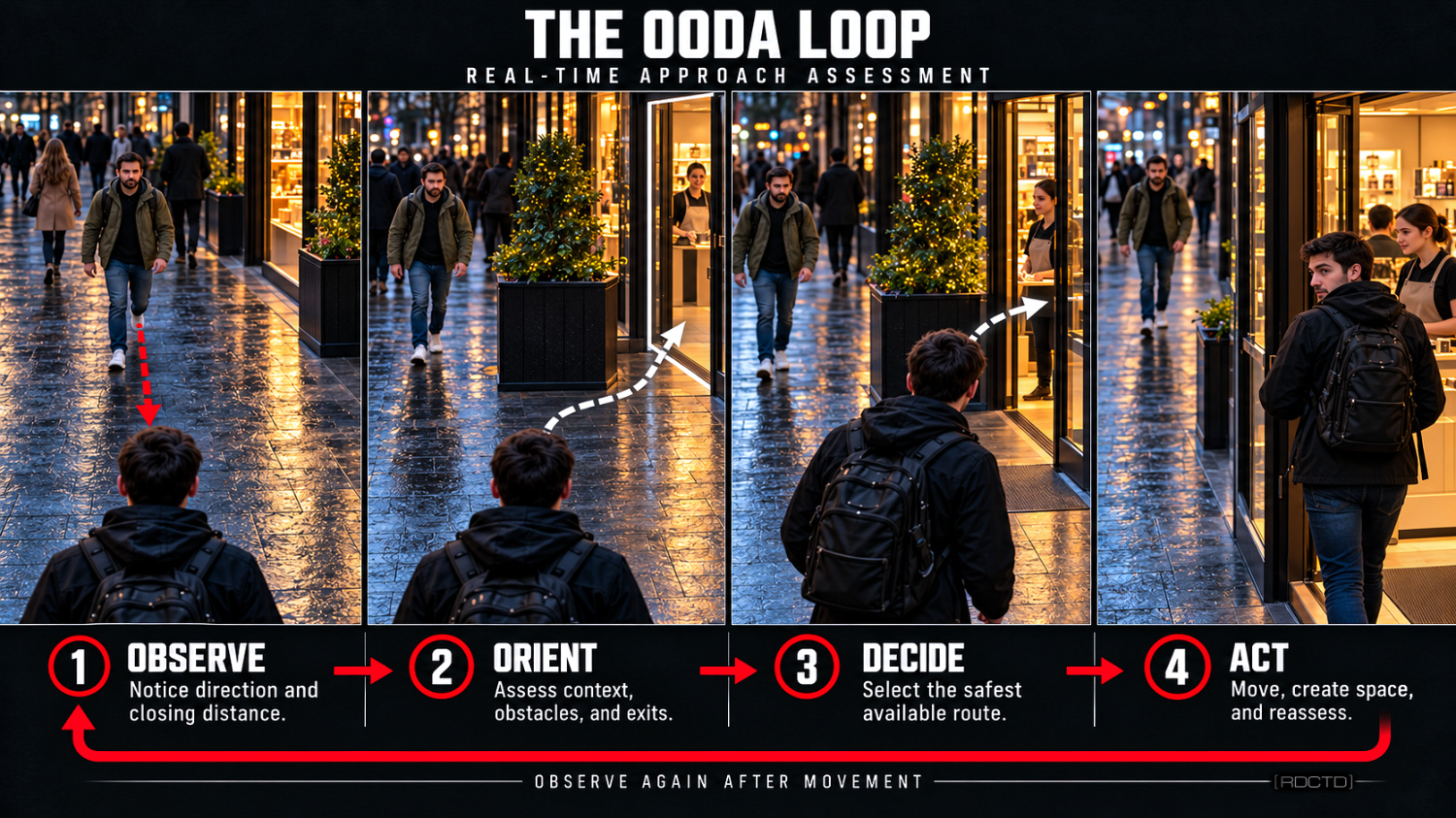
Use a short assessment you can execute while moving. The OODA process is useful here when each action is followed by a fresh look at its effect. A decision based on the previous position can already be obsolete.
Observe the changing distance and direction, orient against pedestrian flow and available exits, then choose a movement that preserves separation. Keep enough attention on your footing and the person’s response to determine whether that movement improves your position. Apply this as routes open or close, without waiting for certainty about the person’s intent.
- Establish the Baseline — identify your intended route, the normal pedestrian flow, and the nearest secure/safe or advantageous area. Register whether you’re carrying equipment, moving with a companion, or dealing with limited mobility. Those conditions determine which exits you can actually use.
- Scan the Approach Axes — check the route ahead, nearby entrances, lateral crossings, and the space you’re about to enter. Include periodic checks behind when you can do so safely. A forward visual sweep doesn’t account for every approach, and sustained backward observation can create a fall or collision.
- Watch for Adjustments — note changes in direction, pace, and orientation. Compare the person’s movement with the environment before attributing it to you. Keep enough attention on footing and exits to act on what you observe.
- Track Time to Contact — assess whether separation is growing, stable, or rapidly shrinking. Account for how long you’d need to reach an opening or gain an advantage. A person several steps away can still be an immediate concern when your movement is restricted.
- Check the Context — examine the apparent destination, shared obstacles, spoken explanation, and response to a clear boundary. Update downward when the person passes and continues away. Retaining a threat judgment after its basis disappears wastes attention and can provoke needless conflict.
- Decide and Act — choose the available action that improves security: allow a normal crossing, create space, move toward your backup, or obtain a crowd. If immediate danger develops, act without completing the remaining checklist. Reassess once the movement has changed your position.
Closing Time and Usable Space
In a simplified straight-line example, six meters of separation disappearing at two meters per second leaves approximately three seconds to contact if neither person changes movement. That’s an illustration of closing speed, with no claim that those distances or speeds define a safe threshold. Real movement includes acceleration, obstacles, and changing direction.
In practice, assess the trend and your ability to leave. You can’t spend the remaining interval performing arithmetic or searching for a perfect explanation. A route to safety that requires unlocking a door, crossing traffic, or moving a companion takes longer than an unobstructed walk into secure premises. Prepare for that delay before proximity becomes restrictive.
On wet ground, loose gravel, or stairs, reduce the complexity of your movement before increasing speed; a fall can remove the separation your decision was intended to preserve.
[ RESPONSE & ENGAGEMENT ]
Act while your options remain open. Match your response to the person’s behavior and your remaining freedom of movement. Use distance, barriers, and boundaries to limit unwanted contact. If an assault begins and your exit is blocked, defend yourself while creating an opening to disengage. Keep reassessing the effect of each action.
Change Path Toward a Useful Destination

Defensive Combat When Escape Is Blocked
Adjust Pace Without Surrendering Space
Use Barriers While Keeping an Exit
Set a Boundary and Keep Moving
Preemptive Combat When Harm Becomes Imminent

Escalate Assistance When Contact Becomes Imminent
In covert operations, preserving a low profile can be useful. Immediate danger can require conspicuous action, a raised voice, or emergency assistance. Remaining unnoticed has little value when it prevents you from obtaining help.
Before entering a shop for assistance, check that the visible person is an employee you can reach and that the entrance won’t leave you isolated behind a locked internal door.
[ OPERATIONAL APPLICATION ]
The same approach creates different problems in an open plaza and a narrow access lane. Assess the location you’re about to occupy. A familiar destination doesn’t guarantee a usable exit, especially when you’re distracted by arrival tasks.
Compromised Cover Hostile Approach
Your cover has been compromised, and a hostile individual is moving to intercept you. Apply the approach-line tradecraft immediately: track closing distance, available barriers, and usable exits. Suspend the current activity and move toward an accessible exit or established assistance point. Avoid getting drawn into defending your cover story while the person closes. Alert your security contact when doing so won’t delay protective movement. If an assault begins before you can leave, protect yourself and work to create an opening to disengage.
Vehicle Access
You’re approaching a parked vehicle when a pedestrian redirects toward you. Unlocking, loading equipment, and entering the seat can occupy your hands and restrict movement. If the approach is concerning, postpone those tasks and move toward an occupied location. Don’t allow reaching the vehicle to become an obligation. Once you’re safely inside a secured vehicle, keep the doors closed and obtain assistance if needed.
Doorways and Access Controls
A keypad, turnstile, or locked entrance can hold you in place while someone closes. Check the surrounding space before beginning the access task. If unwanted proximity develops, leave the restriction while you still can. At a staffed entrance, address the staff directly. Don’t permit social pressure to make you admit an unknown person through a controlled door.
Platforms and Crowded Transit
High pedestrian density makes close proximity routine. Prioritize usable footing, distance from platform edges, and access to security. If someone repeatedly obstructs your movement or directs threatening behavior at you, move toward a staffed area or alert transport personnel. Trying to maintain an arbitrary personal-space radius inside a packed carriage can produce collisions and needless confrontation.
Moving With Another Person
Your companion’s mobility and awareness determine the practical exit. Give a short destination-based instruction: “Come with me to reception.” Move together where possible. Avoid unexplained sudden movement that leaves someone standing inside the developing encounter. If you’re responsible for a person with limited mobility, request staff assistance early and select an accessible route.
When calling for emergency assistance, give your current location before describing the sequence; a dropped connection mustn’t leave responders without a destination.
[ ASSESSMENT FAILURES ]
An operative can recognize an approach correctly and still respond badly. Monitor your own attention when uncertainty starts consuming the entire scene. The assessment has to produce usable movement and accurate reporting.
- Fixation — staring at one person while losing the route, nearby traffic, or a companion’s position. Return attention to the space required for your next action.
- Confirmation Delay — remaining in an exposed location to collect another cue after you’ve already identified a safer destination. Leave before the available route deteriorates.
- Premature Attribution — handling a glance, concealed hand, or diagonal path as proof of an intended assault. Describe the observable behavior and keep the interpretation provisional.
- False Resolution — assuming the encounter is finished because the person has momentarily left view. Stay in the safer location, reassess, and obtain assistance when the preceding behavior warrants it.
Situational awareness requires keeping the wider environment in view while assessing a specific approach. Continue tracking nearby movement, obstacles, and usable exits as the encounter develops. When your attention locks onto one person, deliberately check the space you’ll need for your next action. This keeps your decisions tied to current conditions and helps preserve room to respond.
Record uncertainty alongside the observation; a detail you couldn’t see should remain unknown when the incident is reviewed.
[ FINAL ]
Approach-Line CQC Awareness gives the operative a method for recognizing when ordinary movement is becoming unwanted access. Read the developing intersection, keep the interpretation open to correction, and move before your exit becomes difficult. The value of this tradecraft is you’ve retained control of your movement and prevented an uncertain approach from forcing an avoidable close-contact encounter.
// Recheck your exit whenever a moving person or obstacle changes its accessibility.
+ Covert Operative Kit [ ] gear shop »»
[OPTICS : Undisclosed, Eastern Europe]