



 Time and timing are adaptive skills for any task or objective – the ability to recognize windows, sequencing action, and committing at the exact moment when conditions favor your plan or purpose.

If you control time, you control consequence.
Time affects every part of tradecraft. It determines how long preparation takes, when information remains useful, and which opportunities survive long enough to act on. Mastery of time means understanding how duration, sequence, and changing conditions affect what you’re able to accomplish.
For covert operatives, that understanding has to govern how you analyze, prepare, recognize an opening, and accept the consequences of committing at a particular moment. This optimizes potential and results.
Timing operates above individual skills because it governs when and how those skills are expressed.
I [ TIME CHANGES THE CONDITIONS ]

An hour has a fixed duration. Its operational value depends on what can happen within it. An hour available before a consequential decision may allow verification, consultation, or preparation. The same hour afterward may permit only damage assessment.
Recognizing this difference changes how you allocate effort. Work deserves priority according to when it can still influence the outcome.
Time also gives decisions an irreversible element. A plan can be revised and an error repaired, both occur after circumstances have already changed. The original moment remains unavailable. That makes attention to the present a practical responsibility. It’s the only point at which your effort can influence what happens next, using the abilities and information currently available.
Every situation is developing while you’re assessing it. Information ages. People reconsider commitments. Your own attention becomes less reliable after sustained effort. A plan written yesterday describes conditions that may already have changed. An operative who understands time treats an assessment as having a period of usefulness, with assumptions that require renewed examination as events develop.
Timing belongs to this relationship between an action and its conditions. The same words can clarify a discussion before a commitment and sound like an excuse afterward. An early equipment check leaves room for correction. A check performed at departure can uncover the same defect after you’ve lost most of your alternatives. Competence includes recognizing when a useful action will have its greatest effect.
Other people have their own rates of understanding, preparation, and response. Sending a message takes seconds – making it usable may require context, acknowledgment, and coordination. Your speed can exceed the team’s ability to absorb what you’ve done. The relevant measure is how quickly the necessary result becomes dependable across everyone involved.
This demands humility about prediction. A favorable opening can close sooner than expected. Preparation can take longer than experience suggests. Leave room for those errors wherever the task permits it.
A schedule that requires every estimate to be correct creates unnecessary dependence on favorable circumstances. Understanding time includes respecting how little of its unfolding you can guarantee.
Set the decision point early enough that an unfavorable answer still leaves a usable alternative.
II [ PATIENCE REQUIRES JUDGMENT ]

Waiting is an action with consequences. During a delay, additional evidence may come, a dispute may cool, or a necessary resource may become available. The opportunity may also deteriorate. Patience earns its value through what happens while you wait.
Without that connection, an operative can spend hours preserving uncertainty while calling the delay caution.
Know what you expect the passage of time to improve. A pending confirmation gives waiting a purpose. Repeatedly reviewing the same information may reveal that you’re avoiding responsibility for a decision. Set a point for reassessment and identify what would justify acting sooner. This keeps patience connected to the situation as it develops.
Urgency deserves equal scrutiny. Someone else’s impatience can become your working pace before you’ve examined whether their deadline is real. Anxiety creates a similar effect internally: movement feels preferable because it reduces the discomfort of an unresolved problem. An operative needs enough self-command to distinguish a closing opportunity from the emotional pressure to finish thinking.
In a difficult conversation, a brief pause can prevent an unnecessary commitment. In a deteriorating environment, leaving early may preserve options that extended observation would consume. These decisions require sensitivity to the rate of change. The useful amount of deliberation depends on how long the available response will remain effective.
Complete certainty is rarely available on schedule, or at all. Eventually, further delay can become more consequential than the remaining uncertainty. Accepting that point is part of judgment. It requires confidence in a decision process you’ve tested, along with a realistic account of what remains unknown.
Time mastery includes the willingness to act while doubt is still present, then remain attentive enough to correct the decision when new evidence warrants it.
A plan that’s on schedule can already be late if the conditions it requires are disappearing.
III [ CAPABILITY HAS A PREPARATION TIME ]

What an operative can accomplish in a critical minute depends heavily on what happened months or years earlier. Language proficiency, physical capacity, and reliable observation require development before they’re needed.
A sudden demand reveals the capabilities you’ve made available. The immediate situation usually allows only limited improvement to the person responding to it.
This gives ordinary days strategic importance. Consistent training determines which future tasks you can undertake independently and which will require assistance. Small omissions can also accumulate into persistent limitations.
Postponing a difficult skill feels inexpensive when today’s work remains manageable. Its eventual cost appears when an assignment requires competence that can’t be acquired within the time available.
Repetition needs examination. Years of practice can include years of preserving the same error. Useful development requires feedback, correction, and enough variation to establish whether the skill transfers beyond familiar conditions. Count the capability demonstrated after training. Time invested deserves an assessment of what it produced.
Preparation also reduces the number of decisions that must be made under pressure. Familiar equipment, clear responsibilities, and [rehearsed procedures](https://rdctd.pro/the-automaticity-directive/) leave more attention available for the parts of a situation that demand fresh judgment. That preparation must remain open to revision. A routine loses value when you continue applying it after its assumptions have failed.
Recovery belongs in the same calculation. Exhaustion can increase the time needed to understand a problem and correct avoidable mistakes. A crowded schedule may appear efficient while leaving you less capable at the moment that matters. Judge the allocation of time by reliable output over the relevant period, including the recovery needed to sustain it.
Some preparation will never be tested by the event you anticipated. Its value can still appear in fewer delays, clearer communication, or a wider range of workable responses. An uneventful period remains useful when you’ve used it to become more capable of handling the next demand.
An early arrival earns its value through what you verify before the task begins.
IV [ THE FUTURE INHERITS YOUR DECISIONS ]

Every commitment affects time beyond the moment you accept it. An assignment creates preparation requirements and follow-up work. Equipment requires maintenance. A relationship carries expectations. The initial decision can take seconds while its obligations occupy months.
Assessing only the immediate effort leaves you with an incomplete understanding of what you’ve agreed to do. Account for how other people may respond as those obligations develop.
Shortcuts deserve particular attention because their full duration is easy to underestimate. An unchecked report can require several later corrections. An unresolved misunderstanding can complicate every subsequent exchange. Finishing today’s task can leave additional work for the same team tomorrow. Competent execution accounts for the consequences of today’s work, including how long the result will remain usable and what maintaining it will demand.
Strategic judgment connects those consequences to a longer purpose. An operative can complete a succession of urgent tasks while allowing an important capability to deteriorate. Reviewing the direction of your effort matters because immediate demands can occupy every available hour. Protect time for work whose benefits come later, especially when neglecting it will restrict future assignments.
Past investment can complicate that judgment. A method you’ve spent years learning may become less relevant. A project may stop justifying its demands before it reaches completion. The elapsed time can’t be recovered by continuing. Decide whether the remaining work deserves the time still available, using present conditions and the objective you now need to achieve.
A finite working life makes these choices consequential. Every sustained commitment limits what else you can develop, experience, or complete. Status and habit can keep obligations in place long after their purpose has weakened. Examine them while there’s still time to act on the conclusion.
Mastery of time requires living with that limit without allowing it to produce constant haste. Your present decisions are creating the conditions under which you’ll have to work later, often long after the pressure that prompted them has disappeared. An operative who understands this can give a brief opening their full attention while accounting for the future it’ll create.
Some decisions take years to become understandable, even when their consequences begin immediately.
[ FINAL ]
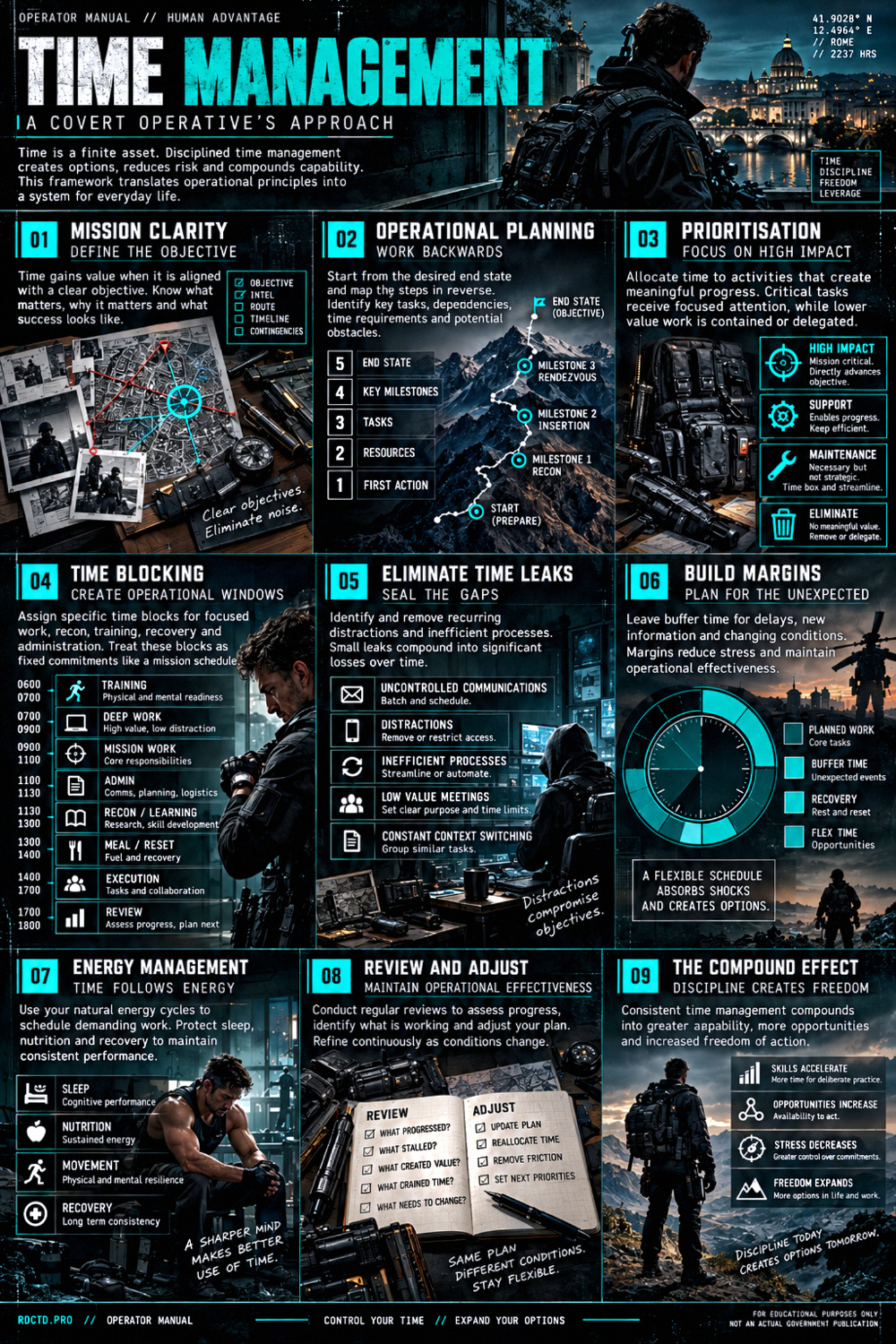 An operative’s understanding of time becomes visible in what their decisions make possible afterward. Each task deserves attention to its immediate demands and the future capacity it’ll consume or create. Apply your tradecraft with that continuity in mind, so urgency doesn’t reduce your judgment to whatever gets you through the next hour.
// Being a master of time is knowing which seconds can decide the value of years.
+ Covert Operative Kit [ ] gear shop »»