



 A tradecraft method of tracing how conditions and actions produce outcomes, testing the explanation against competing causes, and identifying where an intervention can change what happens next.

Causal reasoning is analyzing events through causal mechanisms to identify where a targeted action could change the result.
An operative who mistakes sequence for causation can move fast against the wrong problem, a late report becomes evidence of obstruction. A change in someone’s behavior becomes proof of hostile intent, a successful intervention becomes a process before it’s established why it worked. The explanation starts directing the operation before it’s earned that authority.
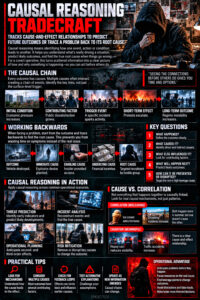
Causal Reasoning Tradecraft is the deliberate examination of causal mechanisms, contributing conditions, and alternative explanations to understand an outcome and assess how an action could affect it. Work backward to reconstruct an incident. Work forward to anticipate consequences. Keep the explanation open to evidence that breaks it.
A causal claim goes beyond observing that two things occur together. It asserts that changing one condition would affect another under specified circumstances. Formal causal inference distinguishes observing a condition from intervening to change it – the latter requires additional assumptions. A field assessment rarely has experimental control. Keep its limitations visible.
For a covert operative, the practical value and strategic use is deciding where to commit attention, verification, time, and resources. A plausible explanation can guide the next check. It can’t automatically justify an accusation or an irreversible action. Match the consequence of the decision to the strength of the evidence supporting it.
This method combines causal mapping with assumption checks and competing explanations. Drawing a chain doesn’t establish causation, every consequential connection still needs examination.
During review, conceal the names and ranks attached to competing explanations. Compare their evidentiary support before restoring the identities of the people defending them.
[ BUILD THE CAUSAL PICTURE ]
Define the problem tightly enough to investigate. “The operation failed” contains too many possible outcomes. “The required assessment reached the decision-maker after the briefing began” identifies a failure you can reconstruct. Start with an observable discrepancy and a decision that depends on explaining it.
Fix the Outcome and Its Boundaries
State what occurred, when it occurred, and which part requires explanation. Strip intent and blame from the initial description. “The recipient didn’t acknowledge the report” preserves an observation. “The recipient suppressed the report” adds a causal judgment that needs separate support.
- Observed Outcome — Describe the measurable departure from the requirement, including what you directly observed and what another individual or entity reported.
- Comparison Condition — Establish the expected result and its basis: a confirmed deadline, normal completion time, or comparable previous task.
- Decision Boundary — Define the action the analysis must support and when that decision becomes necessary, exclude detail that can’t affect it.
A change in reporting can resemble a change in the underlying situation. Increased inspection can produce more recorded defects while the actual defect rate stays constant. Check how the outcome was detected and counted before explaining why it increased.
Separate the Trigger From Its Conditions
The last event before a failure attracts attention because it’s visible and recent. Examine the conditions that made that event consequential. An equipment failure can interrupt delivery; a single delivery dependency can turn that interruption into a missed requirement.
- Immediate Cause — Identify the event or process directly producing the outcome, such as a failed transfer preventing receipt before a deadline.
- Enabling Condition — Identify what allowed that failure to propagate, such as an absent receipt check or an unavailable approved backup.
- Persistent Driver — Examine recurring arrangements that sustain the exposure: unclear ownership, insufficient capacity, or incentives that reward speed while concealing errors.
Distinguish necessity from sufficiency. A required approval can be necessary for release while remaining insufficient without a completed assessment. Several failures can also provide independent routes to the same outcome. Removing one contributor may leave another route fully functional.
Map Branches, Delays, and Feedback
Write each relevant event or condition separately. Connect them only where you can state a proposed mechanism. “Workload increased, review took longer, release occurred late” contains claims you can check. Attach supporting evidence and uncertainty to each connection.
Allow branches. Workload can increase both review delay and transcription errors. Those errors can create additional review work later. Represent feedback across time: today’s backlog produces tomorrow’s rework, which increases the next backlog. This keeps the order of influence explicit.
Mark the delay between cause and effect. A repair can take several reporting cycles to become visible. An immediate improvement can also reflect work already completed before the repair. Define the expected response window before judging the intervention.
*PRO TIP: Boundary Expansion – When a failure repeatedly survives local repairs, extend the causal map across the preceding and following handoffs to identify dependencies excluded by departmental ownership.
A usable causal map identifies the outcome, the proposed mechanisms, and the uncertainty attached to each consequential connection.
Maintain a separate account of interventions that failed to produce their expected effect. Repeated exceptions can expose a missing condition that successful cases allowed you to overlook.
[ TEST THE EXPLANATION ]
Attack the weakest connection in your preferred explanation. More detail won’t repair a missing mechanism. Confidence from senior personnel won’t establish temporal order. Force each causal claim to survive checks that could expose it as wrong.
Establish Sequence and Mechanism
Build the timeline from available records and accounts. Distinguish when an event happened from when someone learned about it. Check clock differences, delayed entries, and reconstructed recollections before declaring that one event preceded another.
- Temporal Order — Establish that the proposed cause preceded the relevant effect; record any uncertainty in the timing that could reverse that order.
- Transmission Mechanism — Explain the physical, informational, organizational, or behavioral process connecting the cause to the outcome.
- Discriminating Evidence — Identify an observation that would be more expected under this explanation than under its strongest credible alternative.
A reliable source can accurately describe an event and still misidentify its cause. Use the Source Reliability Matrix to examine the reporting, then evaluate the causal inference separately. Multiple reports derived from one original account provide repeated transmission of the same evidence.
Break the Correlation Traps
Two conditions can move together because a third influences both. Hot weather can increase ice cream sales and swimming exposure, with greater exposure contributing to drowning counts. The association doesn’t establish that purchasing ice cream produces drownings. Identify the shared cause and the pathway through which it could operate.
- Common Cause — Check whether workload, weather, staffing, or another prior condition could explain both the suspected cause and the observed outcome.
- Reverse Direction — Examine whether the outcome produced the suspected cause; additional supervision may follow deteriorating performance.
- Selection Distortion — Check how cases entered your review; examining only escalated failures can create misleading relationships that don’t hold across routine work.
Preserve the denominator. Six failures across a hundred attempts and five across ten attempts indicate different failure rates. Compare similar task demands and observation periods. Avoid automatically adjusting for every recorded variable – some variables sit within the mechanism you’re trying to understand, and inappropriate adjustment can distort the inference.
Keep Competing Explanations Alive
Write the strongest credible alternative before expanding your favored account. Include ordinary failure where it fits. Equipment faults, misunderstood requirements, overload, and inaccurate reporting deserve examination alongside deliberate interference. Assigning intent requires evidence about intent.
Compare what each explanation predicts. A fact that fits every candidate offers little help choosing between them. A missing record matters only if the proposed mechanism should have produced it and your records would probably have preserved it. Search for contradictions with the same effort you give supporting material.
Use the Known Unknowns Matrix to retain unresolved dependencies. State what would change your judgment and which check would most affect the pending decision. An unresolved explanation remains a working assessment.
Retain the explanation that best survives credible alternatives while keeping material gaps and contradictions visible.
Before collecting another report, specify how each possible answer would affect the decision. If every answer leaves the action unchanged, identify a more consequential uncertainty.
[ OPERATIONAL APPLICATION ]
In covert operations, attention and verification capacity are limited. Use causal reasoning where a better explanation can change preparation, reduce exposure, or recover output. Keep the analysis tied to a decision you can actually make.
Anticipate Operational Failure
Work forward from the conditions a plan requires. Identify which dependencies have to remain available and what follows if they fail. An on-time departure can depend on completed documentation, equipment availability, and a confirmed requirement. Several dependencies may share one administrative bottleneck.
- Failure Path — Trace how a specific dependency could prevent the required outcome and identify any protection already interrupting that path.
- Leading Indicator — Select an observable development expected before the failure becomes unavoidable, such as a review queue exceeding the remaining processing time.
- Response Threshold — Establish when the indicator requires an authorized adjustment, additional verification, or suspension of the affected task.
Keep forecasts conditional. “Completion is unlikely if approval remains unresolved at the cutoff” identifies a dependency. A prediction of inevitable failure can conceal assumptions about available alternatives. Review risk as those conditions change.
Reconstruct an Incident Without Manufacturing Intent
A missed status report establishes a reporting failure. It leaves several possibilities open, including loss of connectivity, an incorrect schedule, incapacity, and deliberate withholding. Follow the existing response procedure while the cause remains unresolved. An urgent protective action can be warranted before the explanation is complete.
Preserve the original sequence and separate direct evidence from interpretation. Examine who knew what at each decision point. A person acting on an outdated instruction can appear obstructive when judged against information received later.
Assess incentives as possible mechanisms. Fear of reporting bad results can encourage delay, but an incentive doesn’t prove that a particular person concealed anything. Keep responsibility attached to supported actions and omissions. Blame assigned early can contaminate subsequent accounts.
Recover Time and Output
Repeated delay deserves the same scrutiny as a conspicuous incident. Track where work waits, where it returns for correction, and where ownership becomes ambiguous. A team can remain fully occupied while unfinished work accumulates between handoffs.
Locate the constraint. Adding capacity upstream can increase congestion when downstream review is already saturated. A correction should address the mechanism limiting completion. Examine whether it merely transfers waiting time or error burden to another person.
Distinguish productive speed from postponed rework. A faster first submission can create a slower final release if error rates rise. Measure completion against the actual requirement, including the quality needed for the next person to use the result.
*PRO TIP: Tail Delay – Review unusually slow cases separately from average completion time to identify intermittent constraints that disappear inside an acceptable overall mean.
Apply causal reasoning to the dependencies controlling operational reliability, information quality, and completed work.
When an intervention improves your metric, inspect the workload of the next recipient. A local gain can conceal a cost your measurement boundary excludes.
[ CAUSAL REASONING PROTOCOL ]
Use a brief check for an immediate decision and a fuller reconstruction when time permits. Work alone by writing the competing accounts before choosing between them. With a team, have another person develop an explanation independently before hearing yours.
Run the Immediate Check
Use a tactical pause when conditions permit. Keep attention on immediate demands and execute established emergency procedures where applicable. The check should clarify the next action without consuming the time available to take it.

If verification can’t be confirmed in time, state the assumption you’re using and its consequence if wrong. Uncertainty belongs in the decision record whenever it materially affects the action.
Work a Delayed Assessment Backward
A field assessment arrives twenty minutes after its scheduled briefing. The author reports submitting it an hour beforehand. The initial allegation is that the reviewer held it deliberately. Handle that allegation as a hypothesis and reconstruct the handoff.
The records support a specific failure mechanism, they don’t establish a person’s motive. If the new process still produces late releases, inspect capacity and other remaining paths. Intelligence analysis requires revision when the observed result contradicts the explanation.
Intervention and Forecast

Complete the assessment with an executable decision, a conditional forecast, and a defined point for review.
When several repairs begin together, record their timing and overlap. Otherwise, the result can justify a package of changes while leaving the contribution of each one unresolved.
[ TRAIN AND AUDIT ]
Train on bounded problems with records you can inspect. Routine delays and quality failures provide enough complexity to expose weak inference. Judge the method by the predictions and corrections it produces.
Use Counterfactuals Carefully
Remove the suspected cause mentally while keeping the remaining conditions coherent. Assess whether the outcome could still occur through another route. This can expose dependencies and redundant failure paths. The imagined result remains dependent on your model.
For a recurring workflow, compare similar cases where the suspected condition was present and absent. Examine differences in difficulty, staffing, timing, and measurement. A before-and-after improvement can also reflect lighter demand or recovery from an unusually bad period.
Where practical, test a reversible process change in a controlled exercise or routine authorized work. Avoid manufacturing field danger to settle an analytical dispute. Preserve enough comparability to interpret the result, and retain unresolved alternative explanations.
Audit the Forecast Against the Result
Record the explanation and forecast before learning the outcome. Use approved records with detail proportionate to the task. Reconstructing your prediction afterward makes it easy to replace an actual error with a more defensible memory.
- Forecast Accuracy — Compare the predicted direction, timing, and conditions with what occurred, including cases where the forecast failed.
- Mechanism Evidence — Check whether the expected intermediate change occurred; an improved final result can coexist with an incorrect explanation.
- Residual Exposure — Identify failure paths the intervention left active and any new burden or dependency it introduced.
- Assessment Revision — State which causal claim changed, why it changed, and how that affects the next decision.
If you assign probabilities repeatedly, review calibration across enough comparable forecasts. One successful prediction can’t establish that your confidence is well judged. Keep the original wording available so the standard doesn’t change after the result.
Stop at the Evidence Limit
“Human error” leaves the causal work unfinished. Identify the decision, the information available, and the conditions that made the error possible or consequential. “Poor culture” is equally weak until you’ve specified the observable practices carrying its effect.
Stop extending the map when additional detail won’t change the pending action, or when evidence no longer supports the next connection. State the unresolved boundary. A single definitive root cause may remain unavailable, especially where several interacting conditions produced the outcome.
*PRO TIP: Explanation Transfer – Before applying a causal lesson to another setting, compare the staffing, incentives, dependencies, and observation methods that allowed the original mechanism to operate.
Keep immediate containment separate from long-term repair so each receives its own completion test. A temporary workaround can restore output while leaving the recurring failure mechanism intact. Verify the repair against subsequent work.
Retain causal lessons within the conditions the evidence supports, and revise them when subsequent work exposes a missing dependency.
After a near miss, identify the condition that prevented harm and establish whether it was a maintained safeguard or an accidental interruption. Future planning needs that distinction.
[ FINAL ]
Causal Reasoning Tradecraft requires you to explain how an outcome was produced and test whether changing a specific condition can affect its recurrence. Define the event precisely. Examine the mechanism and its strongest alternative. As a covert operative, commit resources where the supported explanation identifies practical leverage, with explicit limits on what remains uncertain. When the result contradicts the forecast, reopen the causal assessment before repeating the intervention.
// Before accepting the obvious cause, examine how someone defined the problem.

+ Covert Operative Kit [ ] gear shop »»
[OPTICS : Paris, France]