![[RDCTD]](https://rdctd.pro/wp-content/uploads/RDCTD-Covert-Operative-Tradecraft-Guide-LOGO-tk.png)
![[RDCTD]](https://rdctd.pro/wp-content/uploads/RDCTD-Covert-Operative-Tradecraft-Guide-LOGO-mobile.png)


 A tradecraft field guide for monitoring your thinking, interrogating your judgments, and regulating your responses under pressure – keeping attention, emotion, and behavior accountable to the mission.
Before committing to a consequential decision, identify the assumption you’re least willing to examine. Give that assumption the first independent check.
An operative can follow procedure while working from a defective judgment – decided what a silence means, assigned intent to an ambiguous remark, or accepted a familiar explanation before checking it. Every subsequent action can look competent while carrying the original error forward.
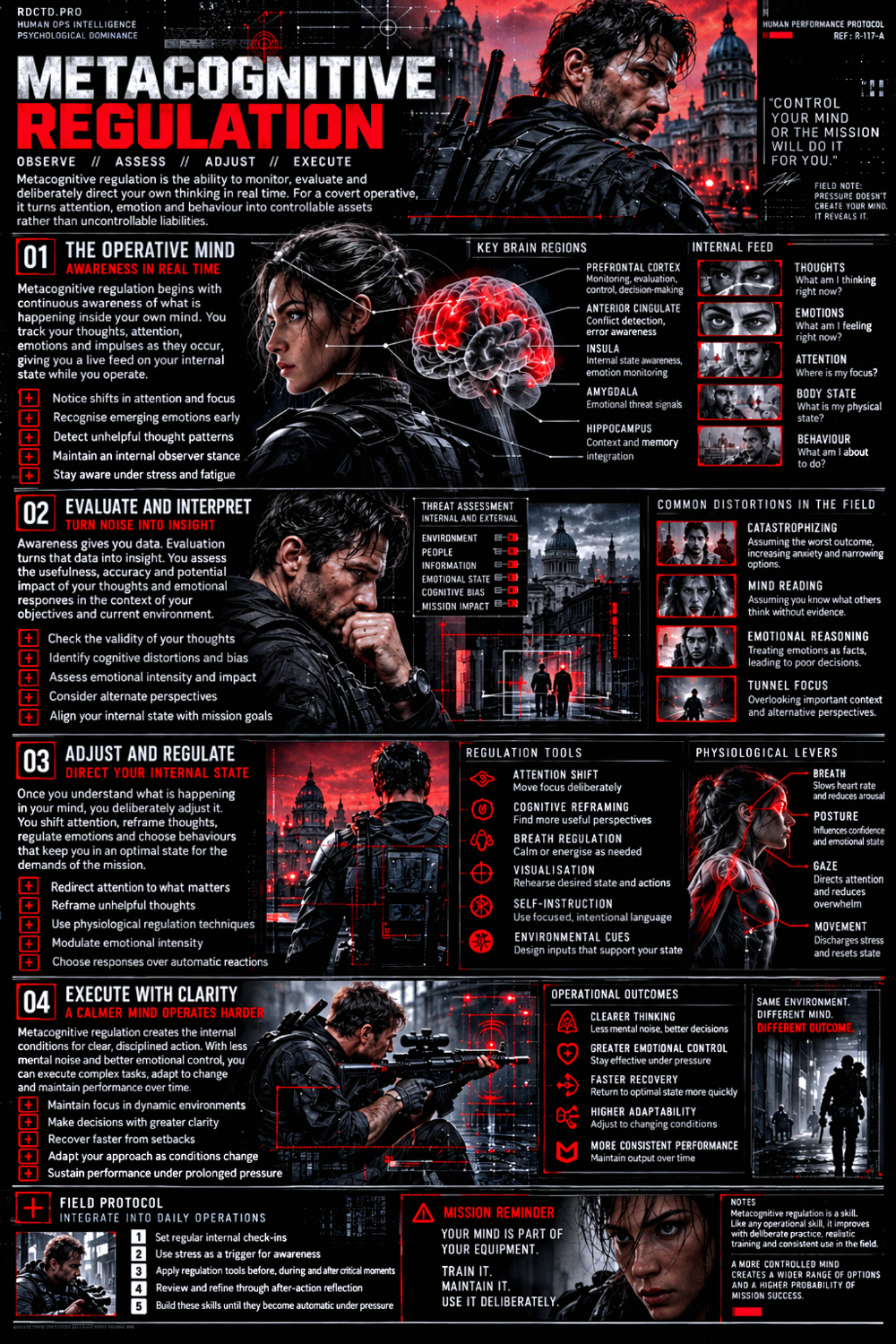
Metacognition is awareness and evaluation of your own thinking. Metacognitive regulation uses that information to direct how you approach a task, allocate attention, and correct your methods. In operational terms, you’re checking the judgment that’s about to authorize your next move.
The practical sequence is observe, assess, adjust, execute. Detect what’s happening internally, examine its relevance and accuracy, apply a specific correction, then check the effect on performance. The cycle stays short enough to support the task.
This extends situational awareness to the person interpreting the environment / scenario. A covert operative needs both. External observation loses value when impatience, fixation, or an untested assumption determines what the observation means.
When your certainty increases, identify the new evidence responsible. If nothing external changed, examine whether repetition, fatigue, or emotional investment strengthened the belief.
[ OBSERVE YOUR INTERNAL STATE ]
Start with the interference you can actually detect. You’re rereading the same sentence, interrupting a briefing, overlooking a changed detail, or preparing a response before the other person finishes. These are usable indicators. A vague declaration that you’re stressed gives you considerably less to work with.
Establish Your Baseline
Know how you perform during an ordinary, manageable workload. Identify your usual reading pace, error rate, tolerance for interruption, and ability to retain instructions. That baseline gives you a reference when conditions deteriorate.
- Attention — Identify the task you’re supposed to be performing and where your attention actually rests; unfinished arguments and anticipated problems can occupy it without producing anything useful.
- Physical Condition — Register fatigue, discomfort, tension, or unusual agitation that may be interfering with the task; handle these as conditions requiring assessment.
- Performance — Look for observable changes such as repeated omissions, lost instructions, unnecessary rereading, or difficulty explaining your next action.
Your baseline isn’t a permanent standard. Workload and circumstances change and evolve. Use it to detect deterioration early enough to adjust the task, obtain support, or take a necessary break.
Identify the Impulse Before Acting
An emotion becomes operationally significant when it starts selecting behavior. Irritation pushes you to interrupt, embarrassment pushes you to conceal an error, anxiety pushes you to repeat a check after it has stopped providing information. Identify the action you’re being pulled toward.
- Thought — State the interpretation specifically: “I’m assuming the delay means the plan has failed.”
- Emotion — Name the response without expanding it into a long story: “I’m frustrated by the lack of confirmation.”
- Impulse — Identify the pending behavior: “I’m about to send another message without checking the agreed response window.”
- Consequence — Assess what acting on that impulse could cause: “Another premature message could create confusion about the agreed timing.”
That separation exposes the point where you can intervene. You may have limited control over the first reaction, you can still examine the action it proposes.
Keep the Check Brief
Constantly inspecting your own performance can become another competing task. Use short checks at meaningful transitions: before a consequential decision, after an interruption, when there’s new evidence, or when you notice an error. Identify the specific interference, choose one corrective action, and return your attention to the task before the check becomes a distraction.
Name the interference and return attention to the work. An operative driving, navigating, or handling equipment can’t afford prolonged inward analysis. Maintain immediate task control and conduct the fuller review when conditions permit. If the same interference keeps returning, reassess your workload at the next safe opportunity before repeated errors compromise the task.
*PRO TIP: Trigger Selection – Attach an internal check to a recurring task boundary, such as finishing a briefing, so the check has a defined place without consuming continuous attention.
Observation is complete when you’ve identified something specific enough to evaluate or correct.
For a disputed interpretation, write down the observation that would favor each plausible explanation. Collect against those differences before spending more time defending a preferred account.
[ ASSESS THE JUDGMENT ]
Put your interpretation through the same scrutiny you’d apply to an unverified report. Familiarity, urgency, and personal investment don’t establish accuracy. The immediate requirement is to distinguish what you’ve observed from what you’ve concluded.
Separate Observation From Inference
“The briefing ended early” describes an event. “They’ve lost confidence in me” assigns a cause. That cause may be possible, but it remains an inference until supporting information establishes it. Mixing the two gives speculation the authority of observation.
- Observed — Record the behavior, statement, discrepancy, or result you can identify directly.
- Inferred — State the meaning you’ve attached to it and the assumptions required for that meaning to hold.
- Unresolved — Identify the missing information that would materially affect your next decision.
This is intelligence analysis applied to your own reasoning. Keep uncertainty visible. Filling a gap with a confident explanation doesn’t eliminate the gap. Identify which missing fact could change your next action and verify it before committing, when conditions permit. If you can’t resolve it in time, carry that uncertainty into the decision and define what would trigger reassessment.
Detect Distorted Reasoning
A useful distortion label identifies how your judgment may be failing. Apply it to a specific claim and examine it. Calling yourself biased without changing the assessment accomplishes nothing. Specify what evidence you’ve dismissed or overvalued, then reassess whether your conclusion still holds.
- Catastrophizing — You’re handling the worst conceivable outcome as the expected outcome; distinguish its severity from the evidence that it will occur.
- Mind Reading — You’re assigning intent from limited behavior; identify plausible alternatives and avoid declaring motive as fact.
- Emotional Reasoning — You’re using the strength of a feeling to certify an external claim; identify the observable evidence separately.
- Tunnel Focus — One detail has taken control of the assessment; revisit the objective and the information you’ve stopped considering.
- Confirmation Bias — You’re accepting supporting information readily while demanding excessive proof from contradictions; apply the same evidentiary standard to both.
Recognizing these patterns doesn’t establish that your concern is false, it establishes a reason to check how you reached the conclusion. A serious problem can exist alongside defective reasoning about it.
Match Confidence to Evidence
State how certain you are and identify what supports that certainty. For consequential decisions, record your assessment before learning the outcome. Retrospective confidence is too easy to rewrite.
- Evidence Quality — Check whether the information is direct, current, independently corroborated, and relevant to the actual decision.
- Decision Cost — Increase scrutiny when an error would be difficult to reverse or would affect other people.
- Revision Condition — Name the finding that would make you reduce confidence, change the plan, or stop.
You won’t always have time to resolve uncertainty. Make the remaining uncertainty explicit and select an action proportionate to it. Urgency doesn’t improve the information available.
An assessment earns operational value when it identifies what you know, what remains uncertain, and what that uncertainty changes.
Before using a regulation technique, define the error it should reduce. Evaluate the technique against that error at the next task boundary; feeling better alone doesn’t establish restored performance.
[ ADJUST YOUR RESPONSE ]
Apply a correction that addresses the detected failure. Wandering attention needs a defined target. Unsupported certainty needs an evidence check. Excessive workload may require fewer demands or additional support. Select the intervention by the problem it can plausibly solve.
Redirect Attention Deliberately
Give attention a concrete assignment. “Focus” leaves the task undefined. “Verify the time against the original message” specifies an action and a completion point. Precision reduces the amount of interpretation required to resume useful work.
- Task Target — Identify the next observable action: finish the readback, check the source, or compare the two conflicting entries.
- Working Memory — Move pending items into an approved checklist or secure note when the environment permits; stop repeatedly rehearsing details that can be recorded reliably.
- Input Control — Remove competing notifications, close irrelevant material, or sequence simultaneous requests while maintaining access to essential information.
When fixation is the problem, widen the review deliberately. Recheck the objective, recent changes, and neglected information. When distraction is the problem, reduce the immediate task to a manageable step. Check whether the adjustment helps you complete that step accurately without losing track of information you’ll need for the next decision.
Reframe Without Falsifying
Reframing changes how you interpret a situation while retaining the facts – it must survive scrutiny. Reassuring yourself that everything is under control is useless when you haven’t established what control remains.
“The plan is ruined” can become “The original timing is unavailable; two alternatives still meet the objective.” “I can’t afford to admit this mistake” can become “The discrepancy exists, and an early correction limits its consequences.”
- Retain the Facts — Preserve the actual loss, constraint, or uncertainty; remove unsupported conclusions added by frustration or fear.
- Identify Remaining Control — Specify the decision, resource, or corrective action still available to you.
- Issue a Usable Instruction — Convert the revised assessment into behavior: “Verify the replacement time before confirming.”
Self-instruction should sound like a clear procedural command. Use wording you can act on immediately. Self-insults add another problem without specifying a correction.
Regulate Physical Interference
Check whether unnecessary tension or hurried breathing is interfering with the task. Where conditions permit, ease your grip, release your jaw, and allow breathing to settle into a comfortable rhythm. Keep your eyes and attention available to the environment.
- Breathing — Use comfortable, unforced breaths during a safe pause; avoid turning a breathing count into another task that consumes essential attention.
- Posture and Movement — Adjust an uncomfortable position or take a brief movement break when appropriate; address the physical condition you’re actually experiencing.
- Capacity — If fatigue or overload continues to produce errors, reduce demand, arrange relief, or stop the affected task according to its requirements.
- Muscular Tension — Check for a clenched jaw, raised shoulders, or an excessive grip; release unnecessary tension while maintaining the control your task requires.
Composure supports execution when it helps you work accurately. It doesn’t validate a judgment or replace rest, preparation, and adequate staffing.
*PRO TIP: Rehearsal Specificity – Before a demanding task, mentally rehearse one likely interruption and the exact step for resuming from the last verified point.
A correction is useful when it restores a capability the task requires.
When recovering from an interruption, identify the last completed verification before resuming. Reconstructing your place from familiarity can preserve an omission you never noticed.
[ EXECUTE AND VERIFY ]
Return to the task with a defined action and an observable standard. Regulation becomes useful through its effect on execution. If the same omissions, rushed judgments, or communication failures continue, the adjustment hasn’t resolved the problem.
Complete the Next Required Action
Endless internal analysis can become a way to postpone commitment. Once you’ve examined the relevant uncertainty and selected an appropriate response, execute within the task’s constraints. Use established immediate-action procedures when conditions require them, then review when a safe opportunity exists.
- Initial Assessment — Identify the conclusion, its supporting evidence, and your stated confidence before the outcome was known.
- Detected Interference — Record the specific behavior that indicated a problem and how early you recognized it.
- Correction — Identify what you changed and whether accuracy, completion, or communication improved afterward.
- Next Repetition — Select one procedural adjustment that can be tested during the next comparable task.

Reopen the decision when relevant information changes. Repeatedly reconsidering the same evidence without a new method consumes time and can delay necessary action. If you can’t identify new evidence or a specific flaw in the reasoning, proceed with the selected action until a defined reassessment condition occurs.
Apply the Full Cycle
During a briefing, a colleague challenges your assessment. You feel irritation and begin preparing a rebuttal while they’re still speaking. The immediate danger is that you’ll defend a conclusion before understanding the objection.
The performance standard is whether you understood and addressed the objection accurately. Feeling irritated afterward doesn’t invalidate a sound response. Check whether your reply addressed the evidence presented and whether any resulting correction reached the people affected. If irritation persists, monitor whether it influences your next judgment.
Contain the Next Error
Once an error occurs, prevent it from generating additional mistakes. An operative who notices a wrong entry may rush the correction, omit a check, and introduce a second discrepancy. The urge to recover lost time deserves scrutiny.
Establish what’s wrong, identify affected work, and correct from a verified point. Notify anyone whose decisions depend on the faulty information. Record the unresolved consequences before continuing.
Concealing an error preserves its ability to affect later decisions. Address the damage while it’s still identifiable, even when reporting it is uncomfortable.
Judge recovery by the accuracy and control of the work that follows the error.
In team reviews, collect individual assessments before exposing everyone to the senior person’s conclusion. Preserve the differences long enough to identify which evidence produced them.
[ INTEGRATE THE FIELD PROTOCOL ]
Build the method into ordinary work before relying on it during pressure. Briefings, planning sessions, report writing, and routine handovers provide repeated opportunities to detect faulty assumptions and measure corrections. Use that repetition deliberately.
Set the Conditions Before the Task
Identify the objective, likely interference, and the point where that interference would become visible. Prepare a short response in advance. “If I begin answering before the briefing ends, I’ll stop and capture the unresolved point.”
Keep the response specific to a recurring problem. An elaborate checklist for every possible mental state will compete with the work. Select the few errors that repeatedly cost accuracy, time, or coordination.
Review Decisions Against the Record
After the task, examine what you believed at the time and how you acted on it. Use available records and external feedback. A favorable outcome can conceal weak reasoning; an unfavorable outcome can follow a reasonable decision made with incomplete information.
Keep any written review within applicable information-handling requirements. The purpose is to improve the method without creating an unnecessary record of sensitive activity.
Train for Observable Improvement
Begin with a familiar task and a manageable workload. Add controlled interruptions or time constraints once the basic procedure is reliable. Track omitted steps, unsupported conclusions, and how long it takes to resume accurate work.
An observer can flag interruptions, skipped checks, or discrepancies you miss. Agree on a brief correction cue beforehand. If the cue becomes an argument about status, its operational value disappears.
*PRO TIP: Calibration Record – Compare predictions made at similar confidence levels across repeated tasks to identify where your certainty consistently exceeds your accuracy.
Practice can make the check easier to retrieve, but performance still depends on conditions. When a familiar correction stops working, reassess the workload and the method instead of repeatedly demanding more effort from the same failing approach.
Training should produce earlier error detection, better calibrated judgments, and fewer repeated failures in comparable work.
Audit successful decisions for assumptions that happened to survive unchecked. A favorable result can teach the wrong lesson when the review never examines how it was obtained.
[ FINAL ]
Metacognition regulation requires you to examine the judgments you’re preparing to act on and intervene when your process is failing. For a covert operative, that means catching the unsupported assumption, correcting the interference, and verifying the next action against the actual requirement. Your first interpretation remains subject to review, regardless of how certain you feel or how much you’ve already invested in it.
// Keep a record of what changed your mind. Over time, it reveals whether your judgments respond to evidence, authority, discomfort, or the desire to finish.
+ Covert Operative Kit [ ] gear shop »»
[TAG : Metacognition Regulation]