




 The tradecraft of making your next move governed by the objective when the stakes rise by preserving awareness and purpose, containing the impulse it creates, then strategically executing with control.

Whenever you’re about to make an irreversible decision for immediate relief, establish what happens after relief passes.
An unknown hostile approaches with a weapon in his hand, and the next few seconds will determine who walks away. An enemy team has spotted you, and you begin a surveillance detection route while deciding whether the operation can continue. A family emergency hits while you’re committed to a mission, dividing your attention. In each situation, emotion can drive your first response before you’ve established what the moment requires.
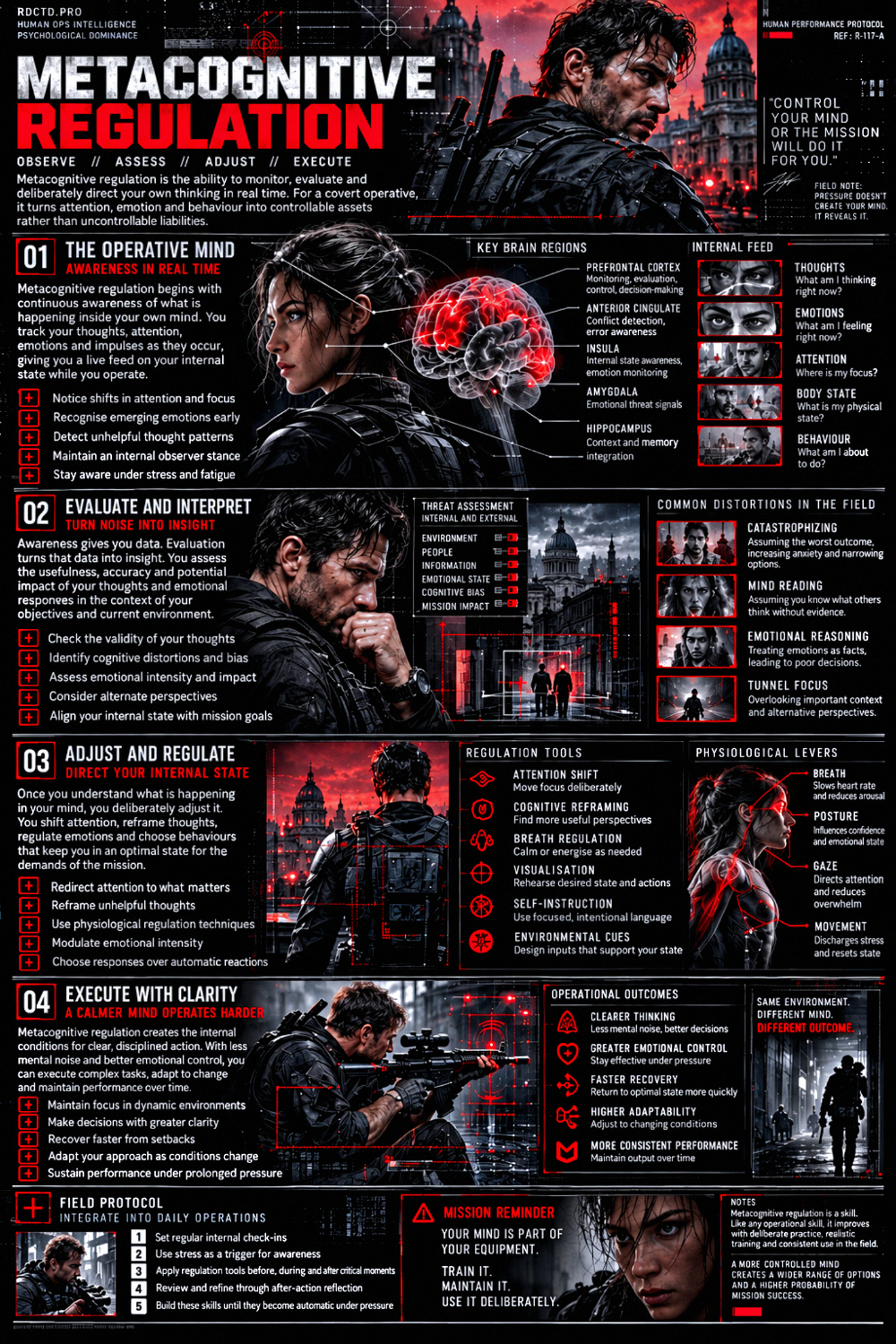
A decision made on a false assumption can put you or someone else in danger. A delay while you wait for certainty can leave you exposed. Your response has to account for the threat, the time available, and the people affected.
The Detachment Protocol gives you a way to take control at that point. You recognize the reaction, contain the impulse, establish the immediate objective, and optimally act on the situation in front of you. The emotion remains available as information. Its demand for immediate expression gets examined before you act on it.
For an operative, this is decision-making under duress applied to the reaction itself. It helps preserve judgment when fear, anger, attachment, guilt, or urgency threatens to narrow your options. A controlled response lets you address the immediate danger, communicate what matters, and continue the mission when conditions permit.
Detachment is a temporary allocation of attention and control. You remain connected to the people, environment, and consequences involved – and return to the emotional response when the immediate requirement allows it.
Before interpreting another person’s behavior, state what you observed in terms a second witness could verify. Keep your explanation separate until you can test it.
[ THE FUNCTION ]
An emotion can signal that something matters with varying degrees of importance. Fear may direct your attention to a risk. Anger may identify a boundary or a possible injustice. Concern for another person may reveal a consequence that belongs in the objective. However, none of those reactions confirms that your first explanation is accurate.
Research on emotion and decision-making distinguishes feelings connected to the decision from feelings carried in from another situation. Both can influence judgment. A reaction can reveal a valid concern, distort your assessment, or do both at once. Handle it as an assumption that requires evaluation.
The operational problem begins when the reaction assigns its own task. Fear demands an immediate escape even when you haven’t identified a safe route. Anger demands confrontation before you’ve assessed the threat. Attachment pulls your attention toward a family crisis while other people depend on your next decision. Each demand can displace the result you’re responsible for producing.
Separate the Three Elements
Keep the elements distinct long enough to evaluate them. A useful objective includes the secure and human constraints that apply to the situation.
- Emotion — The response you notice in yourself: fear as an armed hostile approaches, alarm after possible surveillance, or concern for a family member in danger.
- Impulse — The action the emotion is pressing you toward: rushing into a confrontation, treating an assumption as confirmed, or leaving a responsibility without considering who depends on it.
- Objective — The result the situation actually requires, expressed as an action or condition you can pursue within your authority and constraints.
The distinction is practical: “I’m afraid” describes your state. “I have to confront him now” exposes an impulse. “Get to safety and protect the people with me” defines an immediate objective. When time and conditions allow, examine the cause of the threat before assigning motive.
*NOTE: Competing Objectives – When two outcomes appear to conflict, name the condition each protects and identify the smallest action that preserves both until you have more information.
Separate the Objective From the Outcome
You can control an action without controlling its result. A contact’s agreement, a colleague’s approval, or a family member’s recovery may matter deeply and still depend on factors outside your control. Define the work you can perform and the conditions that would require a different decision.
If a contact misses a check-in after a credible security incident, your immediate task may be to establish their status, report the facts, and activate the applicable contingency. The outcome you want is their safety, pressure can’t guarantee it. Act on what you can verify and revise your response as new information arrives.
An objective that omits the safety of the people affected gives you an incomplete basis for deciding. Add that constraint before selecting the action.
[ IDENTIFY THE POINT OF INTERFERENCE ]
Your first warning may be physical, verbal, or behavioral. The indicator is important because it’s a cue to inspect the decision. It doesn’t prove a specific emotion or establish that your judgment has failed. Learn your own pattern instead of treating one general sign as a universal rule.
Find Your Early Indicators
- Physical Tension — You notice a clenched jaw, held breath, tightened hands, or a sudden urge to move. Check the environment and your task before drawing a conclusion about the cause.
- Compressed Thinking — One explanation feels certain, the available choices appear to narrow, or you stop considering what could disprove your first read.
- Premature Action — You’re preparing a confrontation before assessing your options, issuing an order on an untested assumption, or committing resources without identifying the immediate requirement.
- Personal Stakes — Your attention moves from the task to how you’ll be perceived, whether you’ve been disrespected, or who’ll be blamed.
- Forced Certainty — You feel an immediate need to settle an ambiguous situation even though the missing information is obtainable and the decision can wait.
The signal doesn’t have to be dramatic by default. An operative who repeatedly checks for confirmation may be allowing uncertainty to consume time needed elsewhere. An operative who becomes unusually agreeable may be avoiding an uncomfortable refusal. Both patterns deserve the same examination as overt anger. A working picture of your normal behavior makes changes easier to recognize.
Use emotions as tactical alerts: identify what the response is drawing your attention toward, then check whether the facts support it. An alarm can justify closer observation, it can’t establish intent on its own.
When immediate danger forces a decision before you can verify its cause, preserve the distinction between what you observed and what you assumed. Report the uncertainty when conditions allow.
[ THE DETACHMENT PROTOCOL ]
Run the sequence when you detect a reaction interfering with a decision or action. The full version is for situations with room to think. When an immediate threat demands action, use a shortened pass: identify the immediate requirement, act to protect life, and reassess when conditions permit. Recognize the emotional reaction as the situation allows. Match speed and verification to the consequences and time available.
If a person is in immediate danger, provide appropriate assistance or move to safety as the situation requires. Follow applicable emergency procedures. The protocol must fit the time available – it doesn’t require you to pause in an unsafe position or complete a mental checklist before acting.
Methodology
I. Recognize //

II. Orient //
III. Define //
IV. Sort //
V. Control the Impulse //
VI. Act and Reassess //
VII. Return //
In a fast-moving situation, the sequence can occur in a few moments. When the stakes are high and time is available, record the objective, the uncertainty, and the reason for your decision.
Set a review trigger before taking a reversible action. The trigger should specify what you’ll observe and what change in that observation requires a different decision.
[ APPLY IT IN THE FIELD ]
The protocol becomes useful when you can apply it without turning the situation into an extended internal discussion. Match the length of the check to the available time. During a task that demands continuous attention, keep your attention on that task and use a natural safe pause for the fuller assessment.
A) An Armed Hostile Approaches
An unknown hostile approaches with a weapon visible in his hand. Fear hits immediately. You may feel an urge to freeze, confront him, or move without knowing where that movement will take you. The weapon and his approach demand your attention, even though you may have little information about what he’ll do next.
Your immediate objective is to survive the encounter. If a safe escape or protection is available, take it. If the hostile closes and physical contact becomes unavoidable, engage him as a last resort using CQC techniques you’ve trained. Focus on stopping the immediate attack and creating an opportunity to break contact. Reassess as the encounter changes and disengage when you can.
The Detachment Protocol keeps fear and aggression from dictating your response. Stay aware of the hostile, the weapon, and your surroundings while directing your actions toward the immediate objective. Once the danger is contained, a factual situation report can communicate what you observed and what remains uncertain.
B) A Surveillance Team Spots You
A surveillance team appears to have identified you during an operation. You begin a preplanned surveillance detection route to assess what’s happening. The stakes are immediate: you may have exposed yourself, other people, or the operation. The urge to react can make every ambiguous observation feel like confirmation or push you to continue when the plan’s safety conditions have changed.
Establish the immediate objective and check the situation against your existing safety and contingency procedures. Separate what you observed from what you believe the team knows. Continue an authorized assessment only while conditions allow; if a credible threat or the plan’s abort criteria require you to stop, prioritize safety and notify the appropriate contact when possible.
The route is a means of assessment. It won’t establish intent or the extent of an exposure by itself. Metacognitive regulation helps you inspect the assumptions directing your next decision while remaining attentive to the environment.
C) An Interaction Becomes Provocative
During a consequential meeting, someone raises their voice and makes a personal accusation. Anger rises, but your objective is to keep that reaction from controlling your words or becoming visible in your expression and posture. The person across from you is applying pressure; you remain focused on the issue that brought you into the room.
Keep your face composed, your posture natural, and your voice at its normal volume. Let the person finish, take a brief pause, and address the substance of what was said: “What specifically are you accusing me of?” or “What information are you basing that on?”
Use the Countermove Test to anticipate how your response could affect the exchange. This tradecraft keeps your emotional reaction contained while you direct the conversation toward a usable result.
D) A Family Emergency During a Mission
You’re in the middle of a mission when you receive news that a family member has been taken to a hospital. The information is incomplete. You want to reach them immediately, while the people beside you may be relying on your next action. Fear and guilt can make it difficult to assess either responsibility clearly.
Identify what needs immediate action for your family and what your current situation allows. If you must leave at once, do so safely and communicate the change as soon as possible. When time permits, notify the appropriate person and arrange a handoff for responsibilities that affect others.
Contact someone with direct information and establish what help is needed. If you can’t obtain a full account immediately, agree on the next update and who’ll provide it. Your concern belongs in the situation; the protocol helps you translate it into action without losing track of the people depending on you.
E) Pressure to Make a Financial Commitment
You’re told an opportunity expires today and feel pressure to commit money your family depends on. Determine the actual deadline, the amount at risk, the terms, and who benefits from your decision. Verify material claims through independent records or qualified advice as appropriate.
If you can’t establish what you’re agreeing to within the available time, retain the option to decline or wait. Establish the real decision point and verify any imposed deadline against it. Record the decision and the information you used. Whether the opportunity later succeeds or fails, review the quality of the decision against what was reasonably knowable at the time.
When a reaction demands an immediate decision, identify the decision’s actual deadline before you give that reaction control of your next move.
[ CONTROL THE COMPARTMENT ]
Compartmentalization assigns a response a place and a time. You’re choosing to attend to an immediate requirement while preserving access to the issue afterward. The compartment has a purpose, an end condition, and a return point.
Suppose a meeting contains an accusation that needs an answer, but a safety issue has to be resolved first. Address the safety issue. Record or remember the allegation accurately, identify who needs a response, and set a time to examine it. If the allegation requires urgent reporting, make that part of the immediate objective.
Repeatedly postponing the return can create a backlog of unresolved decisions and reactions. Irritability, sleep disruption, persistent preoccupation, or a decline in attention can be reasons to review the workload and seek support. Those signs have several possible causes; assess them in context.
Set a Return Point
- Identify the Deferred Issue — Name what still requires attention: a fear that needs checking, a conflict that needs a response, or an event that continues to affect you.
- Assign the Return — Set a specific time or a practical event, such as after a handoff or once you’re in a safe place. Record it in an appropriate secure manner when needed.
- Assess the Signal — Ask what the response may have identified, what the evidence shows, and whether an apology, boundary, report, or additional decision is required.
- Restore Capacity — Make room for sleep, recovery, and trusted support. Seek qualified professional help when reactions persist, intensify, or interfere with your ability to function.
The return doesn’t require you to relive an event or force a disclosure. Its purpose is to prevent necessary information, decisions, and care from being abandoned when the immediate pressure ends.
Maintain Presence
Deliberate detachment is a chosen method of directing attention. Dissociation can involve an unwanted sense of being detached from yourself or your surroundings – it can also include gaps in awareness or memory. Experiences of feeling outside oneself or as though surroundings aren’t real. These experiences can have different causes and deserve assessment in context.
When a postponed response involves another person, tell them when they can expect an answer and record the commitment. A private intention to return isn’t a completed handoff.
[ TRAIN THE PROTOCOL ]
Build the sequence under ordinary conditions before relying on it during a live consequential event. Use written scenarios, routine disagreements, or a controlled exercise with a willing partner. Rehearse armed threats, suspected surveillance, and personal emergencies through simulations.
The aim is to recognize interference earlier and produce a decision that accounts for the objective and constraints. Measure the quality of the decision and the time taken to reach it. A calm appearance alone tells you little about either.
Protocol Drills

*NOTE: Decision Audit – Have a partner remove the eventual outcome from a scenario before review, then assess your decision using only the facts and deadline available at the time.
Review the decision point where you first had enough information to act. Compare it with the moment you actually acted and account for the difference.
[ FAILURE POINTS ]
The method fails when it becomes a performance of composure or an excuse to avoid a necessary decision. Check for these errors during the event and again in review.
- Ignoring the Signal — Dismissing fear or concern can remove a useful prompt to examine safety. Identify the potential issue and verify what you can.
- Protecting the Image — A controlled expression can coexist with a bad assessment. Judge your performance by the evidence, action, and result.
- Deferring Without Return — Unaddressed conflicts and reactions accumulate. Set an accountable follow-up and revise it if circumstances change.
- Delaying a Necessary Action — Waiting for complete certainty can increase harm. Identify what must happen now, then update the decision as new facts arrive.
- Narrowing the Objective — A mission defined only as completion can leave out people’s safety, legal limits, or long-term consequences. Put the applicable constraints into the objective.
- Confusing Numbness With Control — Feeling detached from yourself or your surroundings isn’t a performance target. Attend to safety and seek assessment when the experience is recurrent or disruptive.
If your decision depends on another person’s cooperation, account for what they need to know and the time they need to act before you commit them to the plan.
[ FINAL ]

The Detachment Protocol keeps your immediate response accountable to the situation. You identify the emotional pressure, establish the real objective, check the facts available, and take the next optimal action. As circumstances change, reassess the objective and the evidence supporting it. The skill requires a return to whatever you temporarily set aside.
An operative who can act under pressure and later address the unresolved issue retains access to both the information and the capacity needed for the next assignment. That’s the standard to train and evaluate.
// The Detachment Protocol is the tradecraft of holding emotion at a measured distance, keeping your mind in the moment and your next move on the objective.

+ Covert Operative Kit [ ] gear shop »»
[OPTICS : Undisclosed, Amazon Jungle]